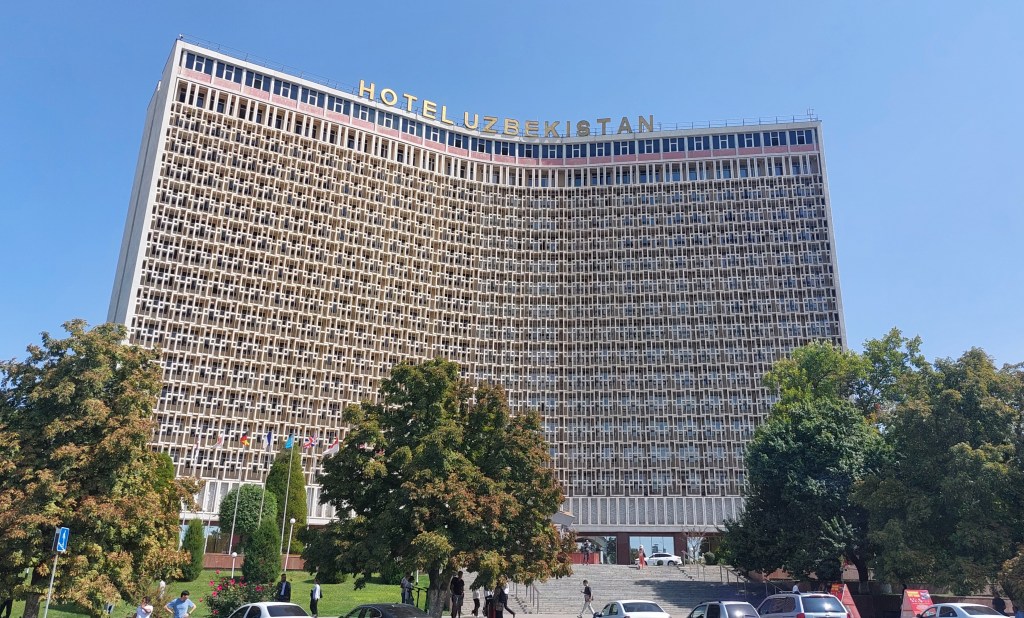
Well, this is something new… Tashkent is a huge modern city full of people (around 3.5 million), traffic and ENORMOUS buildings! Makes a bit of a change from Krygzystan.
So, Tashkent means city of stones is one of the oldest cities in the world with the oldest layer dating back to the 3rd Century BC. However, you would not know that to look at it for two reasons: (i) during ancient times Tashkent was never a capital city, so although many passed along it on the Silk Road, it was never a key city for any dynesty (unlike, say Samarkand or Bukhara) so they did not build fancy buildings; (ii) a huge earthquake struck Tashkent in 1966 and left very little standing.
Today, we went off on a sightseeing tour of the city and our first stop was “Monument of Courage”.
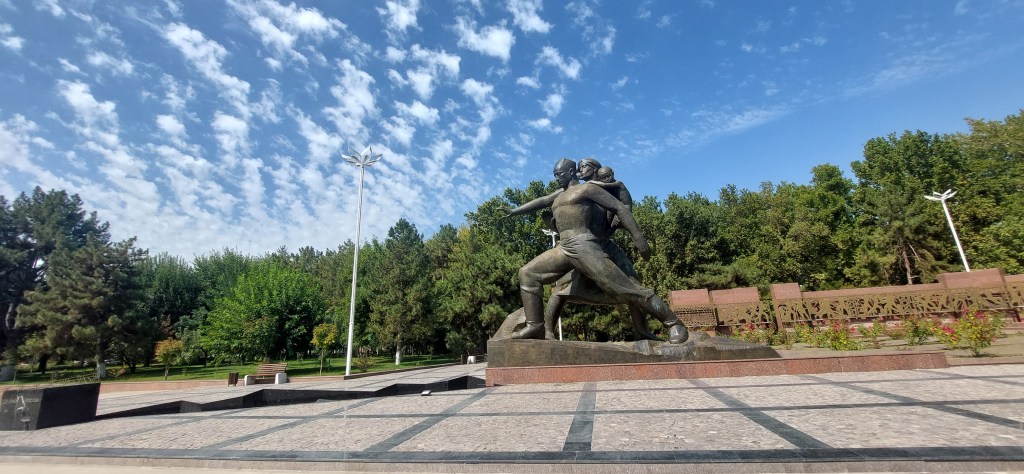
This was built to commorate the 1966 earthquake. The earthquake hit on 26 April with a magnitude of 5.2. Following the earthquake, most of the historic parts of the city were destroyed and left between 200,000 and 300,000 homeless. This monument tells that story, and also what happened afterwards. People/labour and supplies were donated from al over the Soviet Union and within 6 months the city had been mostly rebuilt (albiet in the Soviet style). But many of the people who came stayed, and it is what has made Tashkent a diverse city and just looking aroud today you can see people with more mixed features (unlike in Krygzystan were people seemed to be wither Russian OR Kyrgzyis OR Uzbek). Apparently there have always been waves of immigration into Tashkent, for example, people who had left for Russia after the collapse fo the Soviet Union in 1991, decided to come back last year due to the war in Ukraine.
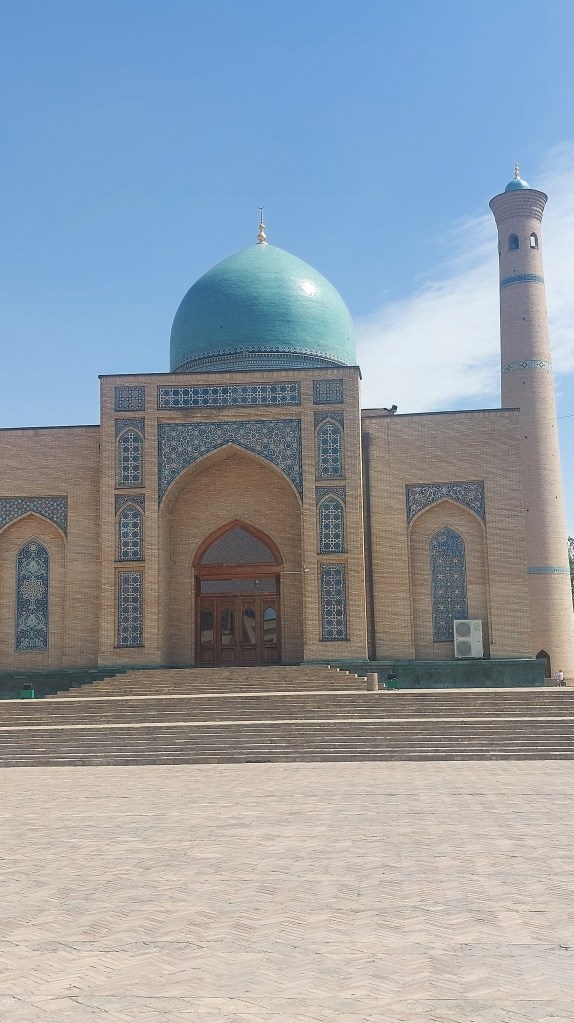
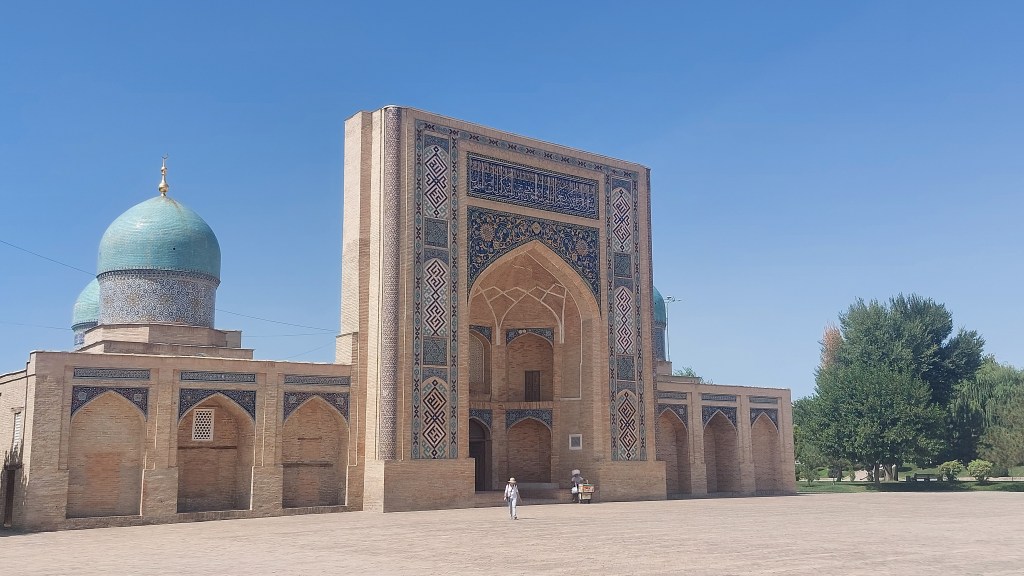
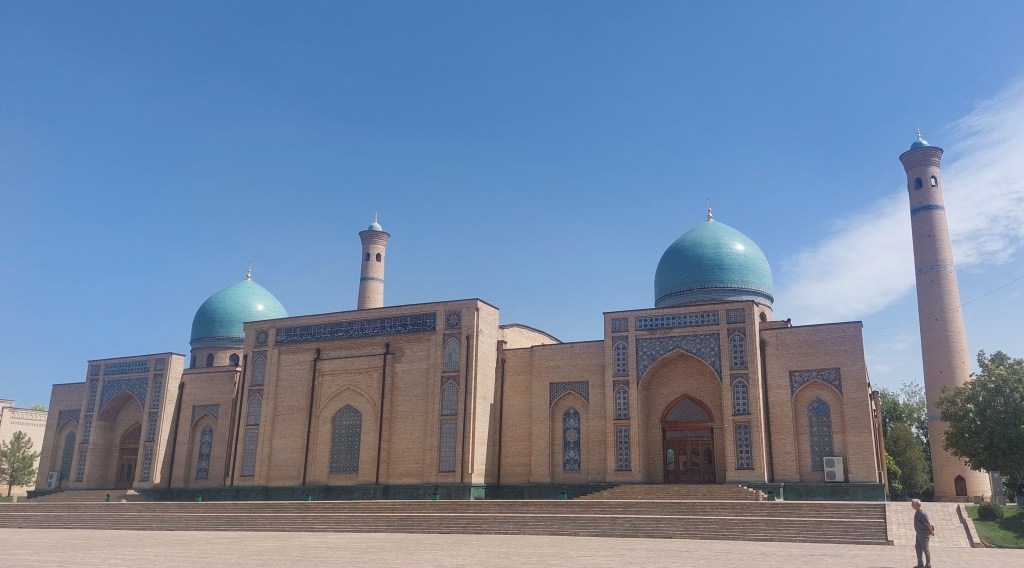
We then want on to the much restored Khazrati Iman Complex which is what is left of the old city and is a collection of buidings including a mosque, madrsah, library and museum. The museum contains one of the oldest qu’ran’s in the world dting back to the 7th century. Originally, a number of manuscrpts formed the Qu’ran, but these were consolidated into 1 book and these manuscripts were burnt. This 1 master book was copied into 6 and distributed across the known-world, but this is the only version to have (partially) survived. It was brought by Tamerlaine to Tashkent, then taken by the Russian’s to the Hermitage in St Petersberg before being given back in 1924. Unfotruantely I was not allowed to take photos, but what struck me most was the thickness of the paper (it eing written on deer hide) and the size of the script – I would guess around 10cm high. This was due to the fact that people were not all “good” readers and this was intended to ensure everyone could understand clearly what was written. Also in this museum is one of the smallest qu’ran’s in the world (written with a human hair), which I was allowed to photograph:
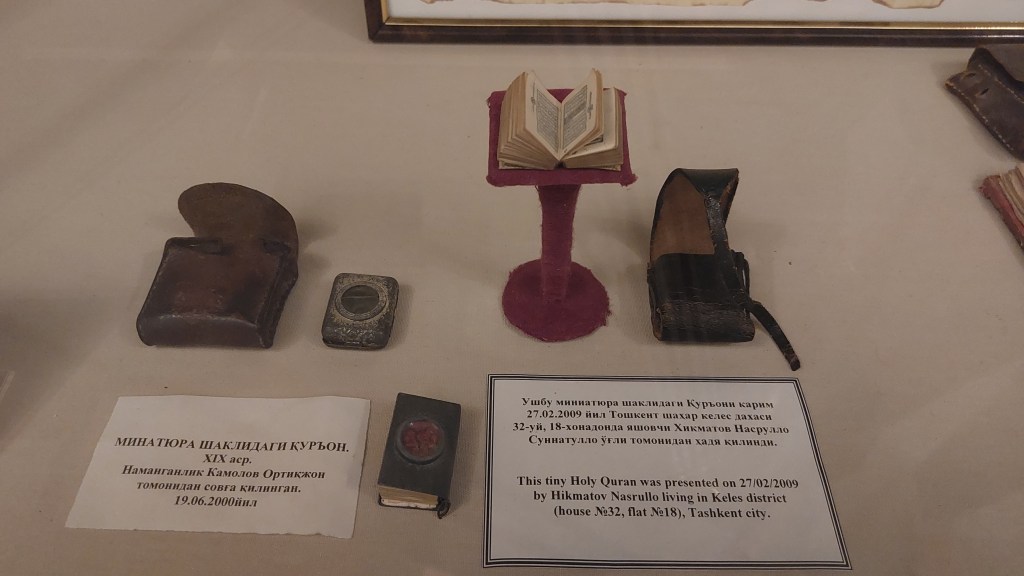
The complex itself is very impressive, and interestingly, empty with a distinct lack of tourists. I suspect things will be different in Samarkand…


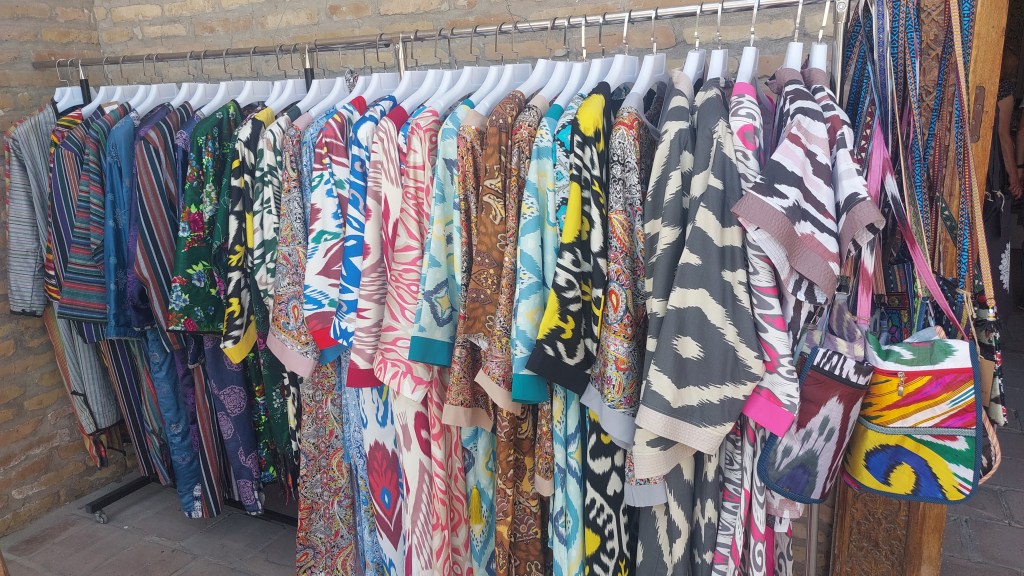
However, Tashkent was more aware of the ability to sell stuff to the few tourists who were about, and I managed to resist (for now), but was tempted. Also, if anyone sees anything they like, let me know.


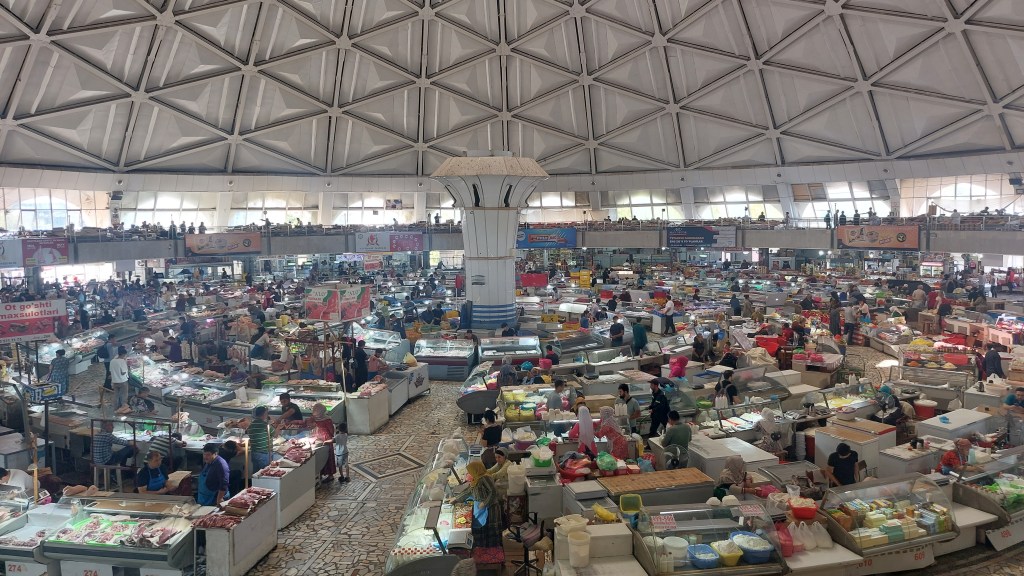
We then headed to the Chorsu Bazaar which has been in operation since the time of the Silk Road and was a key crossing point of goods coming east to west, although today is a modern market with anything people could possibly want. However, Uzbekistani markets have an interesting design whereby the centre is a circular dome with aisles fanning out from the centre – this allows air to circulate and makes it much cooler than you would expect given how hot it can get here.


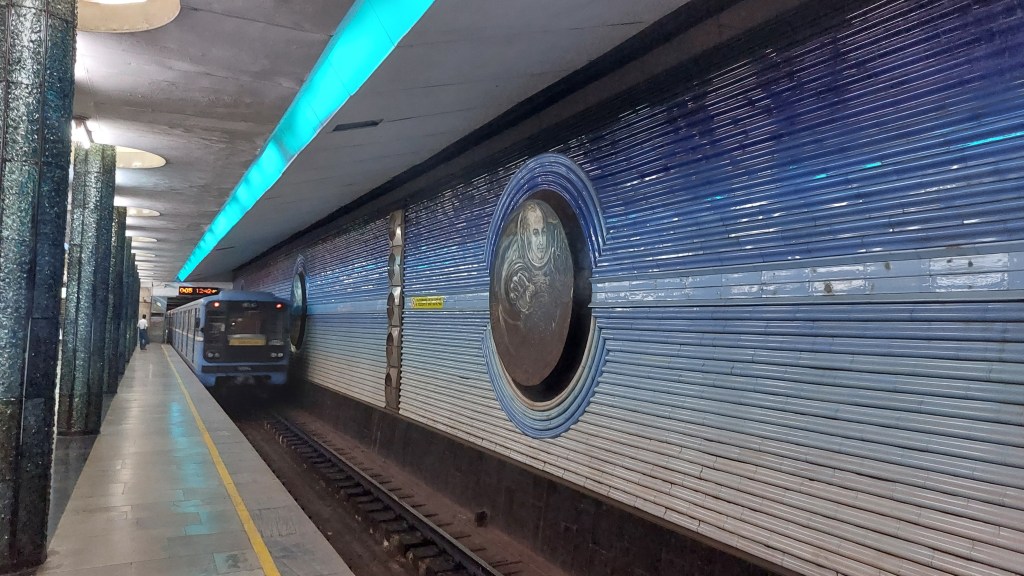
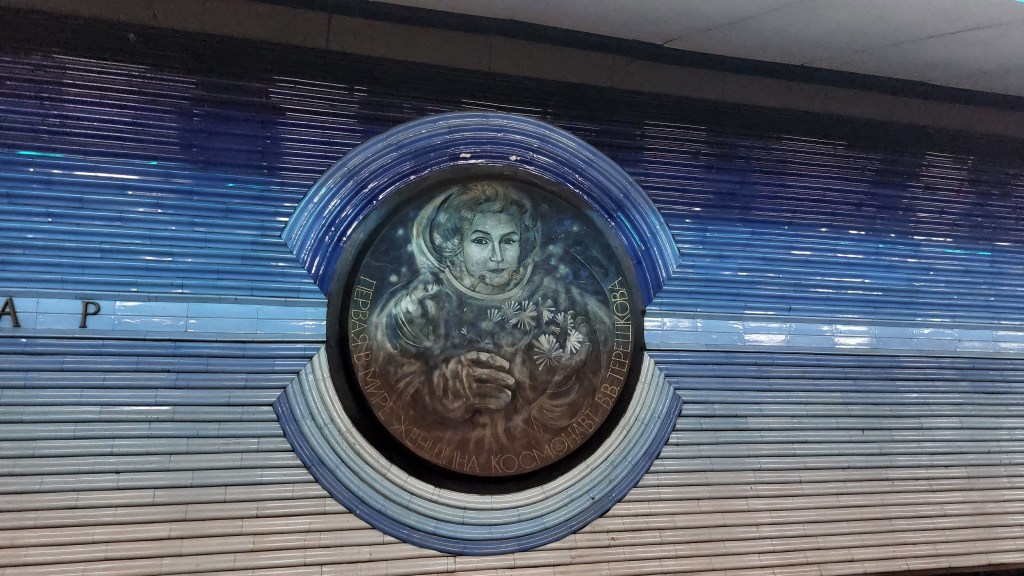
Next a little ride on the metro. Like many Russian designed metros, the stations are beautiful and the nearest station to our hotel is named “Kosmonavtiar” and is dedicated to various Soviet cosmonots (clue was in the name). Our Uzbek guide, Julia was most excited about Vladimir Dzhanibekov (who embarassingly I had never heard of!) who although not born in Tashkent, grew up here and is claimed as one of their own. He even has a physics thing named after him (the Dzhanibekov effect) which says: “rotation about an object’s intermidiate principal axis is unstable while in free fall”. Not 100% sure what that means, but is something about a nut spinning in zero gravity. Anyway, I was more interested by the painting of Valentina Tereshkova who was the first female cosmonaut in space in 1963 (as opposed to the Aericans who did not let a woman into space until 1983). Just saying.
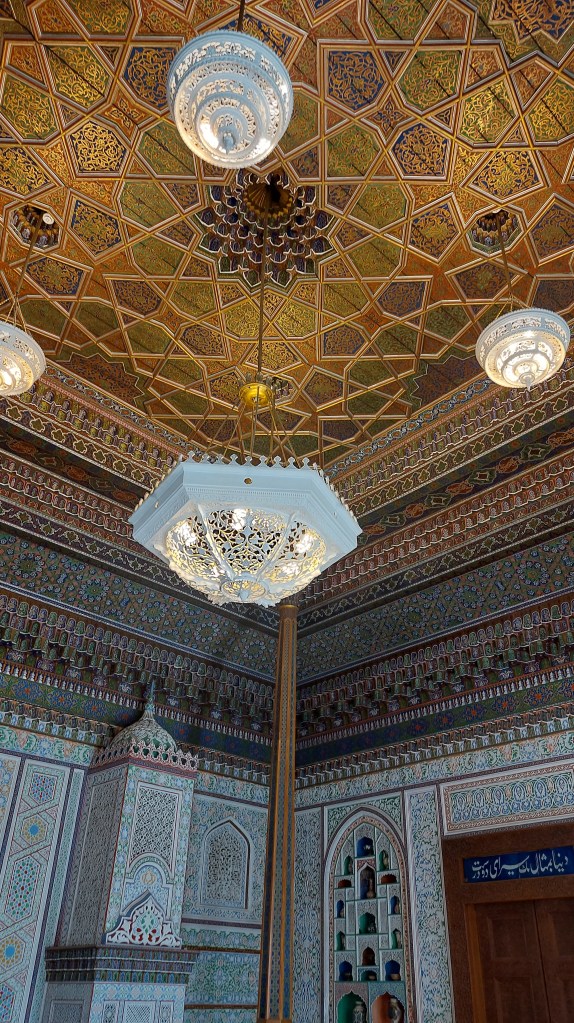
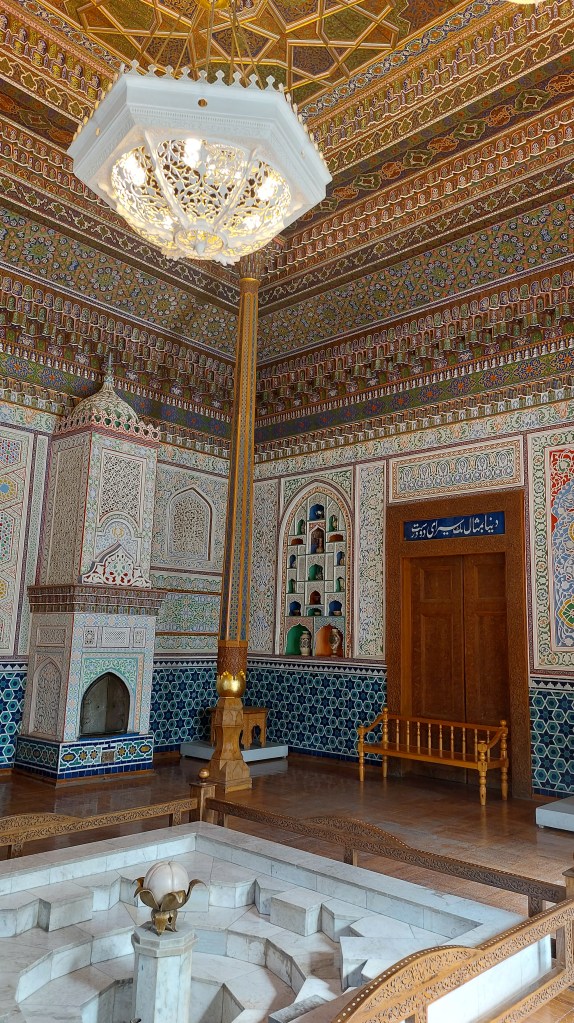
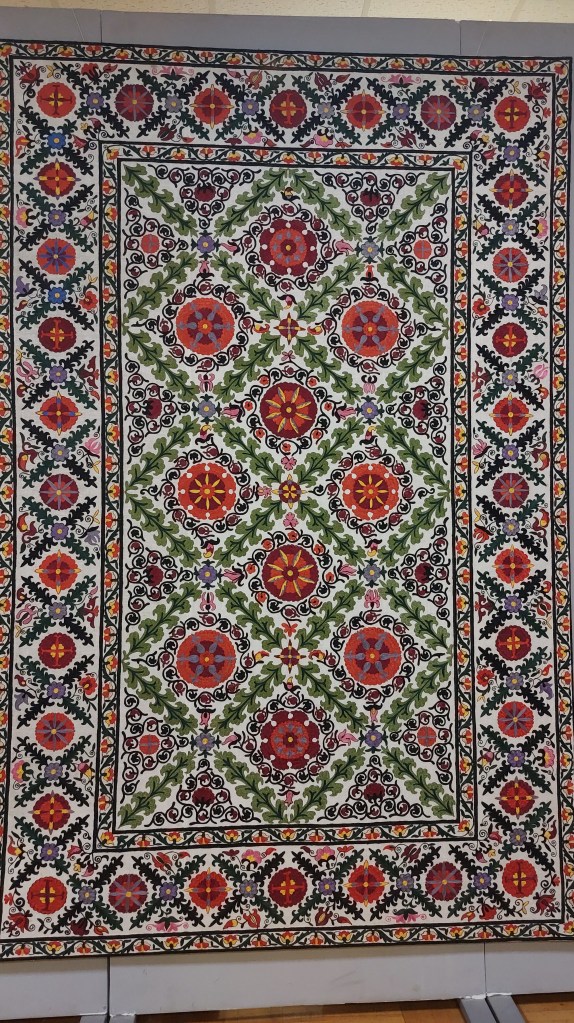
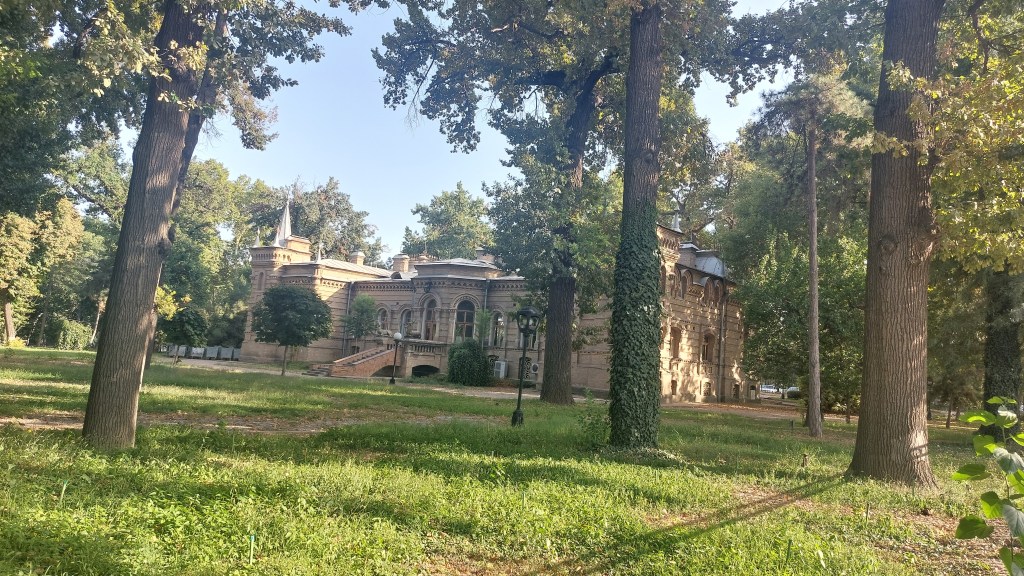
Tashkent has a number of museums including National Histroy Museum (closed on Monday’s but I hope to visit when I loop back to Tashkent at the end of this trip), the Fine Art Museum (also closed on Monday’s), so we went to the Museum of Applied Art and I am very glad that we did. It is in the former palace of Russian Diplomat Alexander Aleaxandrovich Polotsev who was an entusiast of Uzbek and Asian design and had the house readjusted and refurbished to fit this style. The interiors are beautiful and it is filled with examples of “applied art” (clue being in the name), and shows just some of the patterns, carpets, ceramics and carvings created in Uzbekistan.
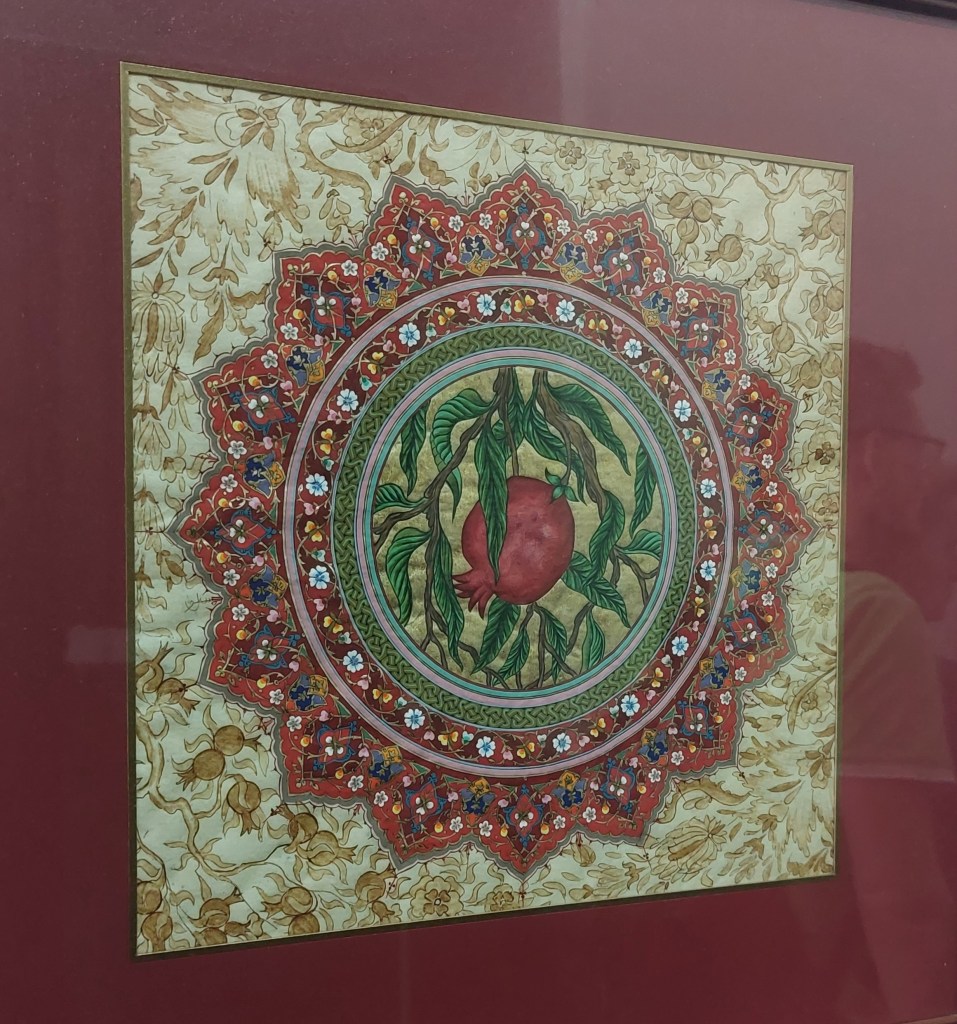
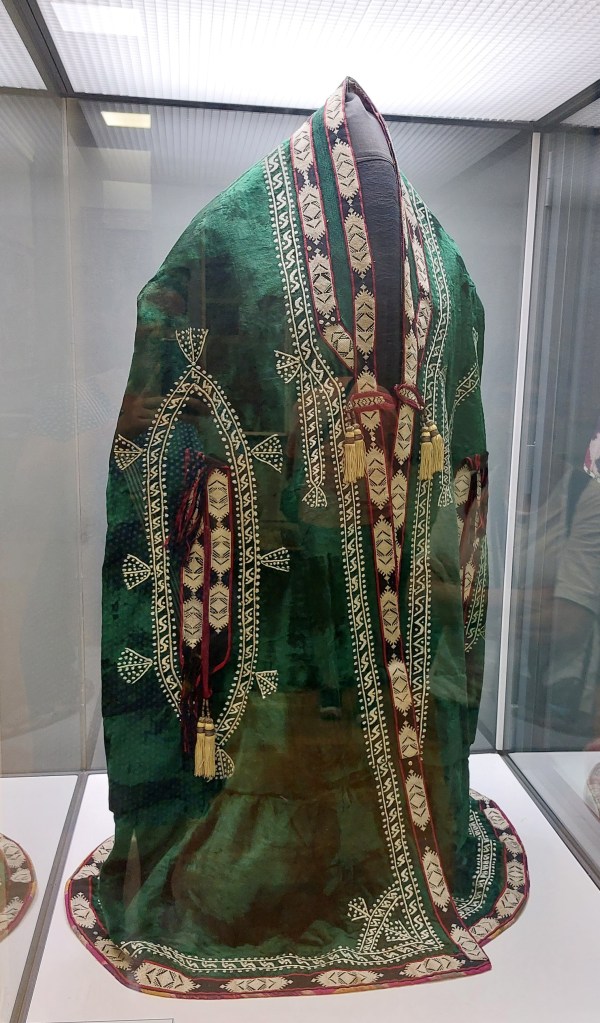
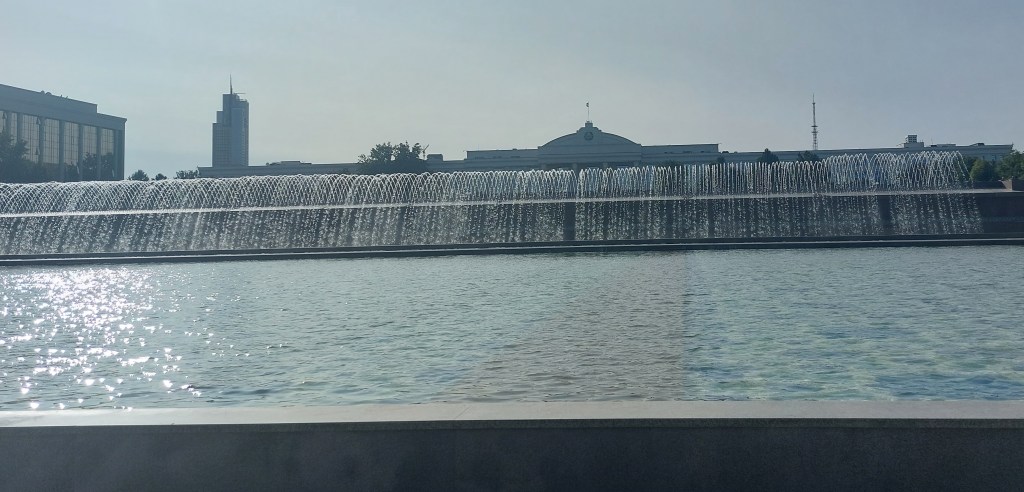
We then went on a little walk, cue photos:
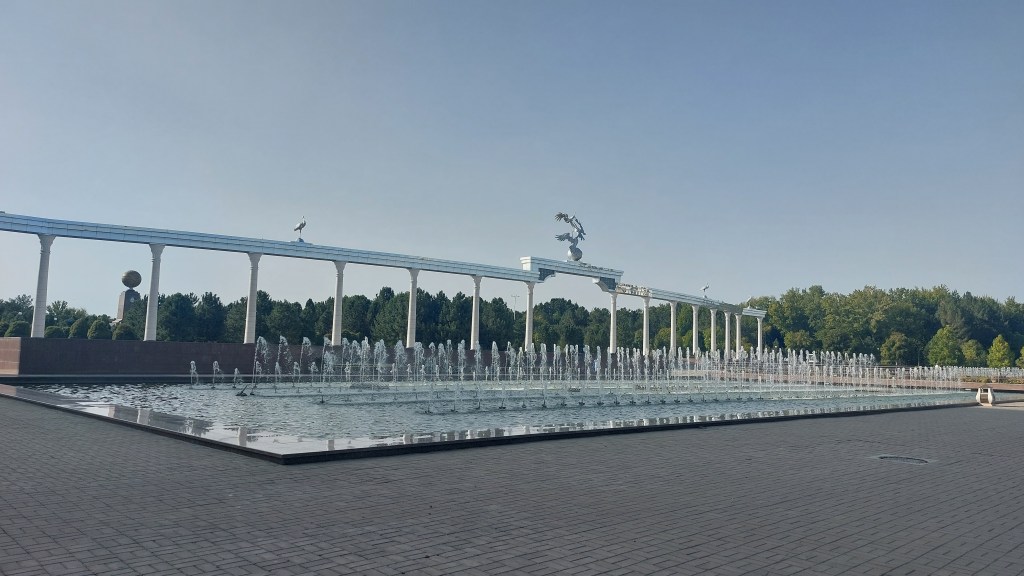
Dinner that evening was a fun experience, 2 people (in our group of 10) had both ordered an aubergiene dish, but the waiter gave it to the wrong people. When we pointed out their mistake, it was apparently all our fault, and they refused to bring another dish (even when we offered to pay). This was a restaurant charging a 20% service charge. Who knows whether it is because we are in a capital city or perhaps Central Asian hospitality does not run as deep here… So, for the next time you are in Tashkent I recommend avoiding (like the plague) “The Lights of Tashkent”. More amusingly, it took us a good 5 minutes to pay the bill – these 000s are impossible!
Tomorrow, we are off to Samakand, and I am VERY EXCITED! For me, this is the pinacle of the trip and the big Silk Road city and in rather relieving news, the temperatures have dropped by about 10 degrees, so its more like 30s rather than 40s. I am therefore less likely to melt.
COMMENTS


 Travels with Kathryn
Leave a comment