
I have finally left Baku! Whoop! Today, we set off bright and early to Shaki and all was going well until we had a slight unscheduled stop outside the city – we had a nail in our back tyre (this is a problem apparently). So there we were, sat in the bus whilst a young man jacked said bus up and various men stood about looking at the tyre. Evidently, “men at work” operate similarly the world over… However, it was quickly resolved, and we were back on the road.
As we drove, we quickly left the spawl of Baku. It was not long until we were in a more barren landscape of scrubby steepe and hills. You can see why this region had not been particularly popular on conquest routes and that it was not until the discovery of oil that people moved here and started investing in making it more habitable. However, this image I have painted may lead you to believe that it was blistering sunshine. Nope. Today has been cold and wet – it almost reminded me of British summer! I was also dressed inappropriately as although I have any number of suitable waterproof garments, these were all in my big bag stowed away in the back of the bus. I shall try harder tomorrow.
Our first stop of the day was the former city of the Shirvanshahs (whose Baku palace we visited yesterday) Shamaki. More specifically, the oldest mosque in Azerbijan which dates back to 733. In the way of this region, it has been completely rennovated (having suffered due to sieismic activity in the region) and looks brand new, but it was certainly more impressive than yesterday’s offering…
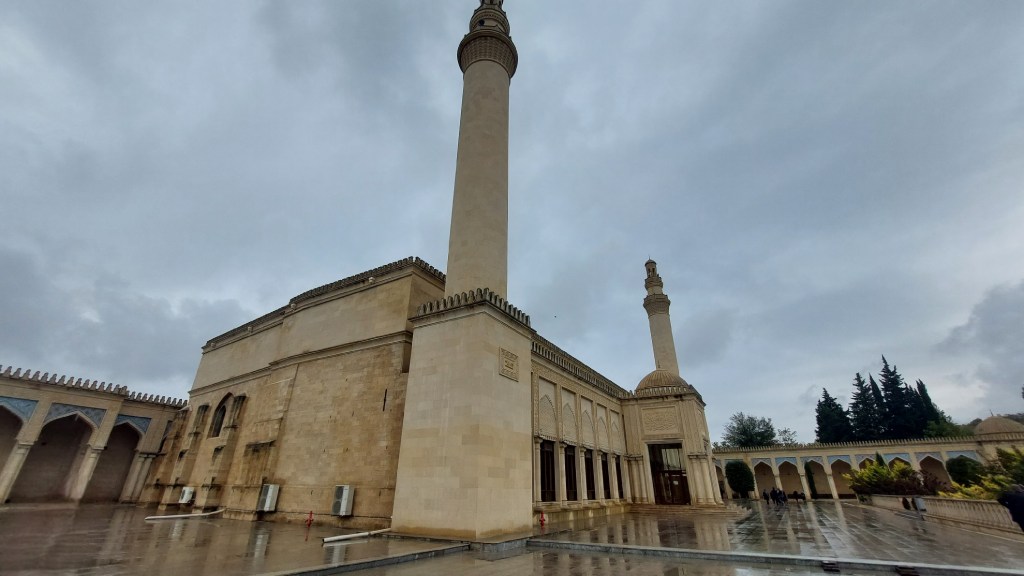

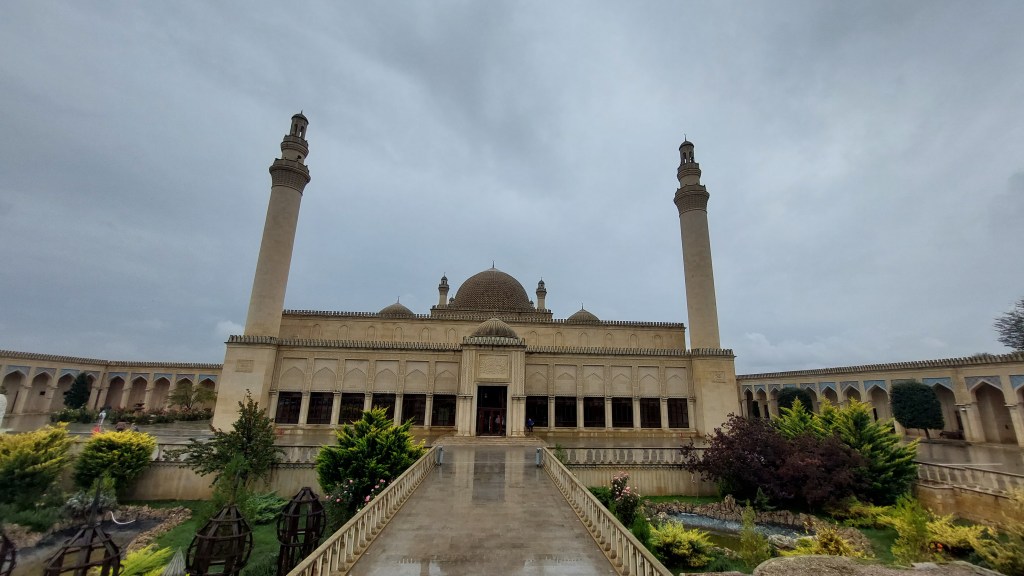
We had then been planning to visit the cemetery of the Shirvanshahs itself, however, due to the fact that it was pouring with rain(!) and apparently, the road is something of a dirt track. It was decided not to attempt it. I suspect this is something I can manage without seeing on this trip!
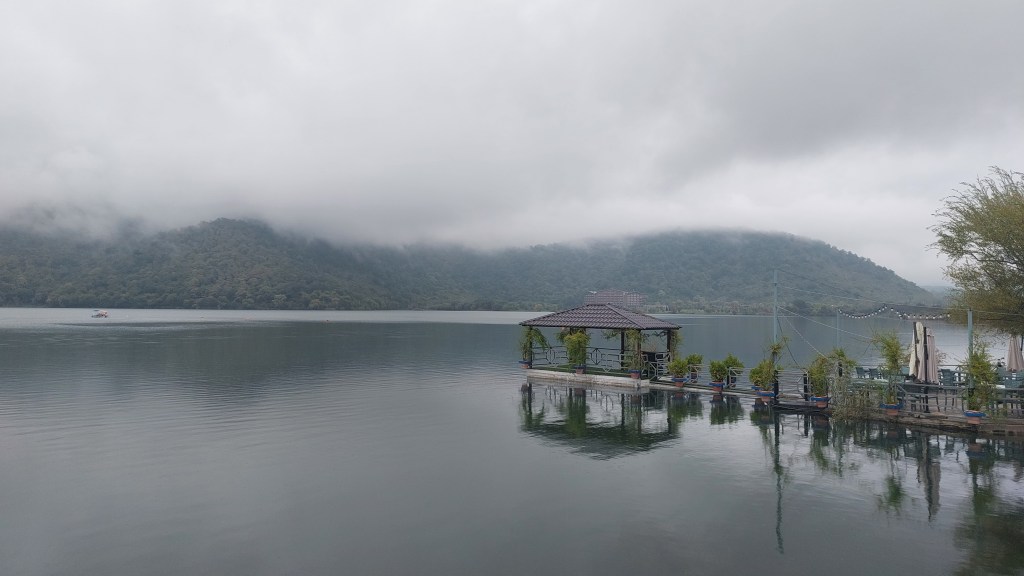
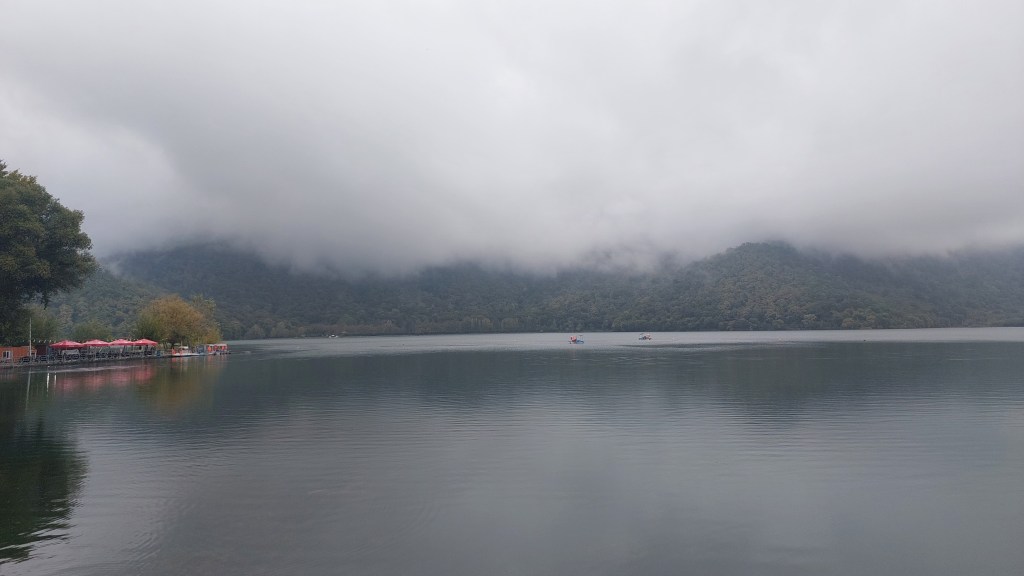
Onwards in ever more depressing weather, and not helped by the fact that the road is currently undergoing rennovation (due to be finished in 2025), which made it rather trecherous. It was still way better than some of Kyrgyzstan’s roads, but it did slow down our progress. We stopped for lunch at what I am sure is a beautiful rest stop of the Gabala lake, which is (apparently) one of the most picturesque places in the region giving magical views of the caucus mountains. It’s time for us all to use our imaginations again:
Another 2 hours, and we made it to Nij village and the small church of Saint Eilsaeus, which is used by the Albanian-Udi community. The Udis are a native people of the Caucuses (and note here that the reference to Albania has nothing to do with the country in the Balkans I hope to be visiting later on this trip) who have there own language and own type of Christianity. There are only around 10,000 Udis in the world, with most living either in Russia (4,500) or in this part of Azerbijan (4,100). The church itself is quite simple and most closely resembles Greek Orthadox, but it is still an interesting visit.
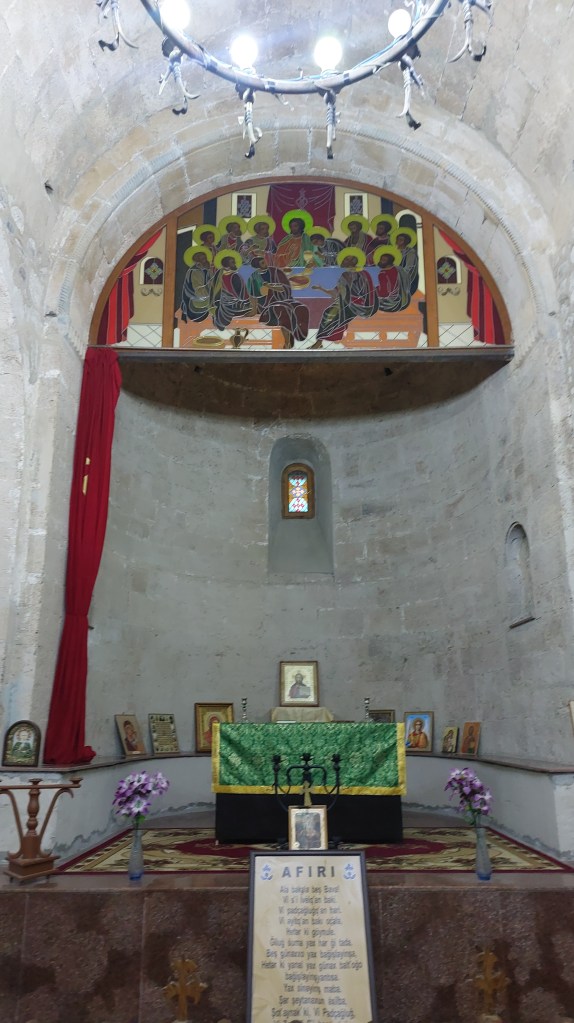
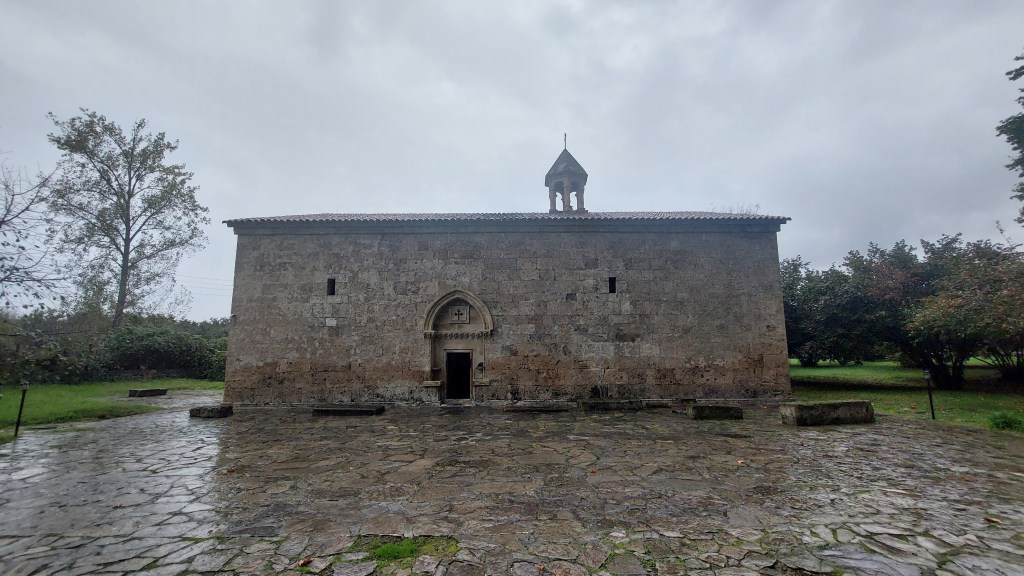
We finally made it to Shaki at around 6pm, just before the Summer Palace of the Shirvanshahs closed. This palace was built in around 1762 and was lived in by the Shirvanshahs until 1813 when they were ousted and this region was absorbed into the Russian Empire.
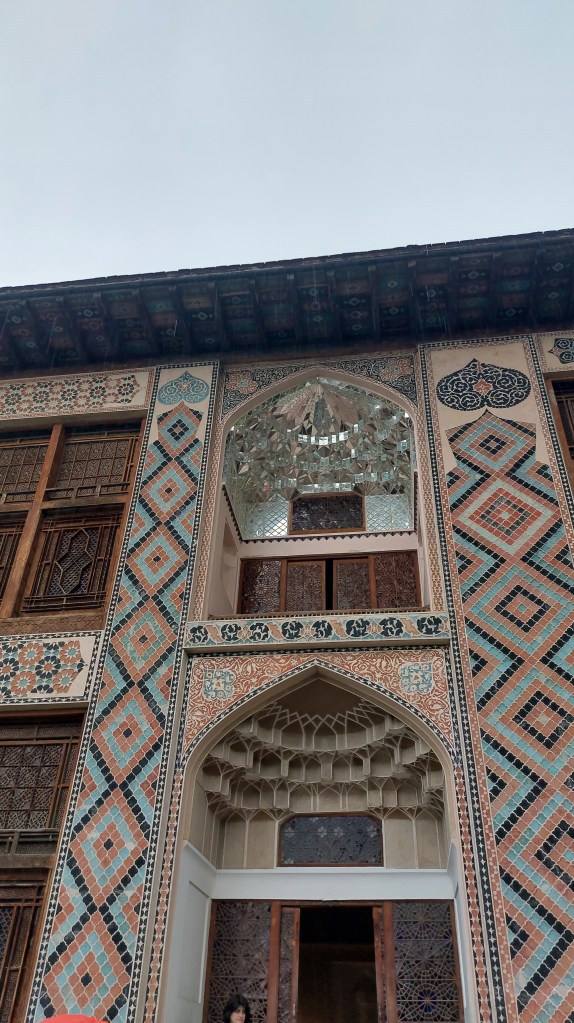

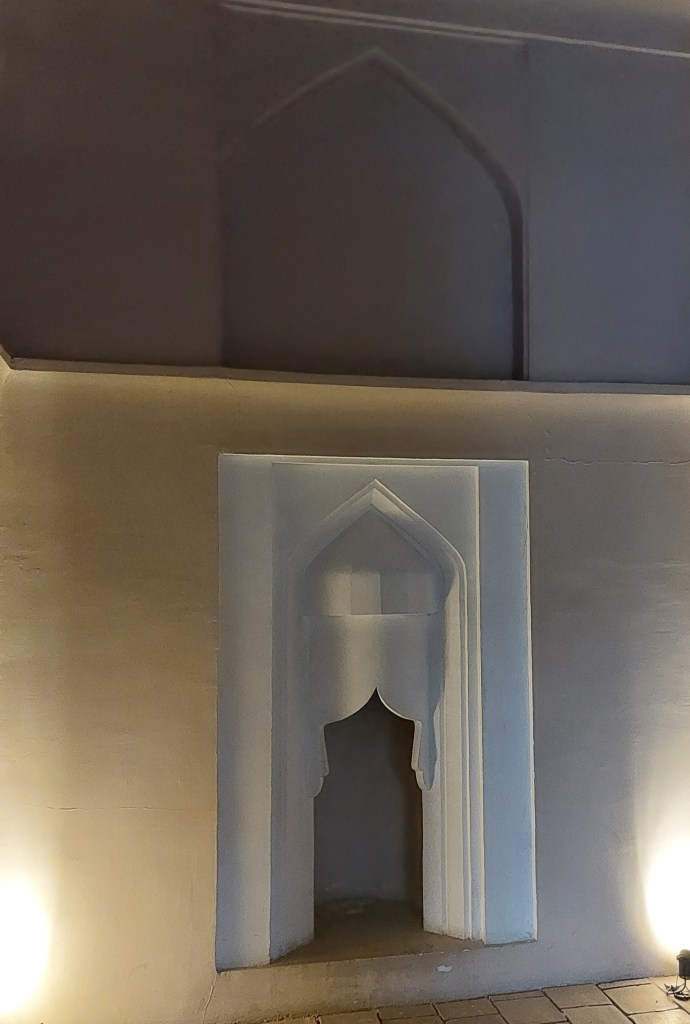
So, no photos allowed, but there are some images in my blog from when I visited the Heydar Aliyev Centre which included an exhibition of carpets inspired by this palace (see:https://travelswithkathryn.blog/2023/09/24/stage-2-0-still-in-baku/) and here: https://www.advantour.com/azerbaijan/sheki/sheki-khan-castle.htm. The inside is incredibly decorated with beautiful wall friezes, mirrored ceilings, and shebeke windows. The decorations included people and animals which, as we know, is not permitted in Islamic art – to get around this, the images are of “made-up” people, clothes and animals and no two are the same in any painting. For example, the men’s room included a war and hunting freize, and every soldier looked and was dressed differently. The most impressive room is the Khan’s room (figues) which includes many different friezes with allegorical meanings such as the strong eat the weak, let your neighbours fight it out and then you swoop in and take their land, the world needs balance. The favourite image of our guide’s was one of a lion with a women’s head emphasising the importance of a male ruler needing a strong wife to support them…
Our last stop was a quick visit to a workshop demonstrating various Azerbijani crafts, including shebeke. Shebeke are windows filled with cloured glass and made using no glue or nails. Instead, the pieces are fitted together like some giant geometric puzzle that is amazingly strong. It really is beautiful, and something I think I do not quite have the level of skill (as even 1mm out means it will not fit together) to make this my next career. Mum, however, thought that she had cracked it (luckily not literally!).


By now it is dark, very wet and we have just made it to our hotel. Tonight is my last night in Azerijan, and although I spent too long in Baku, I feel that I have really only had a taste of what this region can offer. Azerbijan is an interesting country, Baku is very young and cosmopolitan looking to the West (and, specifically, Turkey) for its future. On the back of their oil money it will be interesting to see whether this wealth becomes more evenly shared across the nation (as it does feel somewhat concentrated in Baku) and where Azerbjian decides it wants to play on the world’s stage. I am also interested to now hear the other side of the hostilities with Armenia.
Tomorrow, we cross the border into Gerorigia, which I am really looking forward to. Another day, another adventure!

 Travels with Kathryn
Leave a comment