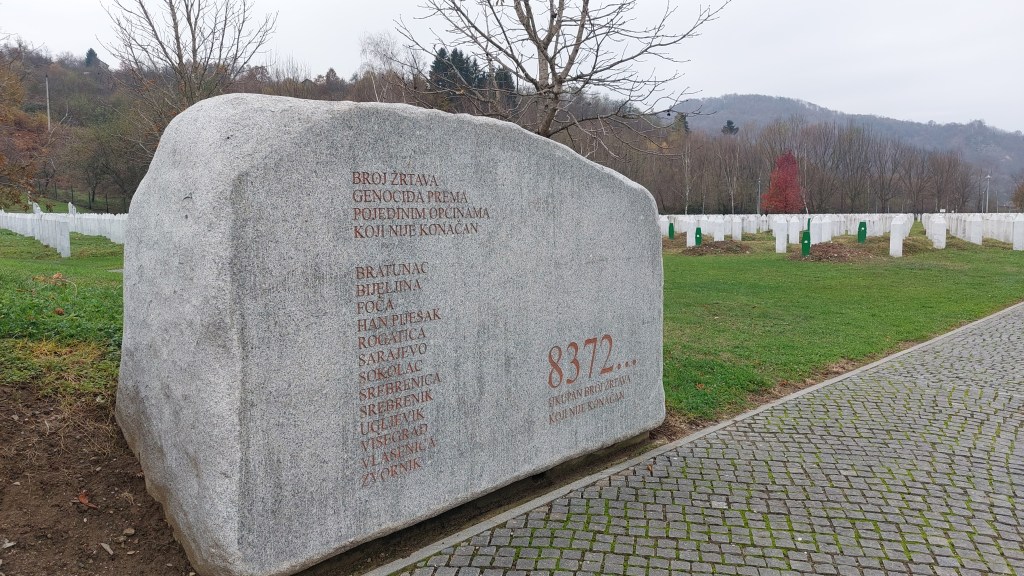
I am never sure how I feel about visting places of absolute horror as a tourist, partly I feel that it is important to see these places, to hear what happened and to ensure that history doesn’t repeat itself. However, I also worry that it is a bit voyeuristic or intrusive and perhaps should be left well alone. So it was in this mindset that I joined today’s (Thursdays) tour to Srebrenica.
Even with only limited knowledge of the Bosnian war, I suspect most of us have heard of the Srebrenica genocide. But to understand what happened, I am going to start with our guide’s explanation of the historical background. In the 13/14th centuries, the area of today’s Bosnia Herzegovina was mostly heretic Christian – heretic as failing to Catholic Christianity, but when the Ottoman’s conquered the region in the 15th century many of these Christians converted to Islam. This was a sensible move as although the Otomans tolerated Christianity, as we know, they were treated as second class citizens and forced to pay higher taxes. By converting, the Bosniaks secured better prospects for themselves and often ganied positions of authority over their Croat Catholic and Serb Orthodox neighbours. Even today, this is seen as weakness by the Bosnaks and a betrayal of their religion and ethnicity.
During WW2, a group of extremist Serbs known as Chetniks collaborated with Italian facists in the killing of non-Christinan Bosniaks. As Tito rose to power, these Chetniks joined the Yugoslav partisans, and under Tito, these partisans were hugely celebrated, and this aided in the rise of Serb nationlism After Tito’s death, the economy went into hyperinflation, and Yugoslavia crumbled. Bosnia Herzegovina voted for independence, but this referendum was boycotted by Serbs, and in 1995, Serbia and the Yugoslav army invaded East Bosnia As the fighting raged, the UN created three “safe” enclaves, one of which was Srebrenica. Bosniaks then flooded into this eclave to over 50,000 people.
As the Serbs marched into Srebrenica, on 11 July 1995, Dutchbat/UNPROFOR abandoned their base in Srebenica to a former battery factory nearby – they took with them some estimated 20,000 people. Many men (and in some cases with their wives and children) gathered in the centre of Srebrenica (some 12,000-15,000) and decided to make the journey on foot, over the mountains, to Bosniak controlled areas. Of the group that stayed with Dutchbat, 5,000-6,000 women and children were allowed inside the compound, with the rest outside. On 12 July, the Serb army (assisted by Dutchbat) separated the women and children from the men. A man was counted as any male over the age of 14. The women and children were loaded onto buses and deported to Bosniak controlled areas. The men and boys who had remained in the enclave or moved to the battery factory were handed over to the Serb army and systematically killed and dumped into mass graves. Of the group that set off over the mountains, this is today known as the column of death as they were hounded by the Serb army and repeatedly shelled. By 15 July, no Bosniaks were left in Srebrenica, and 8,262 were killed. This number is still going up. In an effort to hide the mass murders, the Serbs dug up and moved the remains – some people have been identified by a few bones that were found in different sites.
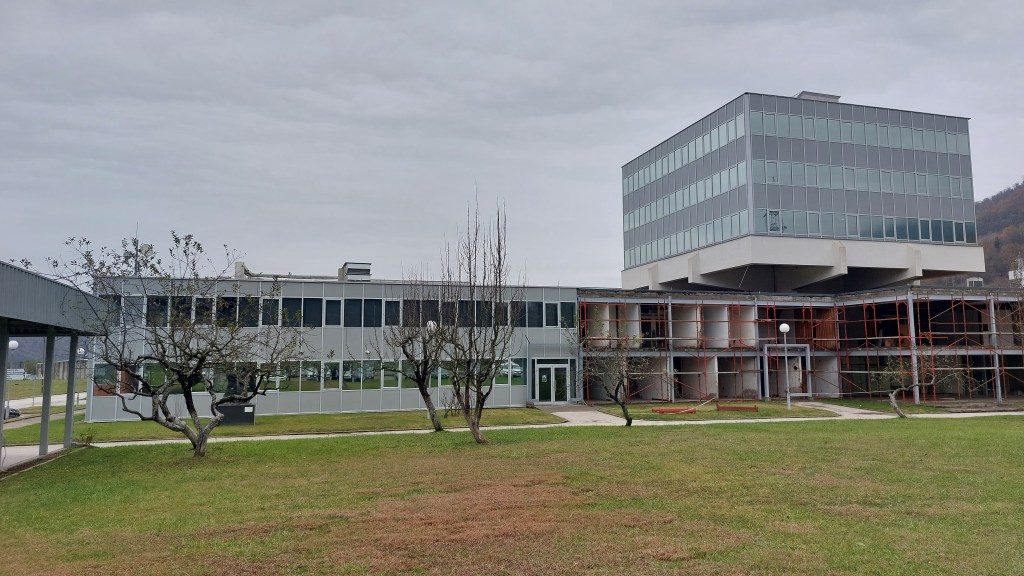
Today, the Srebrenica memorial is in the former battery factory where Dutchbat and Bosniaks took refuge. It sets out the history of what happened and includes personal stories and remains of the dead. There is a balanced criticism of Dutchbat – the criticism of central command feels jusitfiied i.e. air support was arranged the morning the Serb army invaded, and was then cancelled and central UNPROFOR failed to respond to detailed pleas for support and assistance. However, they did stand by and actually helped to organise the deportation of women and children and left men to their death.
Today, the population of Srebrenica is just 4,000, and although this is made up of both Serbs and Bosniaks, tensions in this region remain high. Villages are cleary Bosniak (flying the Bosnia Herzegovina flag) or Serb (flying the Serbian flag). As I mentioned yesterday, these divisions are clearer in Bosnia Herzegovina than in any other part of former Yugoslavia. People here, as well as in Kosovo, North Macedonaia (and to a lesser extent) Albania are very anti-Serb. They feel that it was the Serbs who most benefited under Tito and that they were the aggressors of the Yugoslav war. Talking to people across this region flavours everything I have learned and read, and it is hard to remain neutral. The horrors are too recent, too awful.
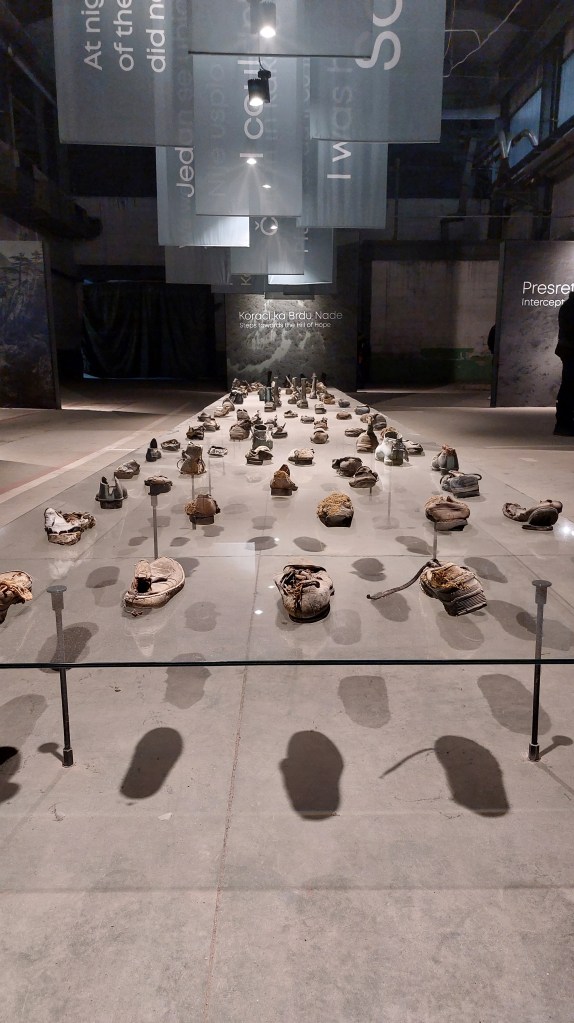
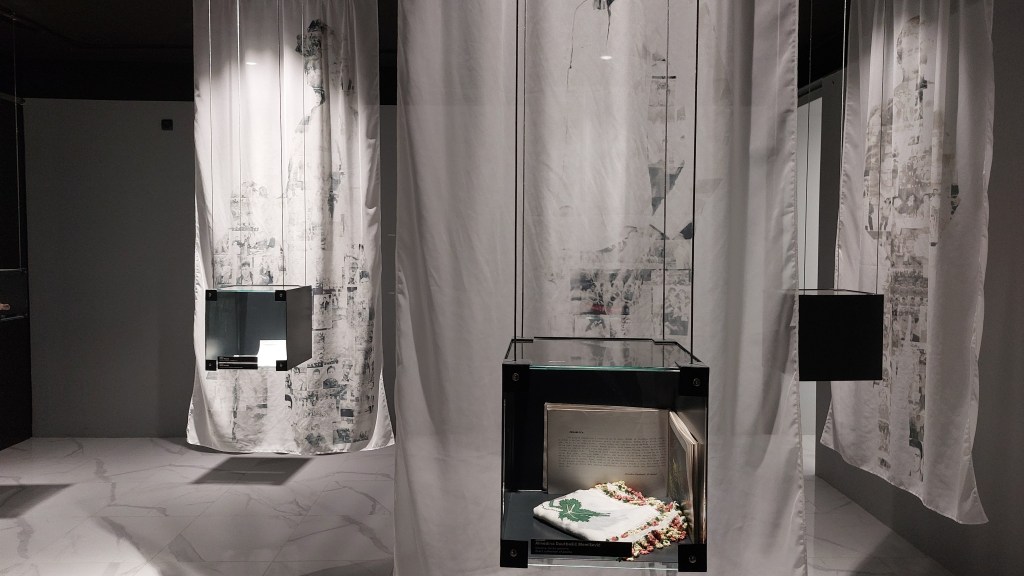
What was most difficult for me is that at the time of the genocide, I would have been 11 and my brother 14. What that would have meant for us is whist Mum and I would (most likely) made it onto buses and deported – so whilst leaving our home, we should have survived. However, at 14, James would have been considered to be an adult, so he and Dad would most likely have been murdered and thrown into a mass grave. For the survivors, many will never know what exactly happened to their fathers, brothers, and sons. Body parts are still being found and identified from DNA testing and items found in mass graves. Where human remains have been able to be identified, they are buried in a cemetary next to the memorial.
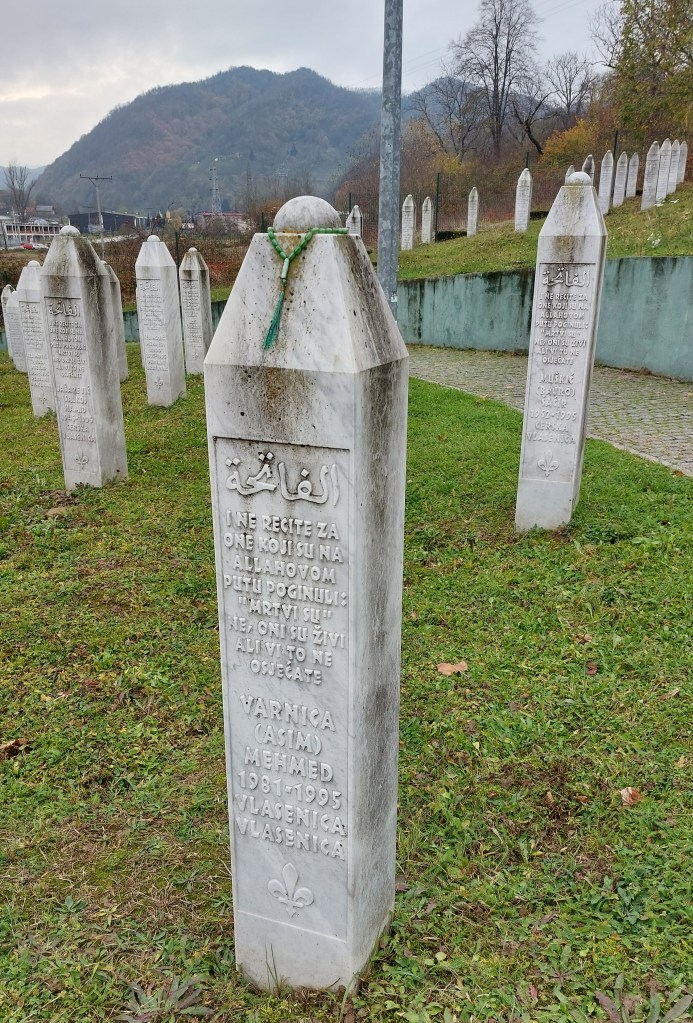
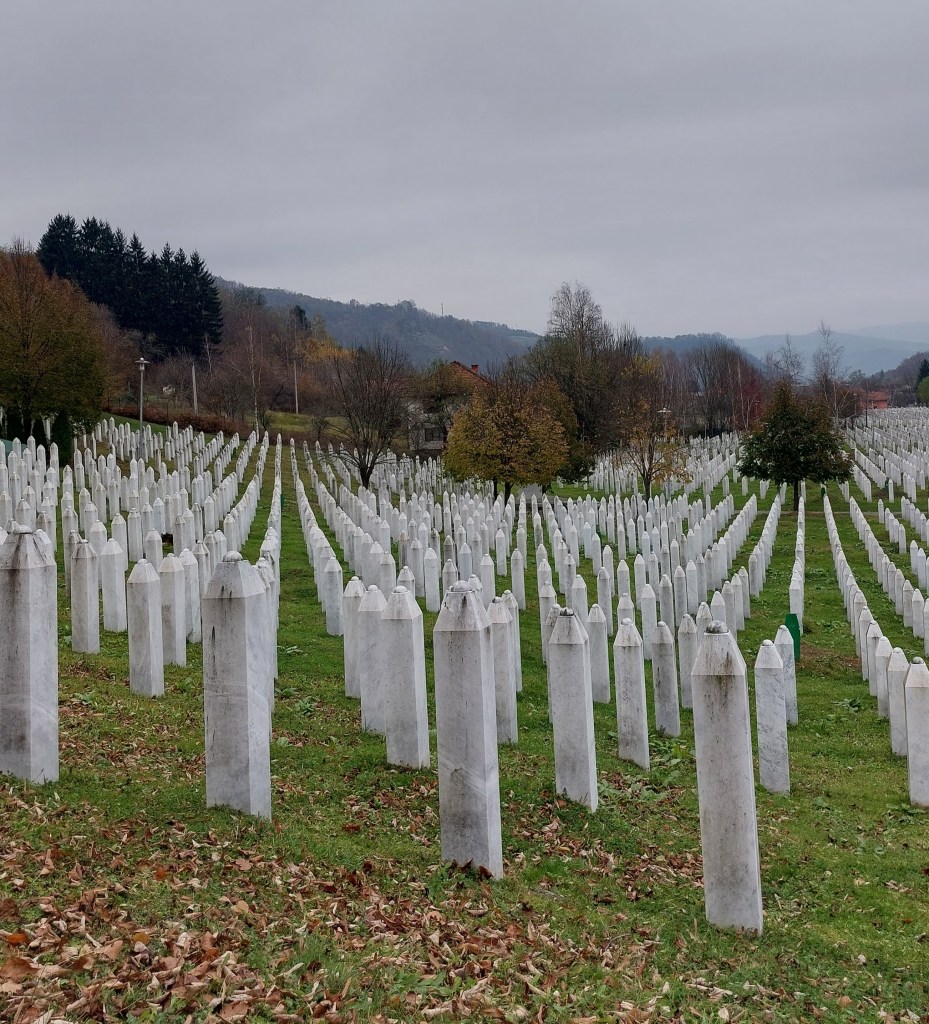
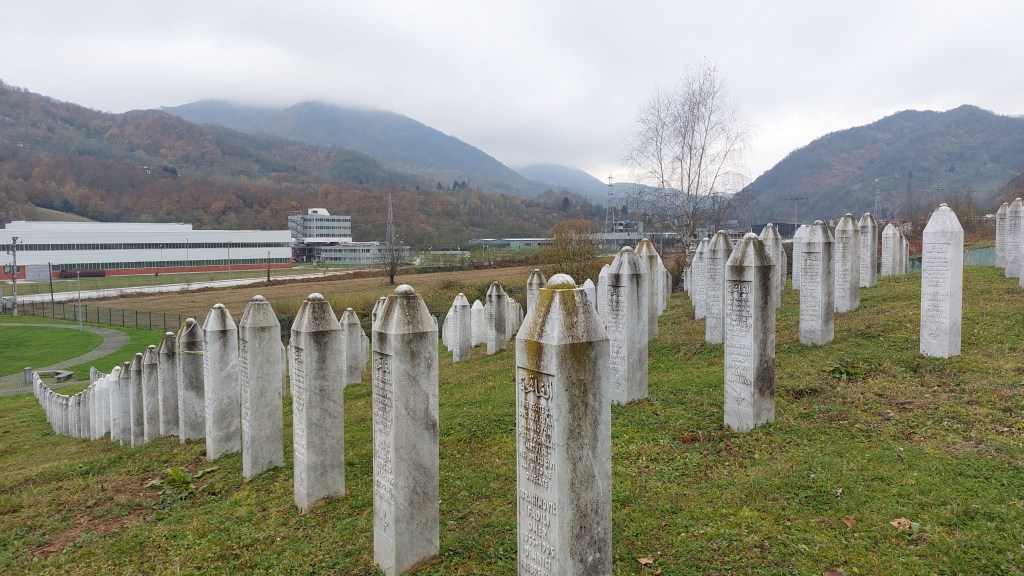
There have been multiple legal proceedings in the years following the genocide, and in the International Court of Justice in 2007 upheld the ruling of the ICTY that the massacre of the enclave’s male inhabitants constituted genocide, a crime under international law and that the forcible transfer and ause of between 25,000 and 30,000 Bosniak muslim women, children and eldery also constituted genocide. In 2013, 2014, and again in 2019, the Dutch state was found liable in the Dutch spreme court and in the Hague district court for failing to do enough to prevent more than 300 of the deaths.
Today was a long day, a distressing day, but I am pleased that I did visit. I think many people visit only Sarajevo and Mostar without coming to this region and I think it is important that people do. I knew about the Srebrenica genocide and studied the ICJ proceedings at university, however, coming here and actually being in this place, hearing personal stories really brings it into focus.
On return to Sarajevo, my next travel companion Diane (my room mate from the Central Asian leg) has arrived and it was good to have a de-compression meal and form a plan for the next couple of days. Tomorrow, we will start with the siege of Sarajevo.

 Travels with Kathryn
Leave a comment