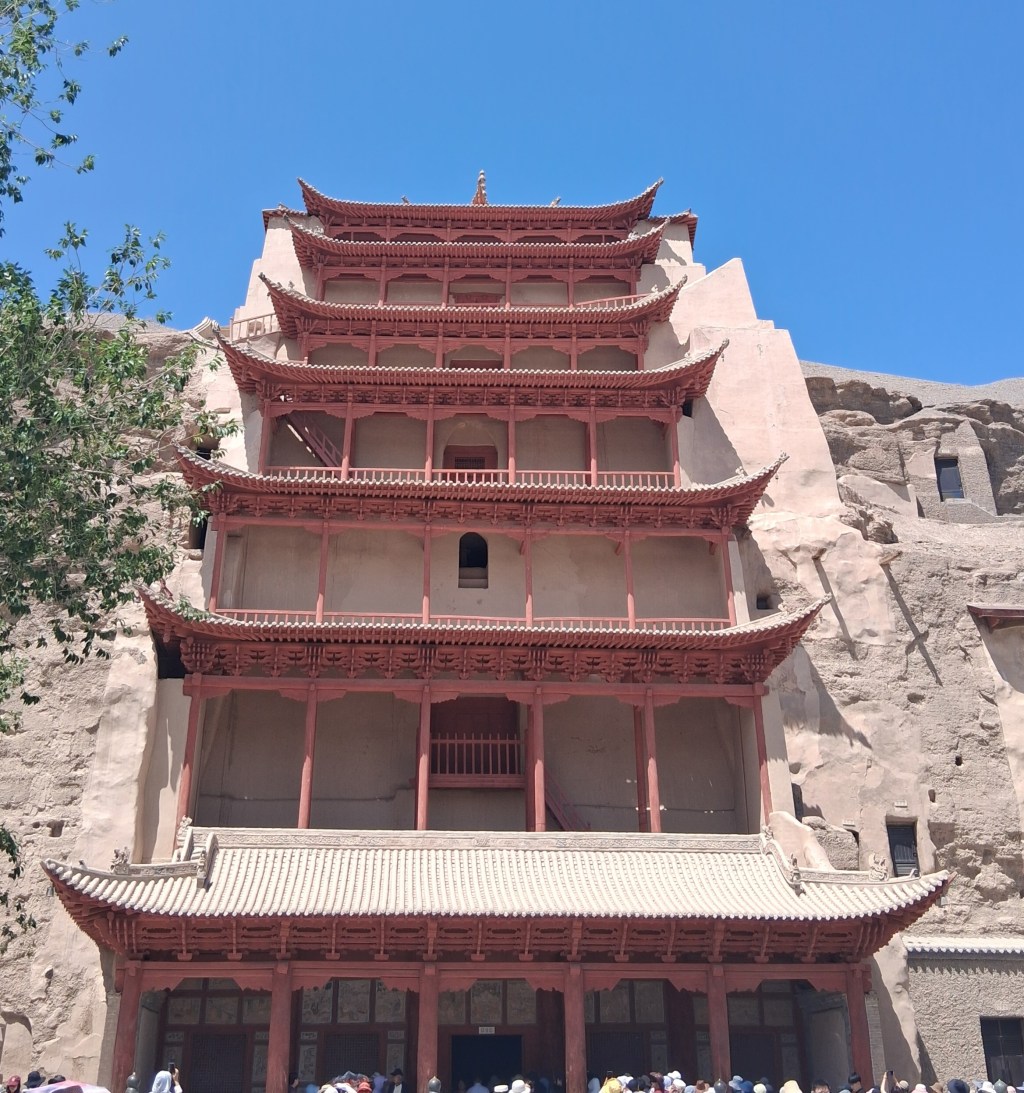
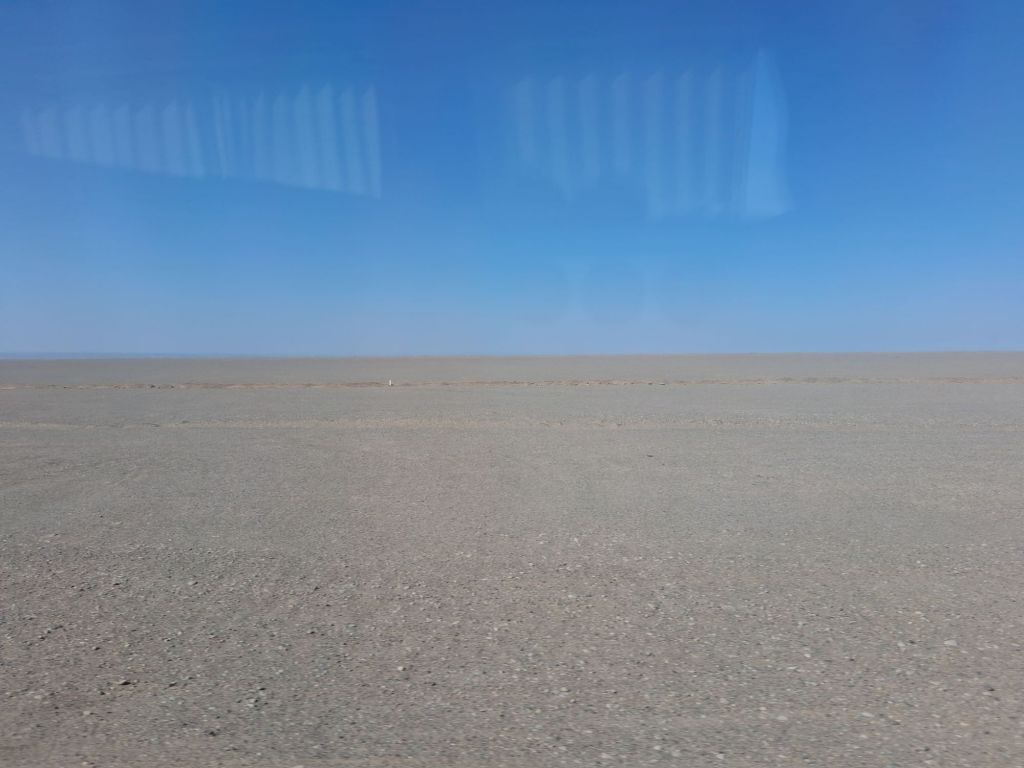
I think it is fair to say that Dunhuang is in the middle of nowhere. We drove for miles and miles, hours, and hours, and it’s just scrubby Gobi desert. However, we did spend a good 2 hours going past wind turbines and solar panels.
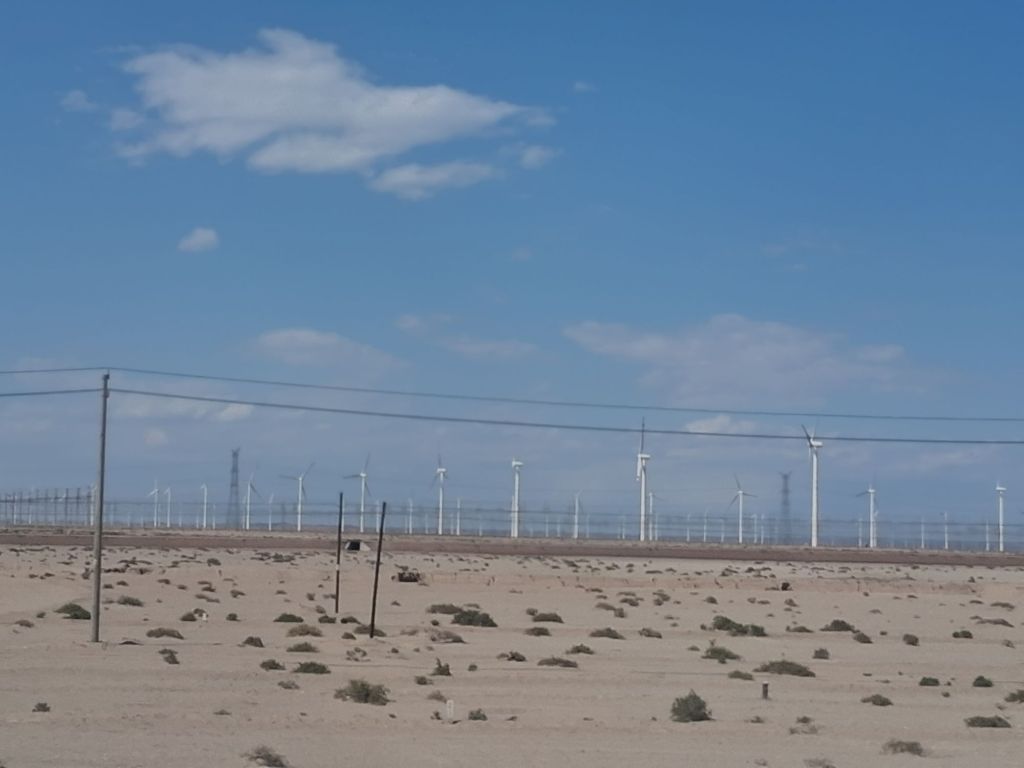
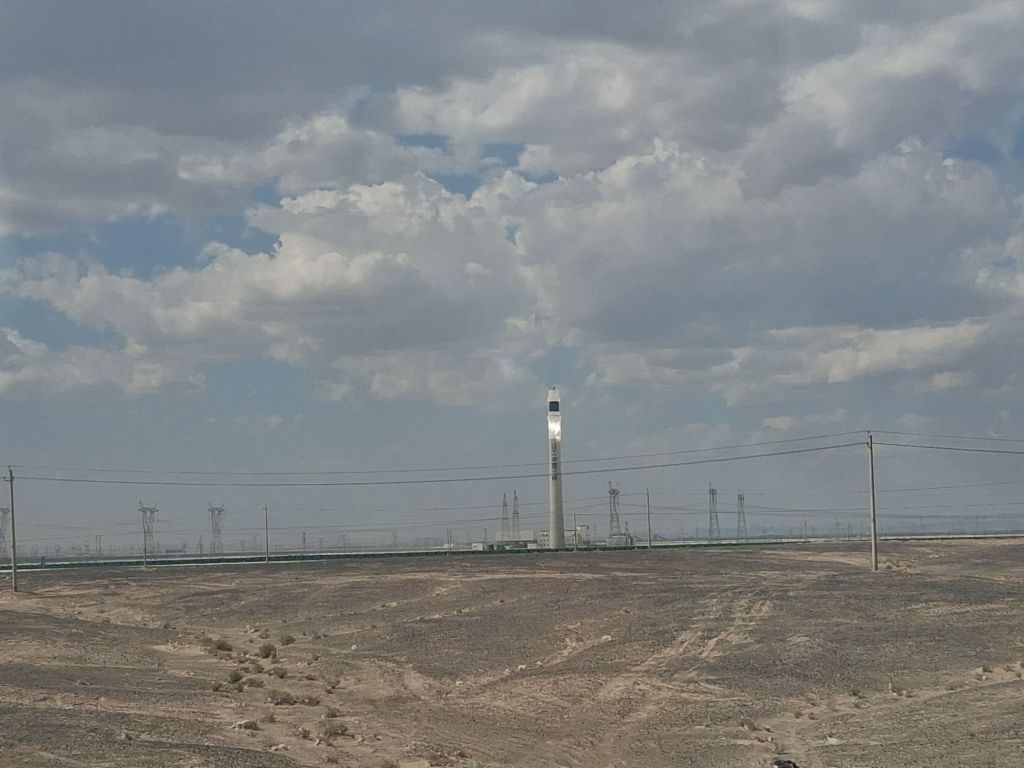
On that note, some interesting statistics for you, in the first quarter of this year 39% of China’s energy came from wind power which created a new international record. However, in 2024 93% of the world’s new coal power stations were in China. Effectively, China is working towards being cabon neutral by 2060, but in order to do this, it needs to continue to increase its carbon emissions in the next decades. We then posed the question, “Let us ignore having any human rights for a moment. If we let China run the world, would we be doing better?” I am starting to think yes, so maybe I am catching Communism…
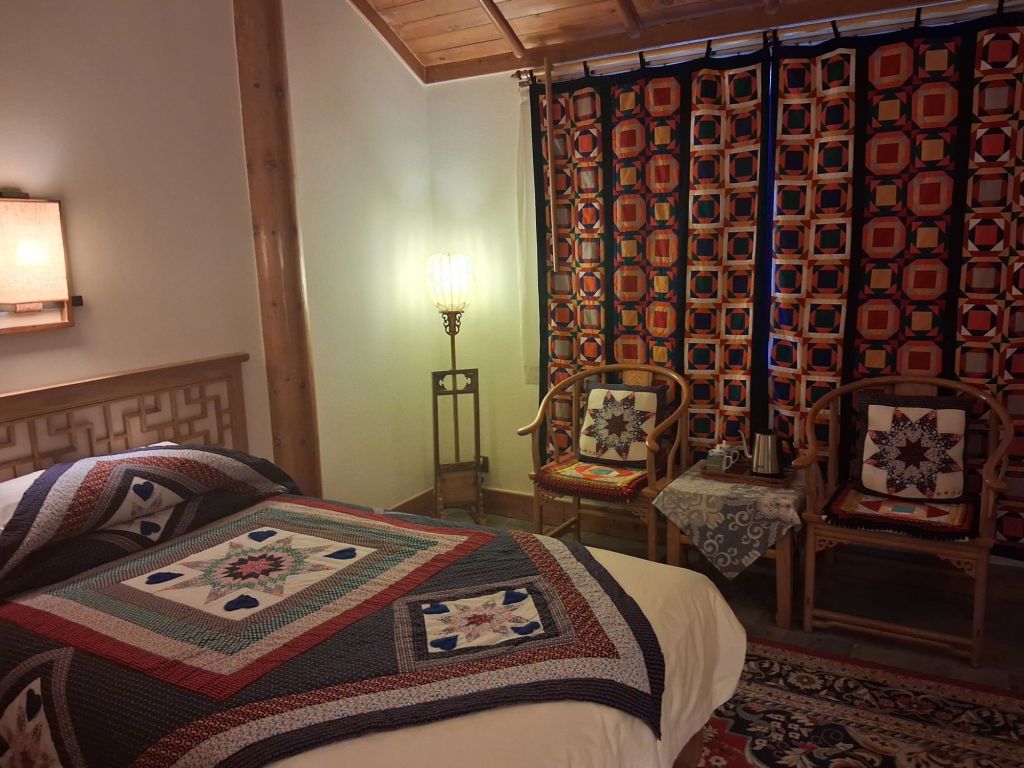
Anyway, the scrubby desert turned into irrigated greenery, and we arrived at our hotel at around 7 pm, and it’s lovely. I have previously commented on the fanciness of the hotels that Wild Frontiers used, but this one had gone to the effort of looking like a Tang dynasty fortress and is furnished with authentic looking fabric-y things and furtiture. We had dinner on the roof overlooking the sand dunes, and I even treated myself to a gin and tonic to celebrate getting a job offer!


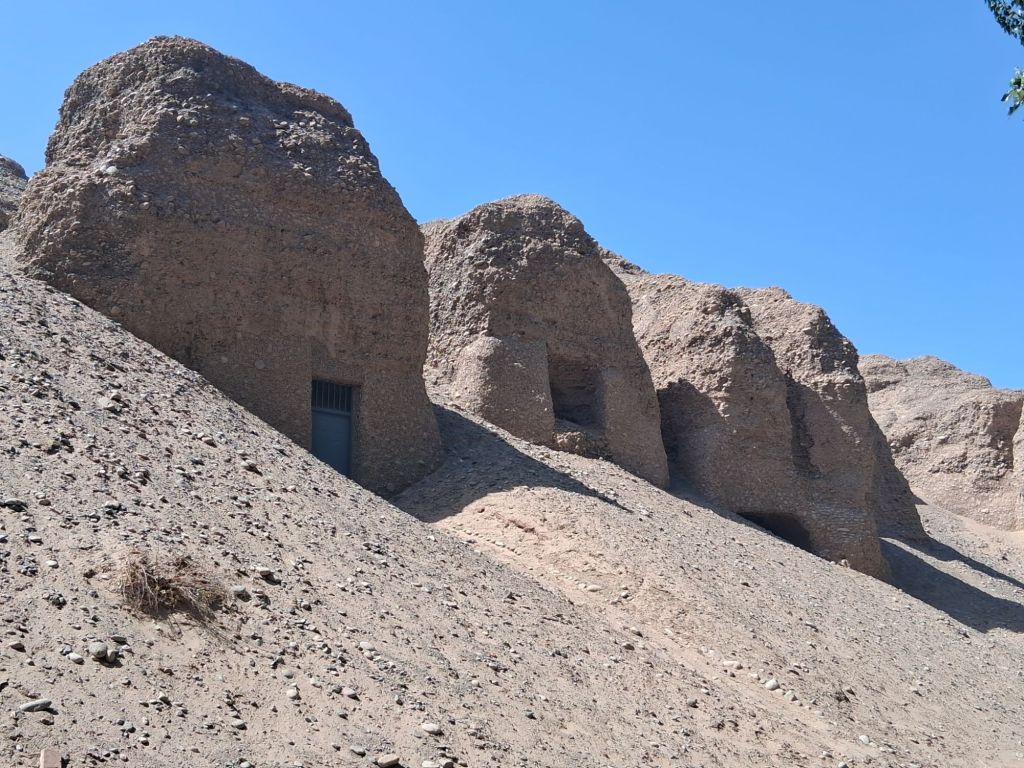
Today (Saturday) we visited the Mogao Grottos (also known as the Thousand Budha caves) which are 735 caves carved into the cliffs of the Dangquan River and Mingsha mountain containing the largest “treasure trove”of Buddhist art in the world. The earliest caves date back to 366AD, but some caves were subsequently redecorated in later dynesties, and new caves continued to be created into the 12th century. The caves contain 2,415 coloured sculptures and 45,000 m2 of murals – they also used to house 50,000 ancient sciptures, but more on that later… Part of the reason they were created here is this is the very edge of the Taklamakan desert and travellers wanted to pray for, or give thanks for, a safe journey.
This is another incredibly popular tourist destination in China, and I am rather embarrassed to say that I had not heard of Mogoa until I was looking into and planning this trip. Perhaps because of this, it is another incredibly impressive example of how China “does” tourist destinations well (Terracotta Army take note). Firstly, tickets must be purchased in advance and are timed entry. General entry only gives you access to a certain number of caves with a Magoa Grottos guide, in addition, there are some “special caves” which require a seperate ticket (again, more on this below). This all happens some kms away from the caves themselves, and you enter a welcome centre and watch pre-show one which tells a story of how the caves came to be made and then rediscovered, and then a second pre-show which gives you a panoramic experiece of some of the caves (some of which are currently open and some not). At this point, I pause to give huge kudos to our local guide, Amy, who has obviously been Disney trained in terms of where to sit at each show to give the fastest exit into the next experience! Anyway, having gotten in the mood with the pre-show, you are then driven in coaches (by what looked like all the local retired men in the vicinity) to the grottos themselves.
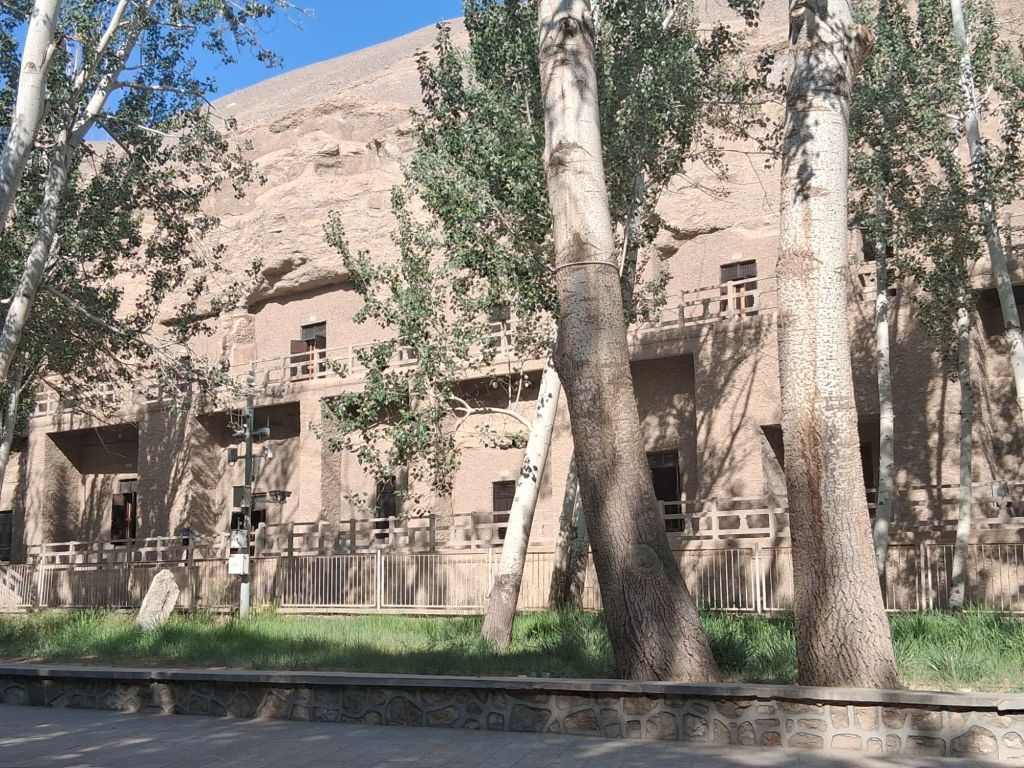
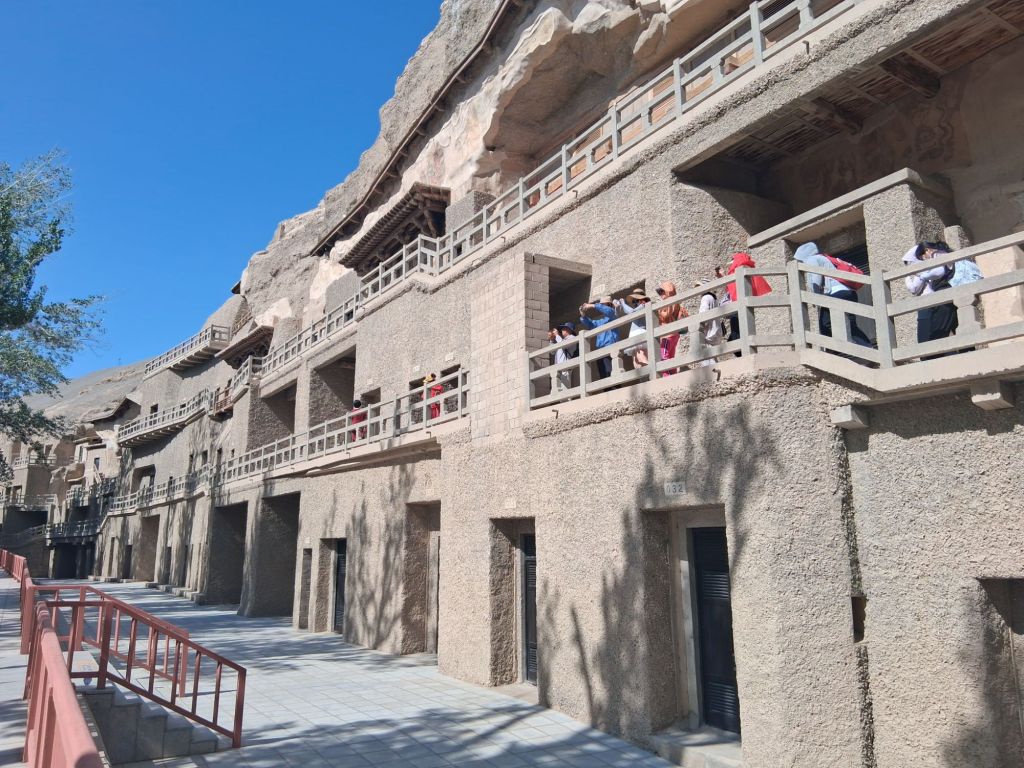
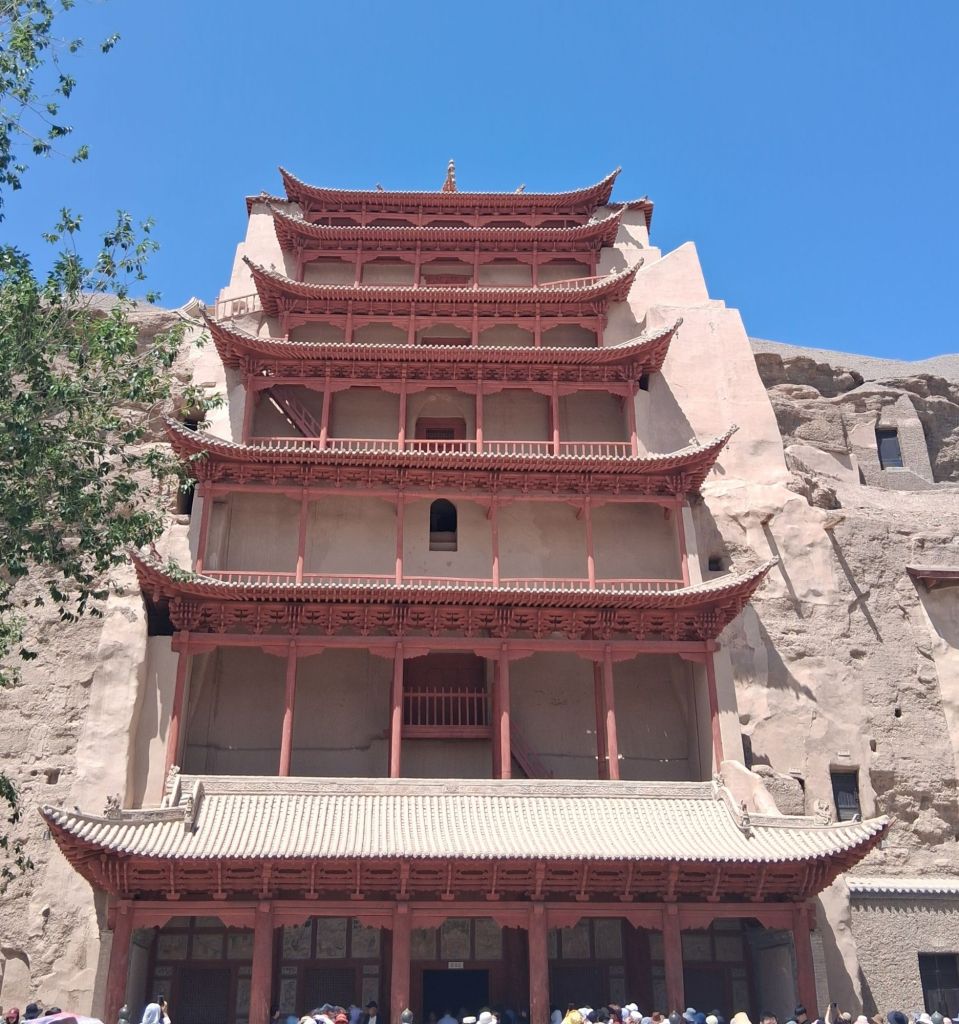
Each cave contains (or would have contained) a central Buddha sculpture flanked by deities, and every wall is covered in decoration from thousand Buddha repeats walls, to large murals and at the bottom paintings of the cave “sponsors” who were wealthy local people who paid for the temples to be created.
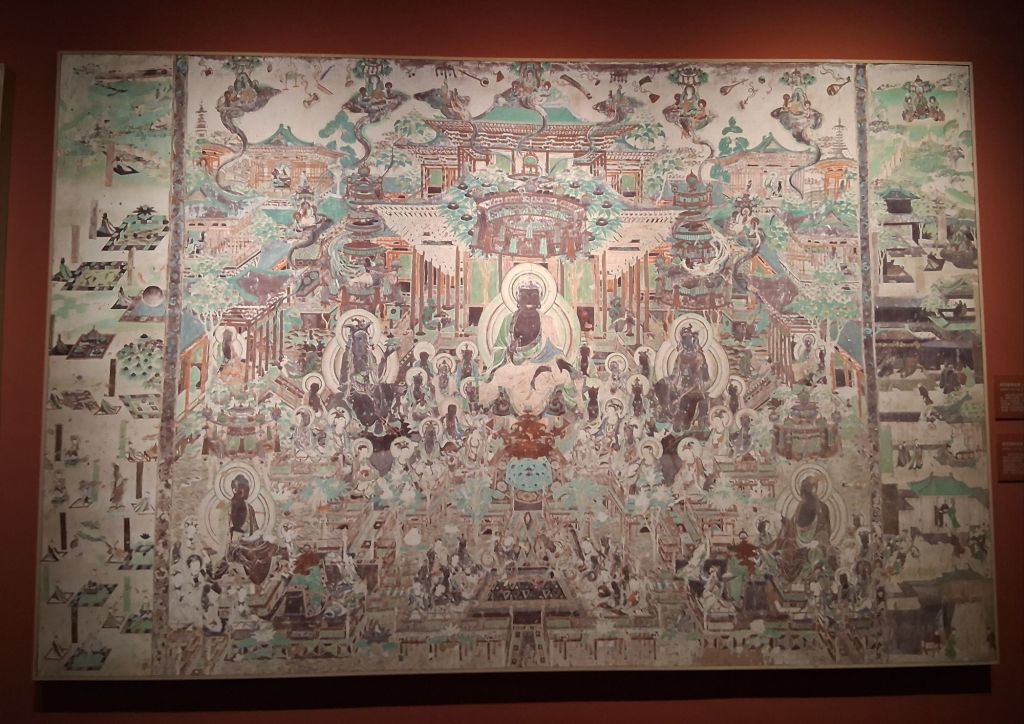
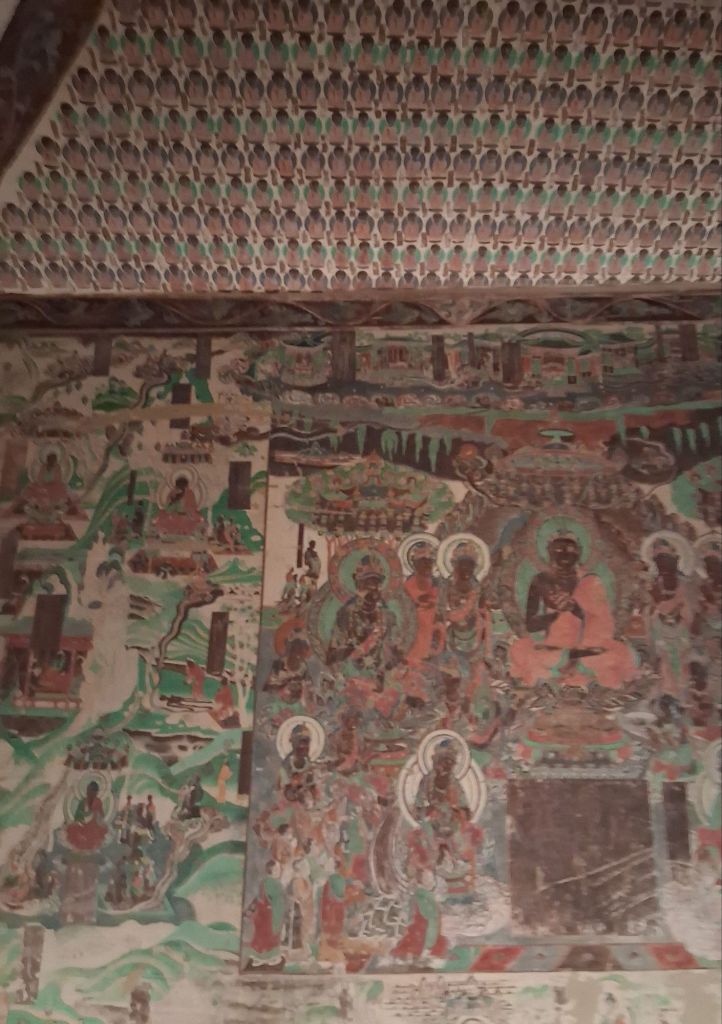
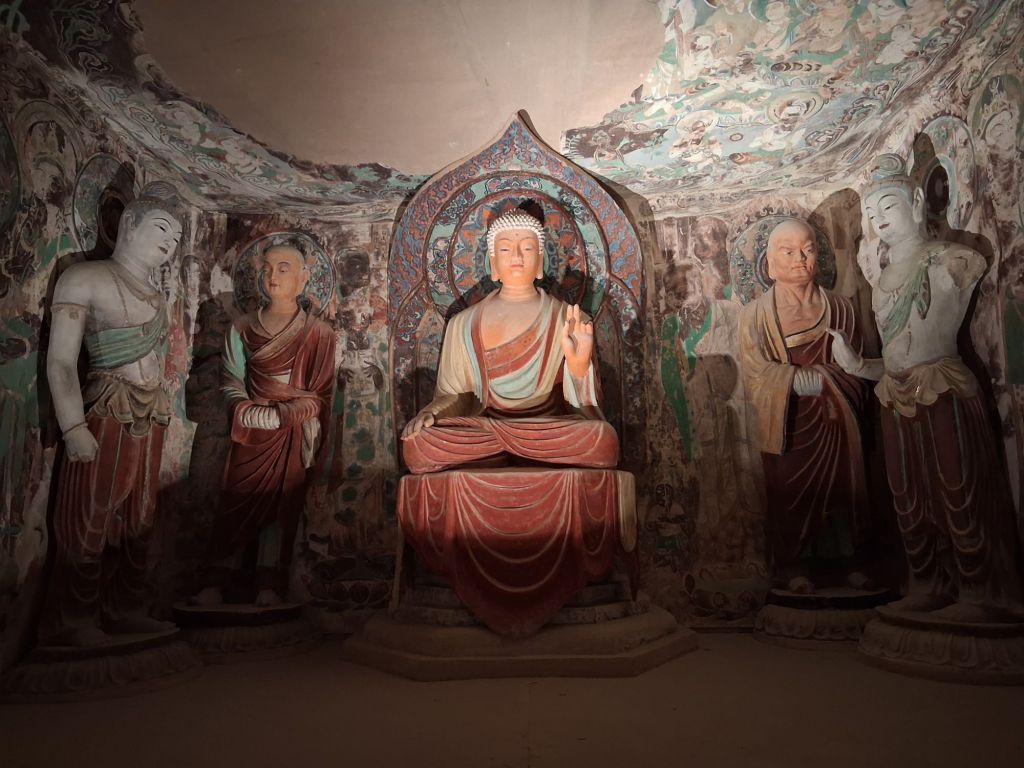
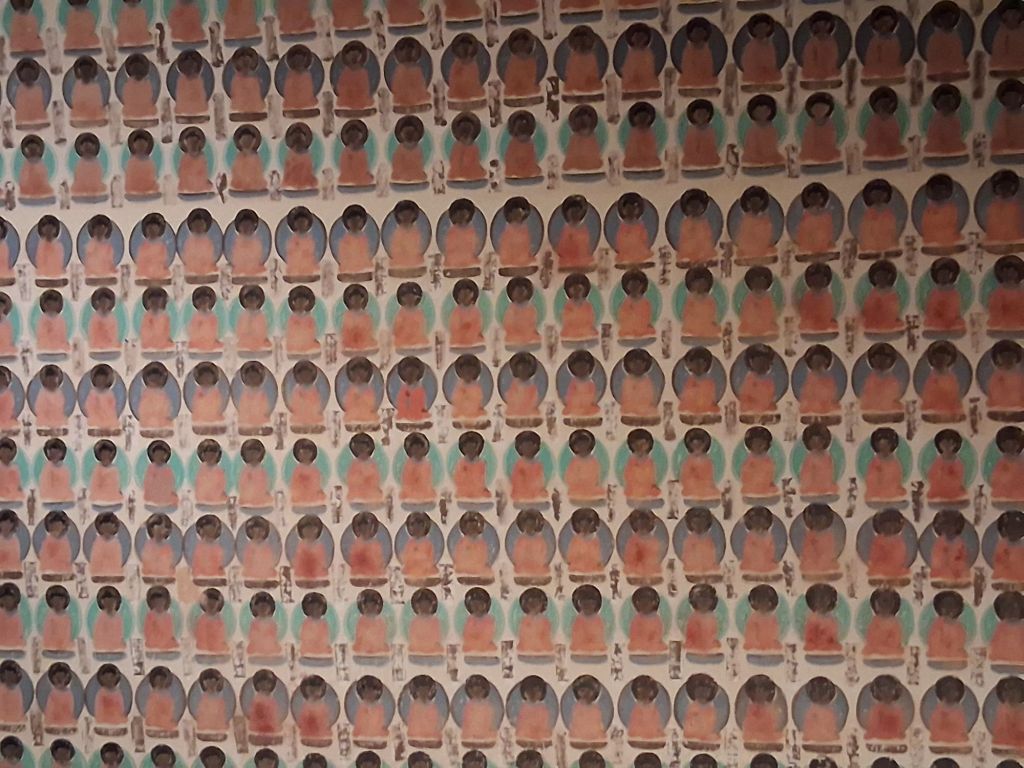
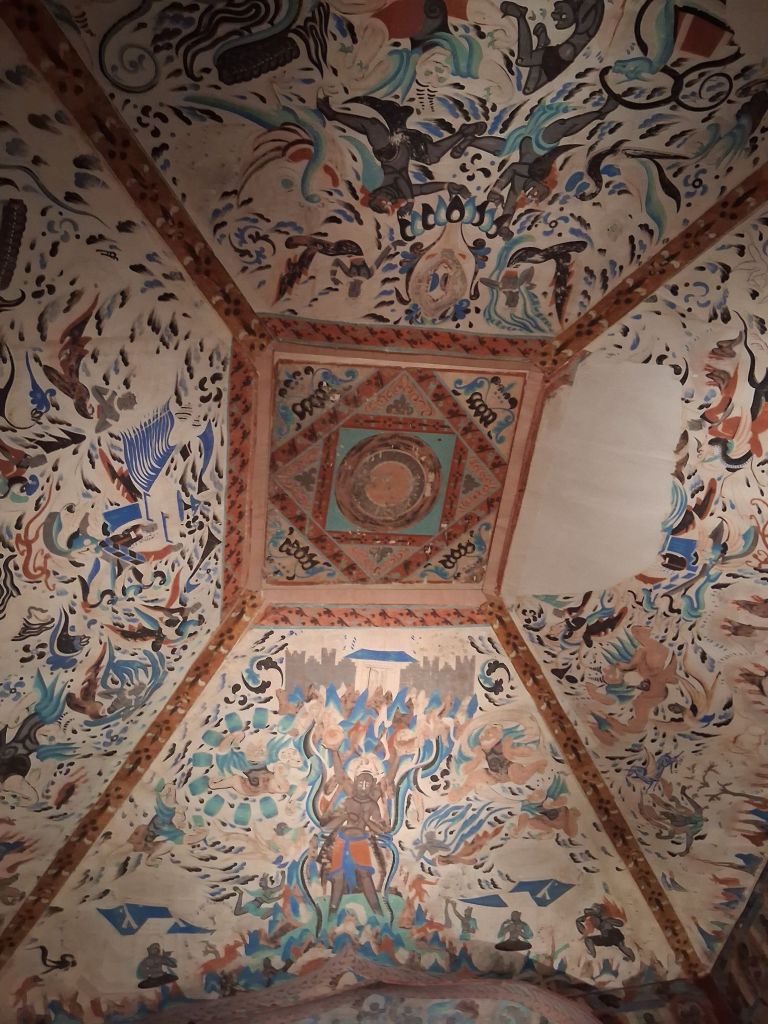
In terms of how they were created, the grotto would have been dug out of the loosely-structured sandstone exposing a rough gravel surface. This was then plastered over, firstly, with several coarse mud layers made of local mud mixed with straw and water. A fine mud layer was then added of local washed clau mixed with fibers and water, then finally a powder layer of kaolin (fine white clay used in porcelain). Artists would have then drawn the design directly onto this, before painting it over.
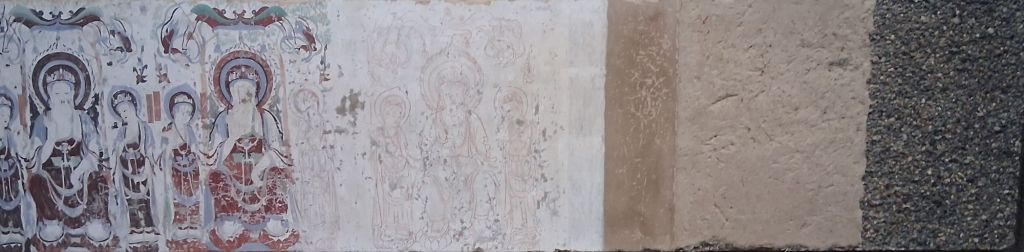
In terms of the caves we visited:
- Cave 334 – A Tang dynasty cave, re-painted during the Ming dynasty.
- Cave 335 – A Ching dynasty update of Tang dynasty cave, showing differnt styles on different walls.
- Cave 427 – This dates back to the Song period and contains the oldest wooden architecture of the grottos.
- Cave 428 – this is the oldest cave open for visits and shows the Indian Buddhist painting style, as opposed to the later Chinese style. It also contained a ceiling of 10,000 moulded Buddhas.
- Cave 61- This was originally built in 500 AD and then repainted over in the 10th century and contained my favourite wall mural of a map showing all the Buddhist temples on a mountain (accurate for the time apparently, and unfortuantely not available on a postcard in the gift shop!).
- Cave 96 – containing a 26m tall Tang dynasty Buddha carved directly out of the rock.
We also visited cave 16/17. This was discovered in 1901 by a Taoist named Wang Yuanlu who when cleaning the grottos found this cave (now known as the library grotto) which contained had been sealed in the 11th century and contained an almost complete Asian library of manuscripts dating back to the 4th century in a range of languages. Although he did report his find to the local governors, no one realised their value, so he started selling them off (for nothing like their actual value) to visiting “explorers.” Today, 70% of the documents are in museums outside of China, including I am sure you will be very surprised to learn, the British Museum…
I am proud to say that all of my group wanted to pay the extra (a very expensive £20) to visit cave 45. This is a totally original early Tang dynasy cave and includes an original floor tile and was decorated in a combination of Indian, Zororastrianism, and Chinese styles. It’s absolutely amazing.
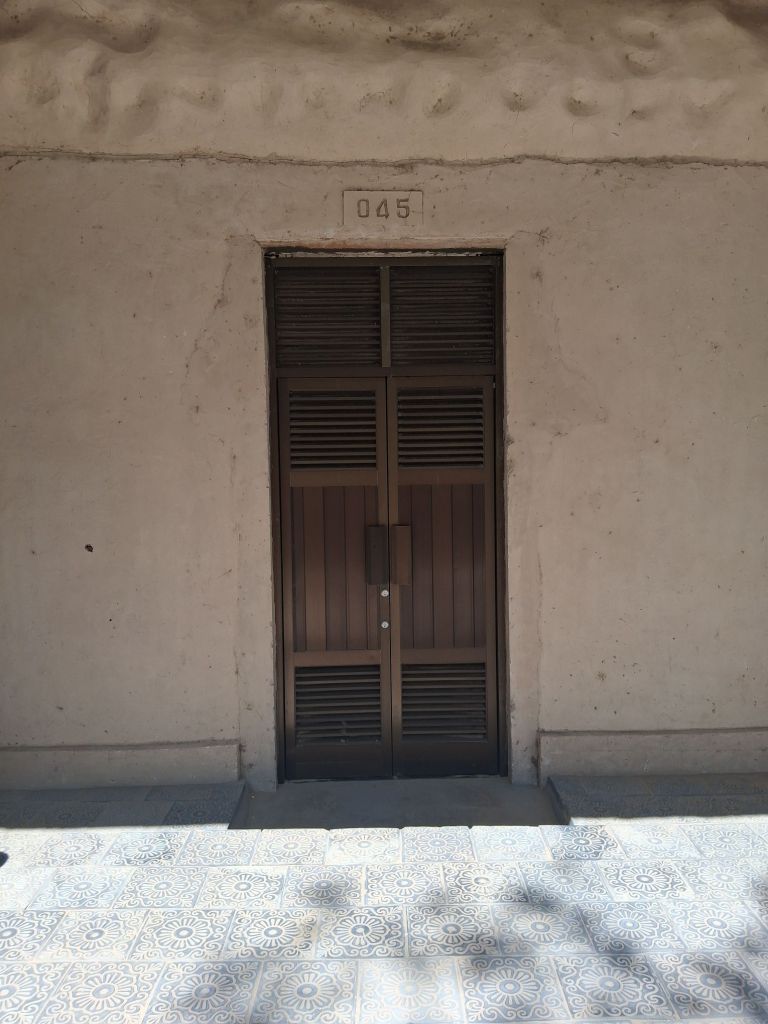
Photographs were not allowed in the caves, but even if they were, I do not think they would be able to capture how incredibly impressive they are. They effectively catalogue and demonstrate the evolution of Buddhist art and painting techniques from the first century AD up to the 11th century. I genuinely feel very privileged to be able to visit a place like this and to see something like this.
After lunch, we drove to the Western Thousand Buddha Caves (again no photos) and although these were not as well preserved or as numerous as the Magoa grottos, we effectively had them to ourselves so were able to spend a bit more time looking closely at the painting and marvelling at how somehing so old was so detailed and still, so amazing.
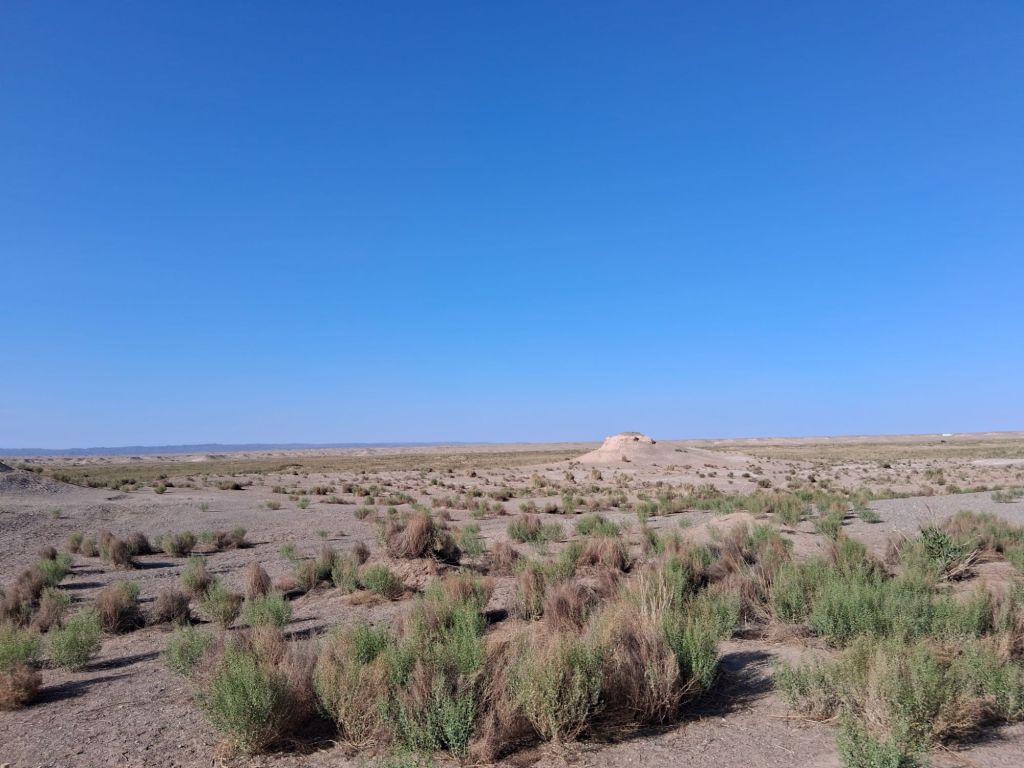
It was then time for a drive out really into nothingness (I suspect nothingness is going to become a bit of a theme of the next week or so) to visit the Yumenguan Gate/Jade Gate Pass.

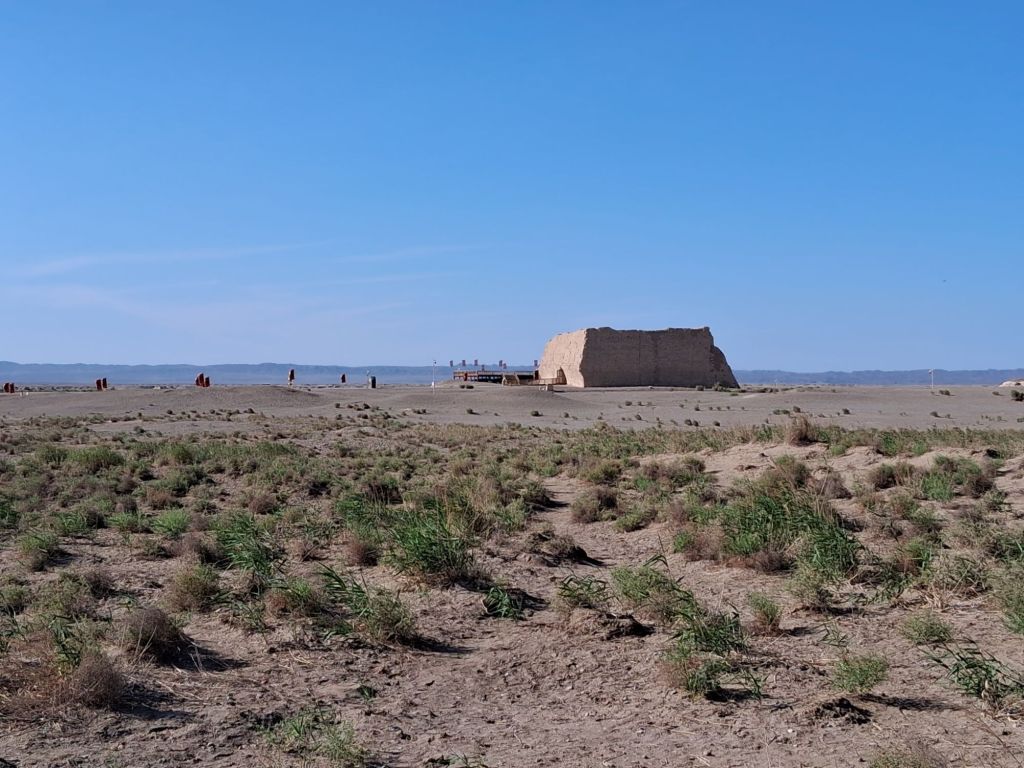
Yumengun was a strategic fort on the Silk Road and was built by Emperor Wudi of the Western Han Dynasty between 206 BC and 224 AD as a military garrison outpost. This was at a strategic site and allowed the Han to protect themselves against the Xiongnu by controlling a vital pass in the Hexi corridor. It also helped to guard the Silk Road and hence the name jade gate, as it was through this gate that jade would have been transported from Xinjiang into the Han Empire.
Now, having gotten rather used to Chinese rebuilding, one needed to use a lot of imagination to imagine the fortress that once would have stood here. Today, little remains other than a command post, some short walls, and not much else. As it’s in the desert, it’s 35 degrees, sunny, and the sand was blowing – we perhaps did not give it the energy it needed…

By now, it was 8pm and we were returning to Dunhuang to visit the night market. I have decided that given the length of this post, we may need a part 2…
Answers to yesterday’s question- 1:5.
3 responses to “Stage 7.7 – Dunhuang (Part 1)”
-
-
Keith here: Another excellent blog, reminding me of Race Across the World (hours of travelling through nothing to get to the middle of nowhere).
My Google search put the sheep to people ratio closer to 1:7, but it did also claim that China has more sheep than any other country…
And here’s a joke for all the lawyers reading this:
My plumber did a job for me that took him only 30 minutes. He gave me a bill for £500.
In shock I said “that works out to £1,000 an hour. I’m a lawyer and I don’t make that kind of money.”
He looked me straight in the eye and said “Neither did I when I was a lawyer.”
LikeLike
-
I’ve read Dunhuang Part 2 on the email link although it doesn’t appear on WordPress listed in sequence with the other posts. I’d have enjoyed the foodie experience of the night market but I was with you every step of the way up that dune! I’ve also read ‘Turpan’ which is listed with the other posts but which won’t allow me to comment. Onwards and upwards, carry on fighting the fight!😘
LikeLike


 Travels with Kathryn
Leave a comment