So after the overwhelming amazingness of the sites of Samarkand, I was interested to see how I would feel about Bukhara. Bukhara does not have the big impressive specific buildings/squares of Samarkand, rather the whole old city has been preserved which gives it a lovely feel. However, its hot, very hot.
We travelled to Bukhara by coach (a classic 50-seater minibus, there are 10 of us, including the guide!) which felt a little excessive. However, the reason for this is although there is a train between Samarkand and Bukhara it only stops for 3 minutes at Samarkand where lots of tourists get off with luggage and they just don’t want to risk groups of tourists with luggage trying to all get on in the scrum of the platform. Having taken the train back from Bukhara via Samarkand to Tashkent, I am not sure we would have made it! Also, by travelling by road we are passing along The Silk Road and we did manage to see (although not photograph) some Caravanserai from the road. Caravanserai were generally every 40-50km as this was roughly how far camals could do in one stretch, and were effectively travellers rest stop and watering hole.
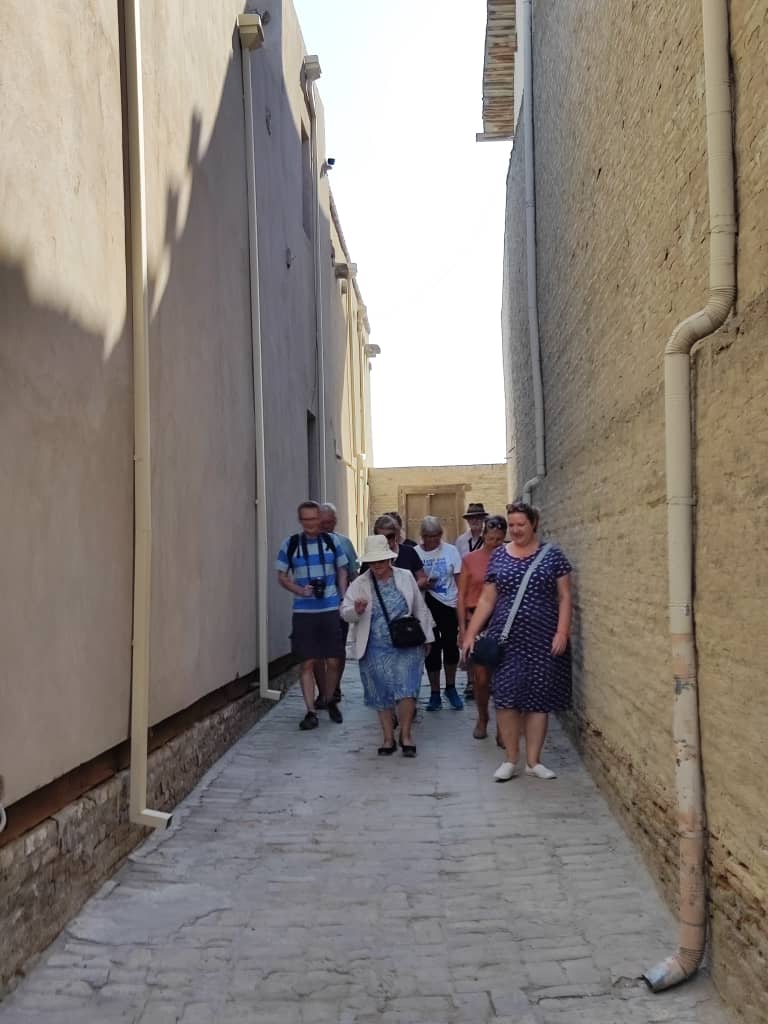
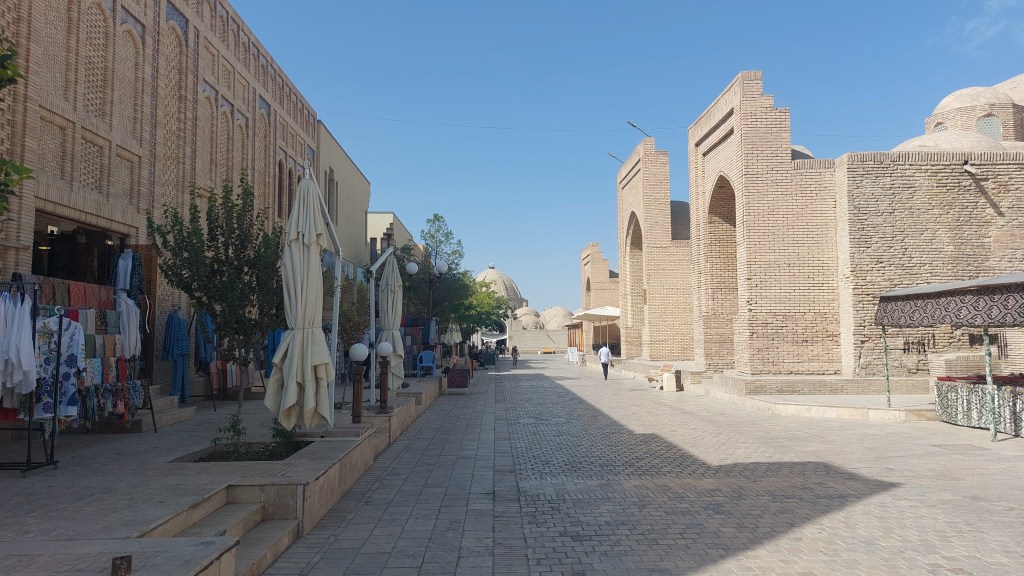
Bukhara is a city of 250,000 of which 70% are Tajiks, so although smaller than Samarkand, the ancient city is on the UNESCO World Heritage list. It also forms (together with Samarkand and Khvia, where I heading in a couple of days) what is known as “The Triangle of the Orient”. I suspect this is marketing, but it it working for me as an idea. The medevial city of Bukhara is (with some light restoration) as it would have been at the time, and what it lacks in sites, it makes up for in general atmosphere and street life:
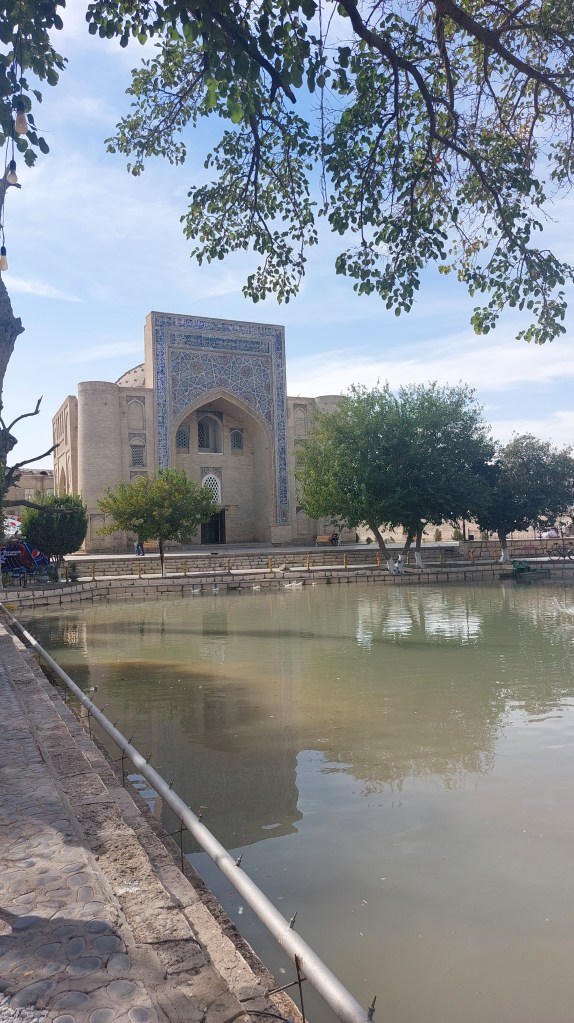
We managed to fit in our first site on the way to our hotel, the Lyabi-Hauz which means in Tajik, literally, “around the pool”. Until the Soviet era, this was just one of many pools that formed part of a canal system used for the population as a source of all water. As you can imagine, water-bourne diseases were something of an issue, and the Soviets installed new water pipes and filled in most of these pools.
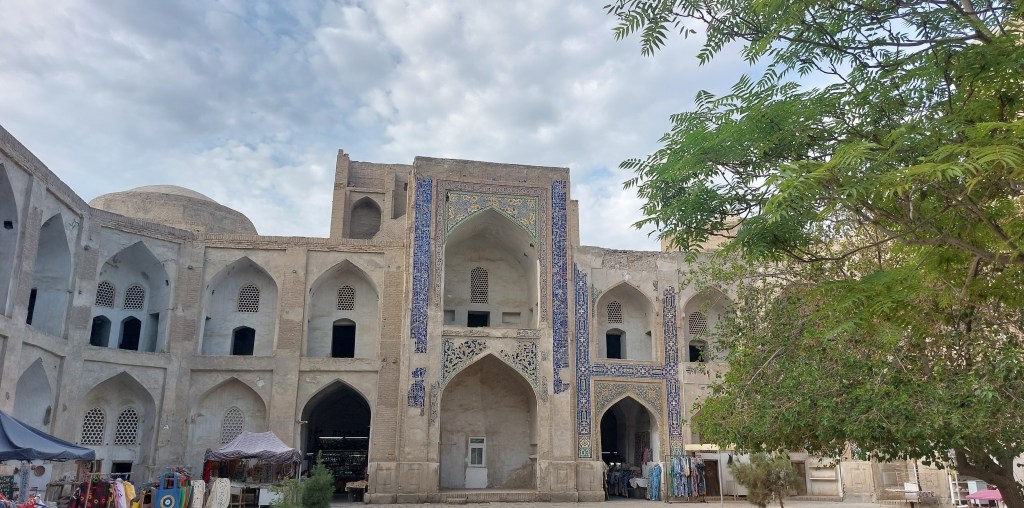
The streets are linked with what were known as trading domes (photos below) which formed arcades and crossroads and were dedicated to particular activities i.e. mony changing, cap making or jewellery and were a cooler place to do business (have I mentioned the heat?). These have now, in the spirit of touristing, pretty much all turned into craft workshops and tourist shops. However, again, it is not pushy and haggling is minimal (only around 10% off) – pretty much everything is made here or locally, rather than China, and people are pretty open about whether its genuine silk, silk mix, cotton etc. Also, during Soviet times these types of shops (small trade) and handicrafts had all been banned, so it has taken a while to get them going again, but it is actually lovey to see things actually been made and then sold – and I hope I could tell the difference!
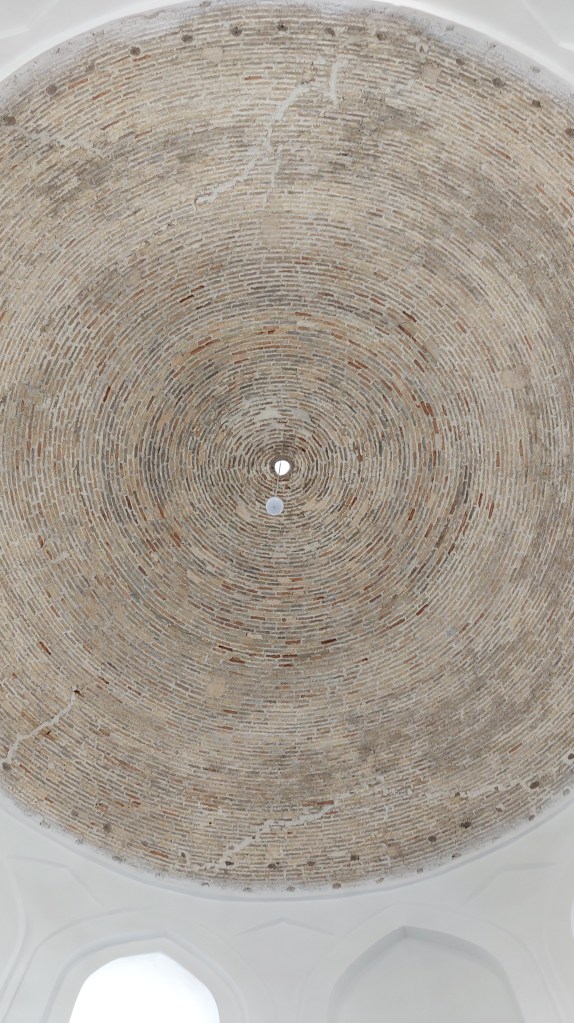
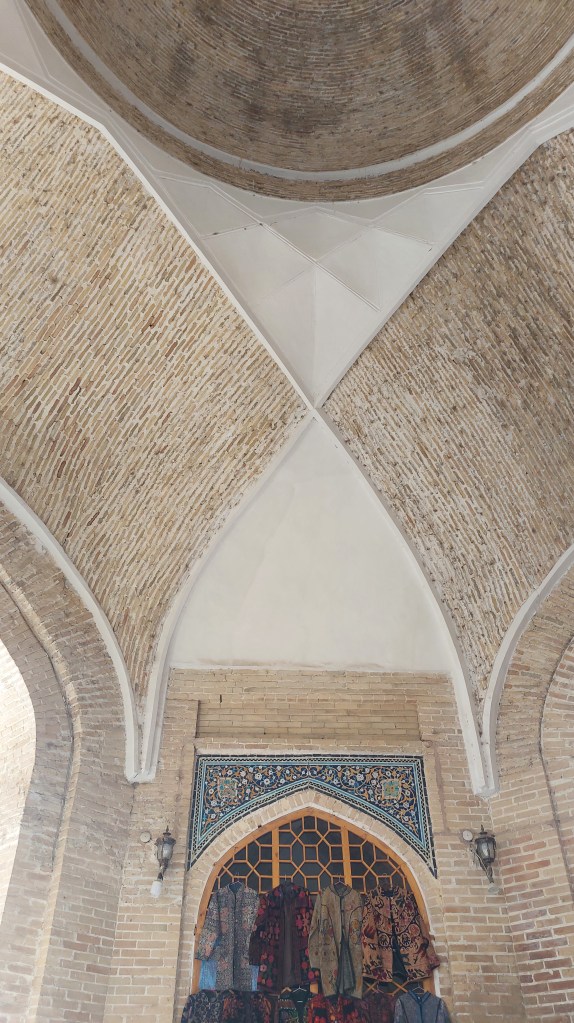
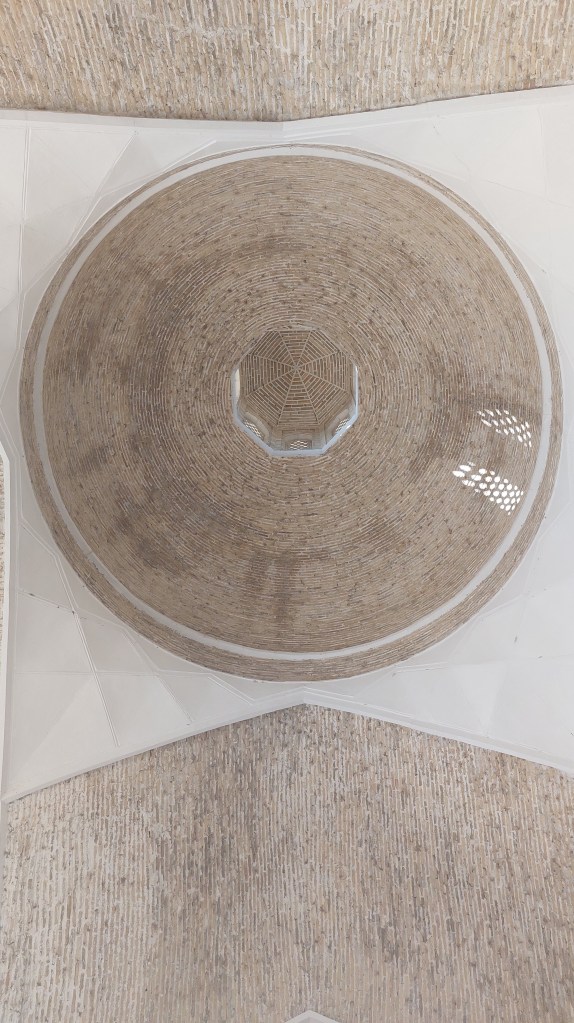
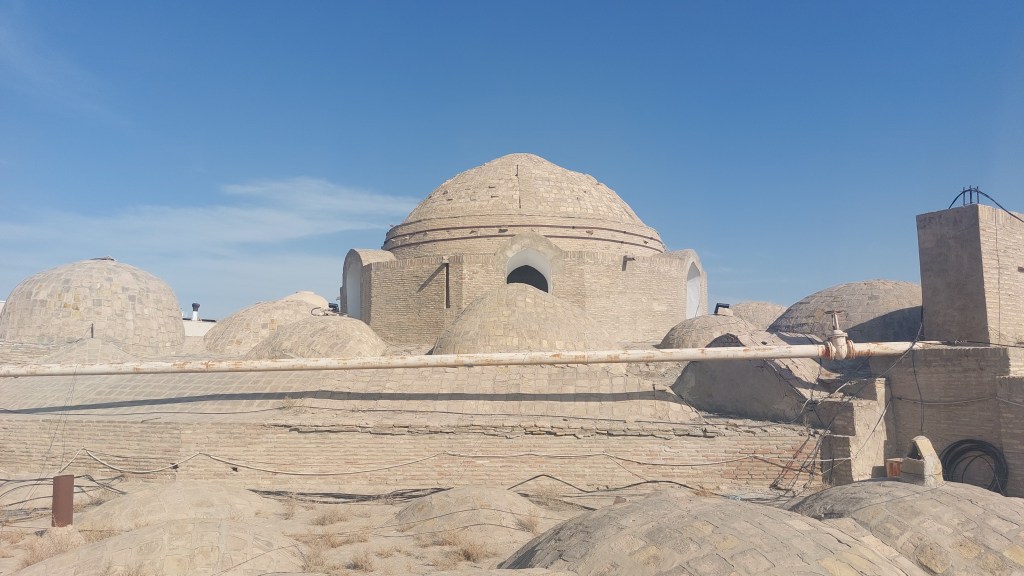
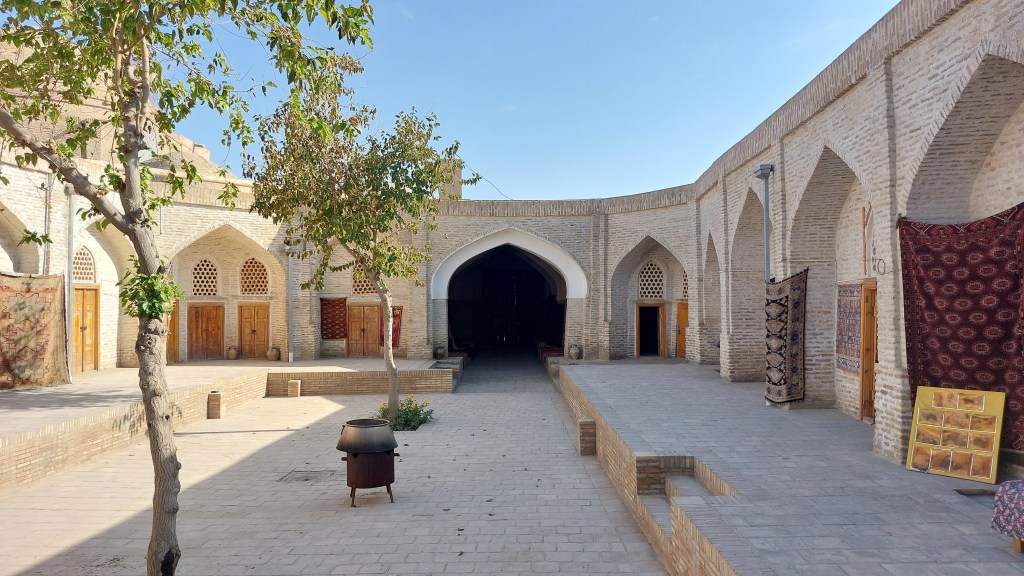
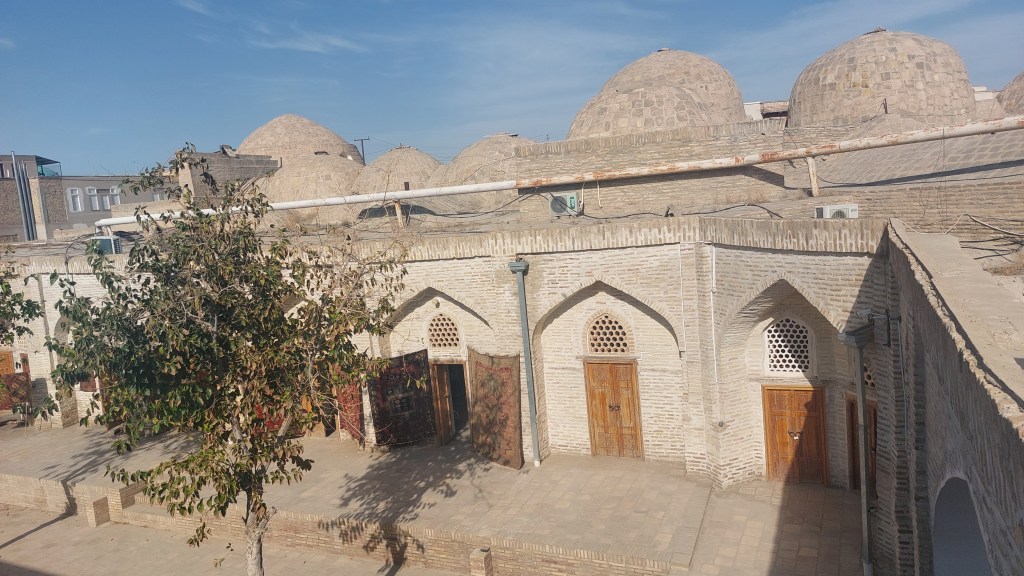
What was particularly interesting, is on the edge of one of the domes we ducked into a shop, out of the backdoor, and found ourselves in a Caravanserai where we were allowed onto the rooftop to get a view looking down:
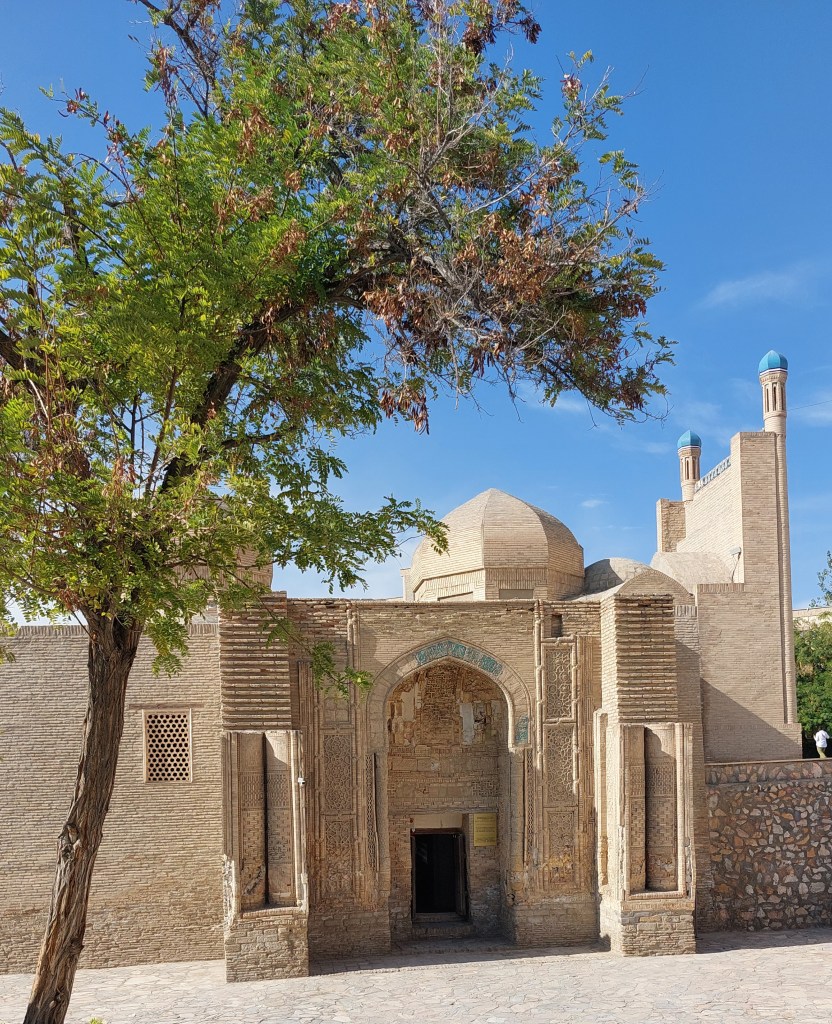
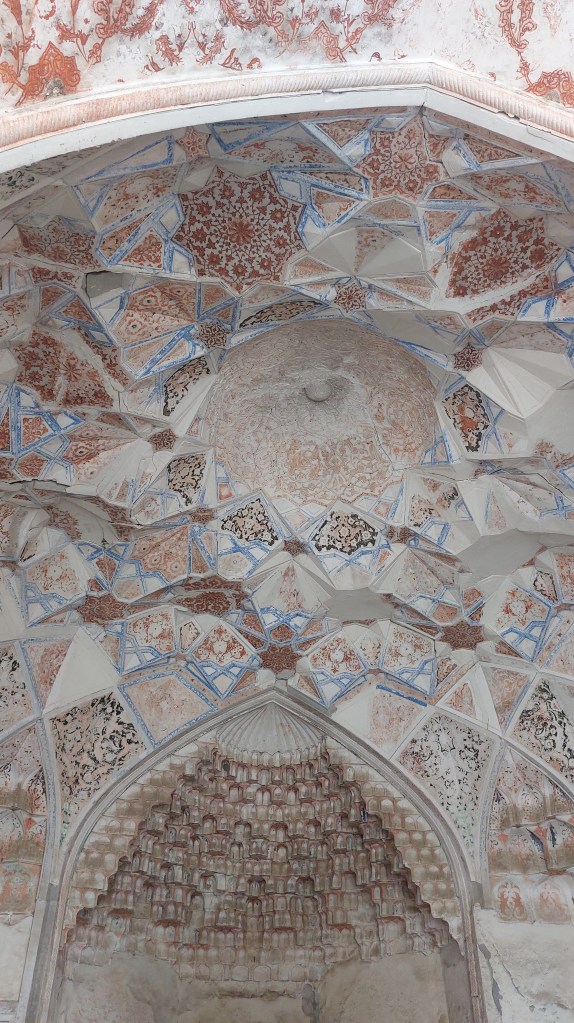
We then visited the Maghok-i-Attar which is the oldest surviving mosque in Central Asia dating back to the 9th century (and probably before then as bits of a 5th century Zoroastrian temple, and an even earlier Buddhist temple before then). As we learnt in Samarkand, Gengis Khan and his band of merry men had a tendancy to burn cities, buildings, anything going to the ground, however, this mosque survived. It survived (according to legend) as locals buried it which does have a ring of truth as when it was uncovered in the 1920 sit sits some depth below current street level. Due to its age, all decoration was made of terracotta (rather than the blue and green tiles found in 15th century buildings, but you can see some blue decoration added later.
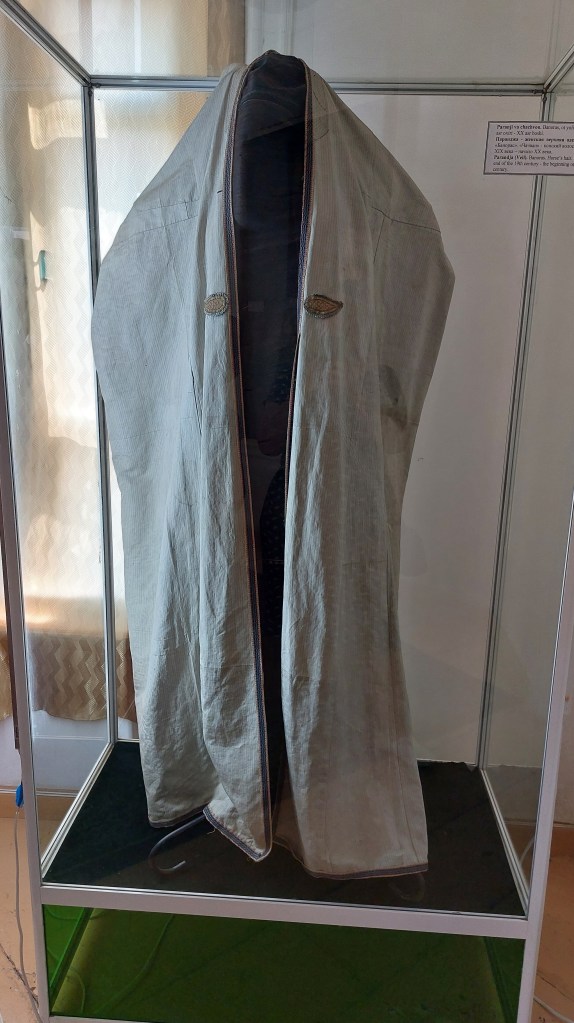
We continued walking through the streets with our local guide, Raisa who was an interesting lady. 73 years old, and has obviously been doing this for a while – of Russian (Tatar apparently) origin, she had some pretty strong views on Soviet Russia. It may be the rose tinted glasses of older people, but certainly, she felt that things were better when there was universal healthcare, free education, guaranteed jobs on graduation and trying to improve rights for women including encouraging women to stop wearing head scarves or the parandji (see photo and description below). Whilst she is very supprotive of the ending of Soviet control and the ability to trade, she worries about the Islamification of Uzbekistan, and we have seen many more women wearing the hiajab here than in Krygzystan. A couple of times over these 2 days, she has spoken to young women who she has known for years who have started to wear the hijab and ask them why and the answer usually seems to be it is because their husbands wanted them to. I do not know enough to know what is better, Soviet control or government control (which is certainly the case in Uzbekistan today), but neither seem to be necessarily giving people free choice in Uzbekistan so it will be interesting to see what happens in the years to come. She also owned the hotel we were staying in and we were all given a goodbye plate on departure which was a lovely gesture.
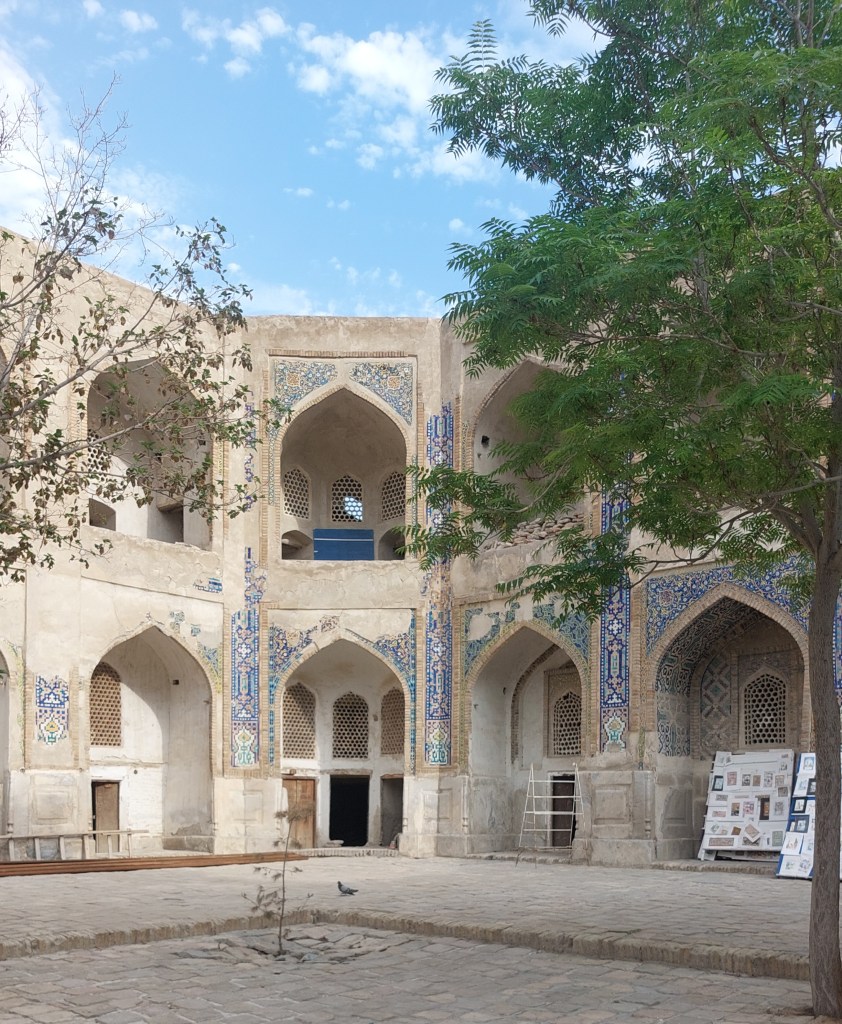
Anyway, moving on, we toured the mosques and madrassa’s of Bukhara. The most interesting of which is Mur-i-Arab Madrassa as this is a functioning college and has been re-opened since 1943 (it was built in the 16th century) after local people petitioned Stalin for it to be reopened, and in return, they promised to pray for victory so perhaps it worked?
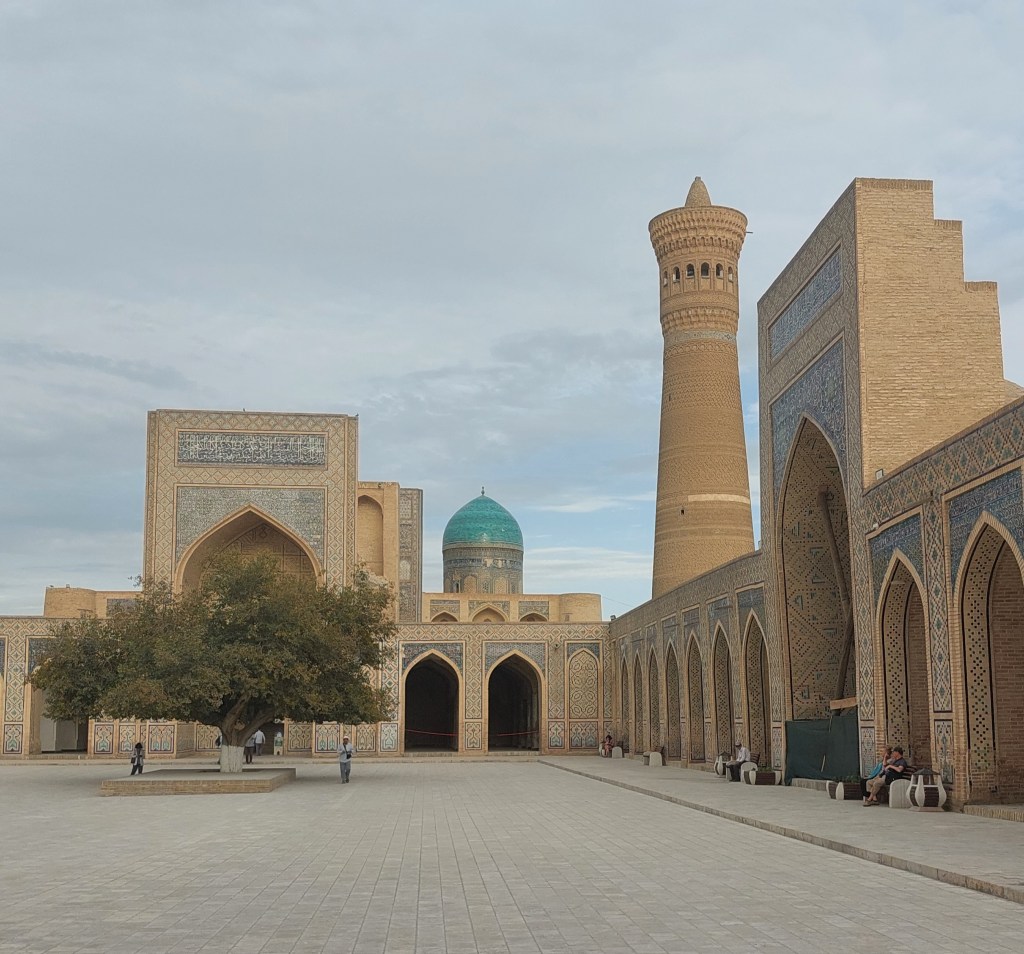
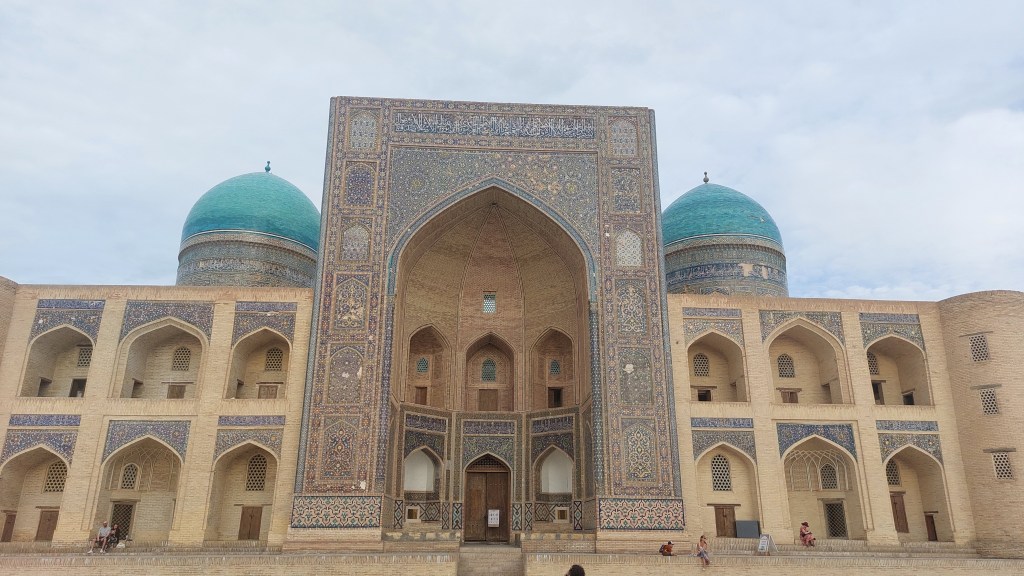
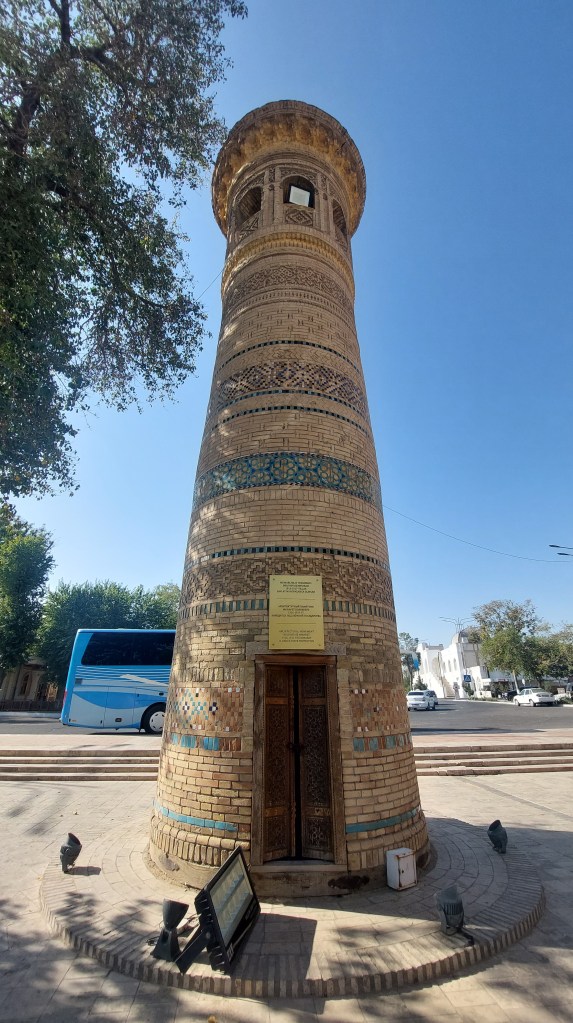
Between the Mir-i-Arab Madrassa and Kalon Mosque stands the 47m tall Kalon Minaret which is probably, the tallest building in Central Asia and was built in 1127.
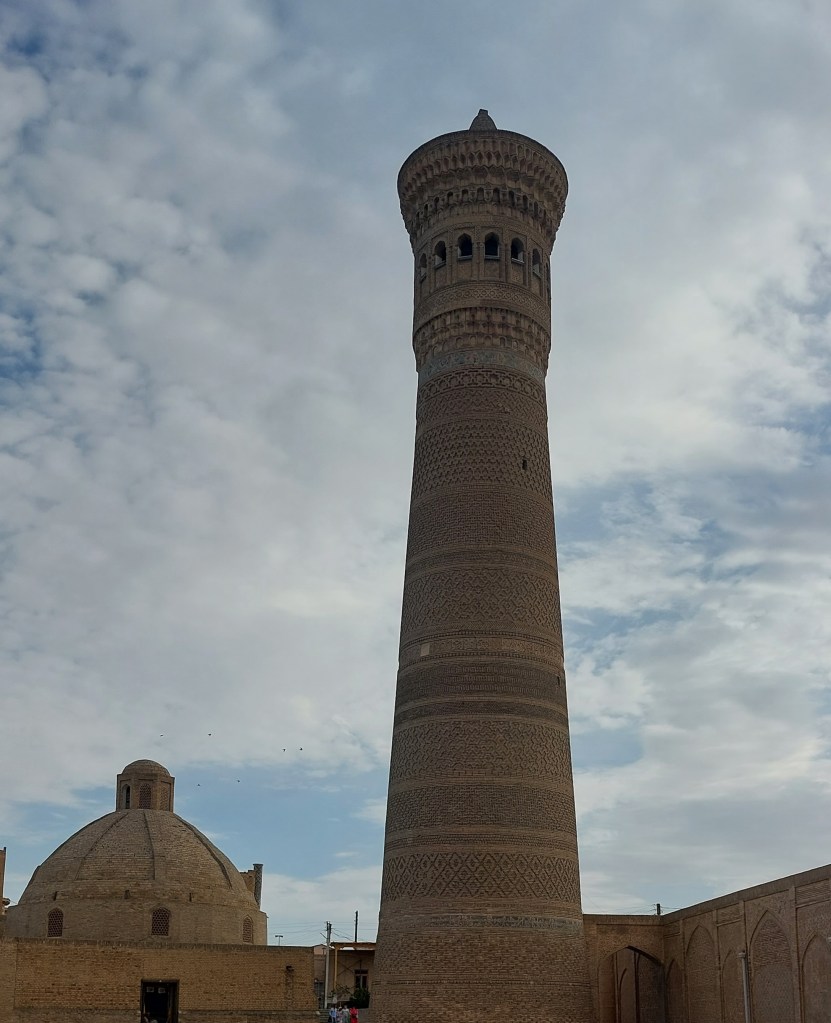
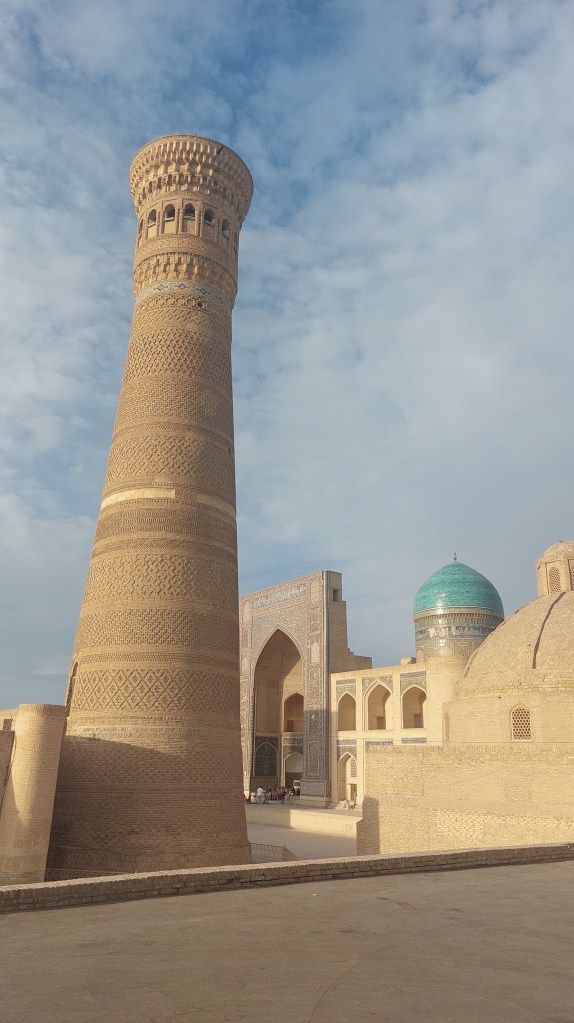
For avid blog readers, I am sure you’ll be asking yourselves- wait a minute, why wasn’t it destroyed (like essentially everything else) by Gengis and his merry men? Well, excellent question, legend has it that Gengis was so impressed by its size he decided to save it. I think it also helped that it came in quite handy as a watchtower. This minaret is also known as “The Tower of Death” as over the centuries it has also been used as a place of execution – including of unfaithful women who were thrown from the top. Delightful. During the days of The Silk Road it was also used as a lighthouse to guide travellers into Bukhara so it had a slightly nicer use.
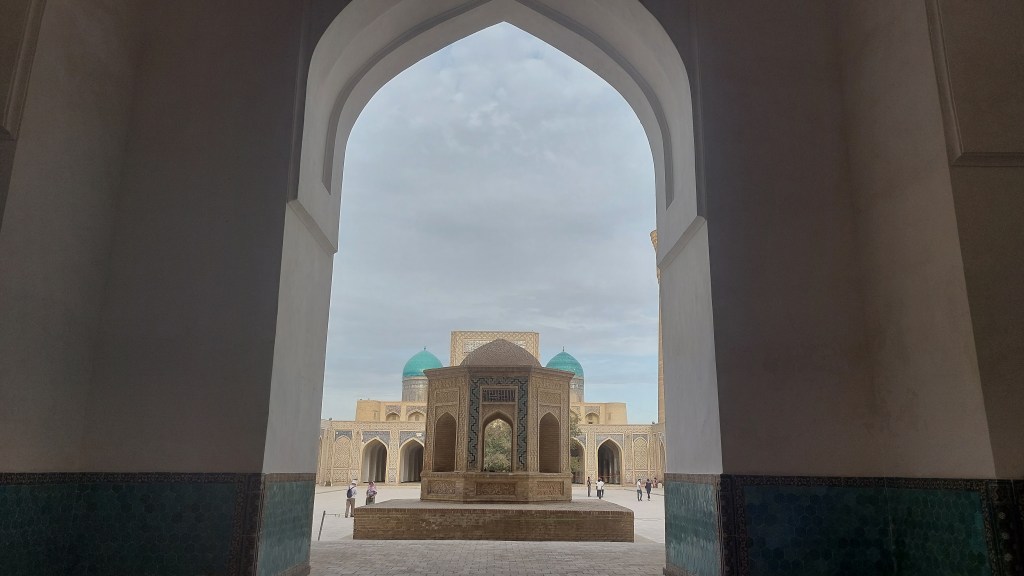
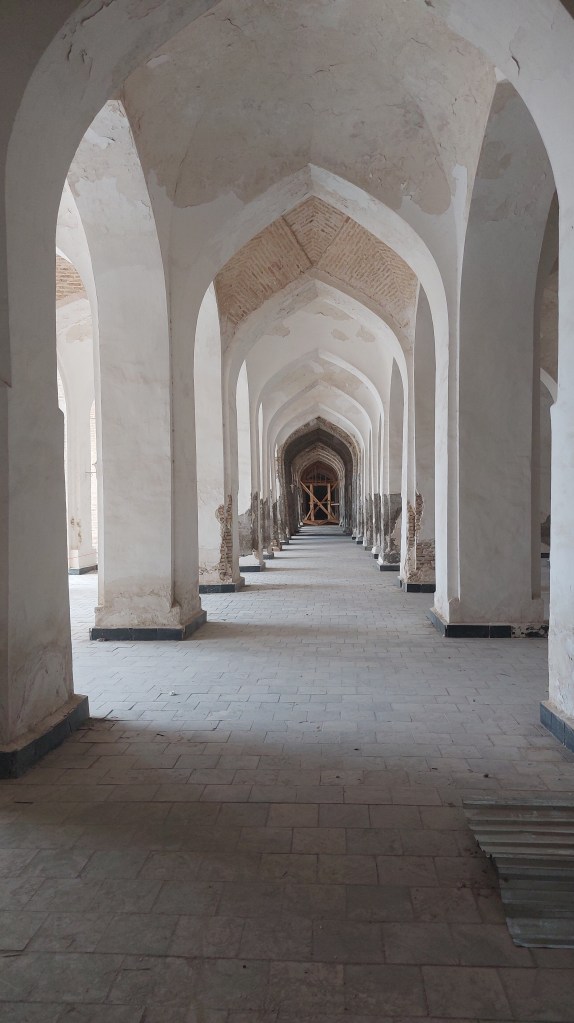
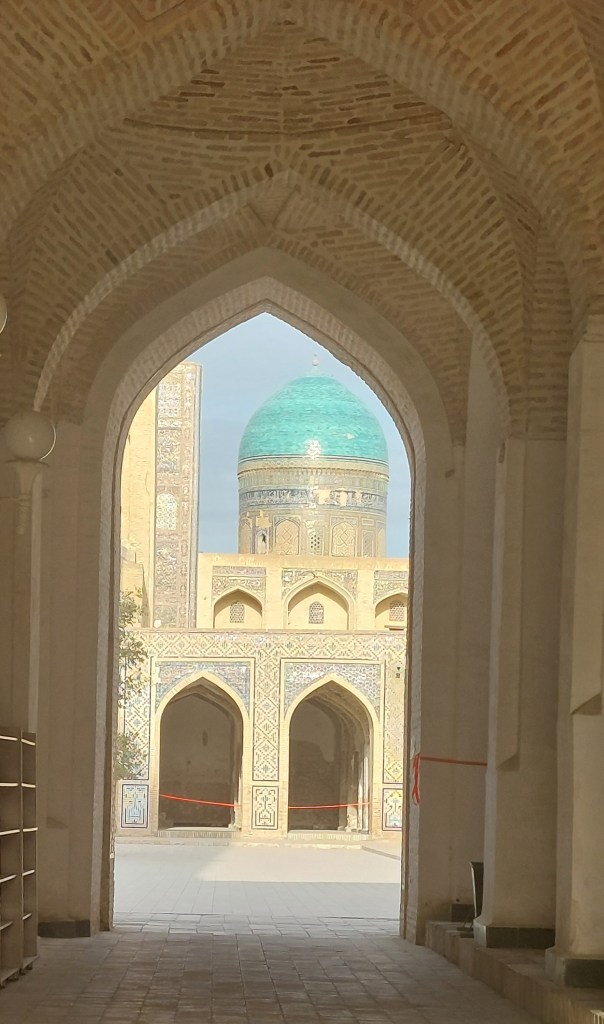
Our final stop of the day was the Kalon mosque itself – this is undergoing reconstruction (as what Bukhara really needs is another, enlarged mosque), but there was a lovely view through the courtyard back to the entrance and the dome of the Madrassa:
So, day 1 in Bukhara has been lovely. As I hope you can see from the photos, the whole city has been preserved, which makes it a lovely place to wander around and there are lots of nice shops (particularly containing fabric-y things) to look at as you wander along or pretend to look at whilst you enjoy their shade/air conditioning…
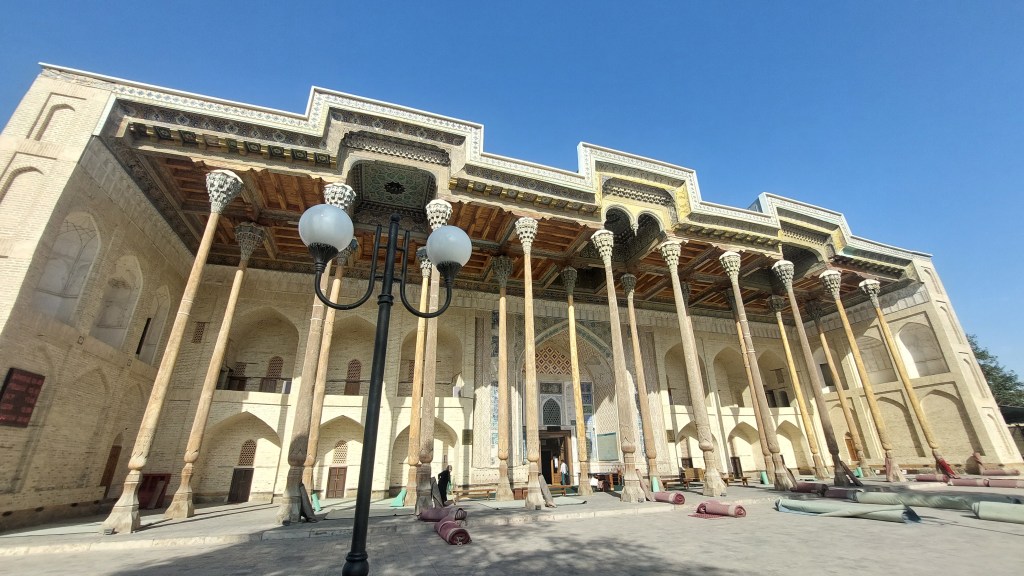
Ok, onto day 2, today we were covering off the sites which requires transport by bus so we ere back in the giant coach, however, the giant coach does have air conditioning which as the day progressed I become more and more grateful (it got up to 37 degrees by the late afternoon). Our first stop was the Jome mosque, which was unusual for its wooden pillars. However, being infidels we were not allowed in, not even onto the carpet near the door.
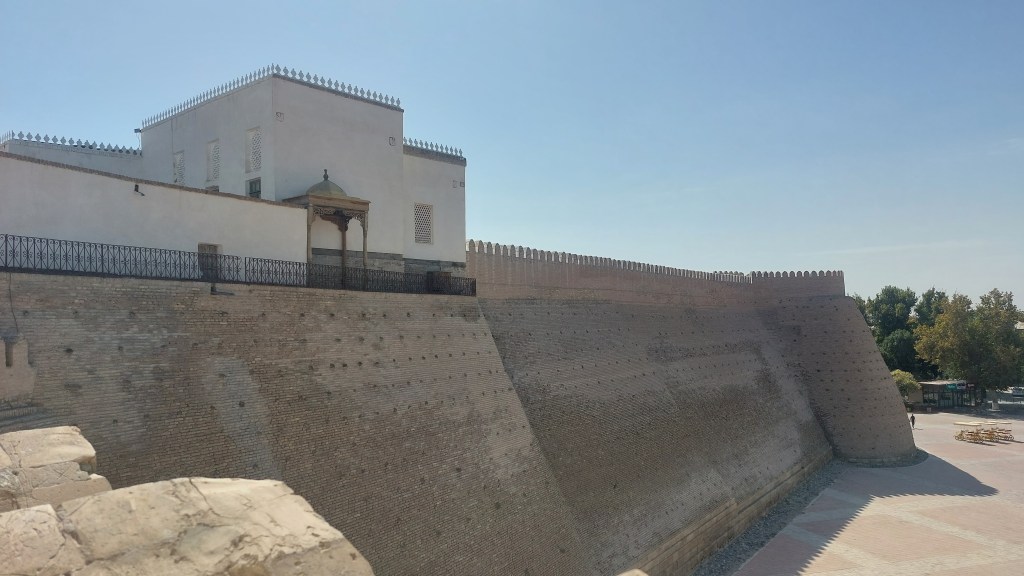
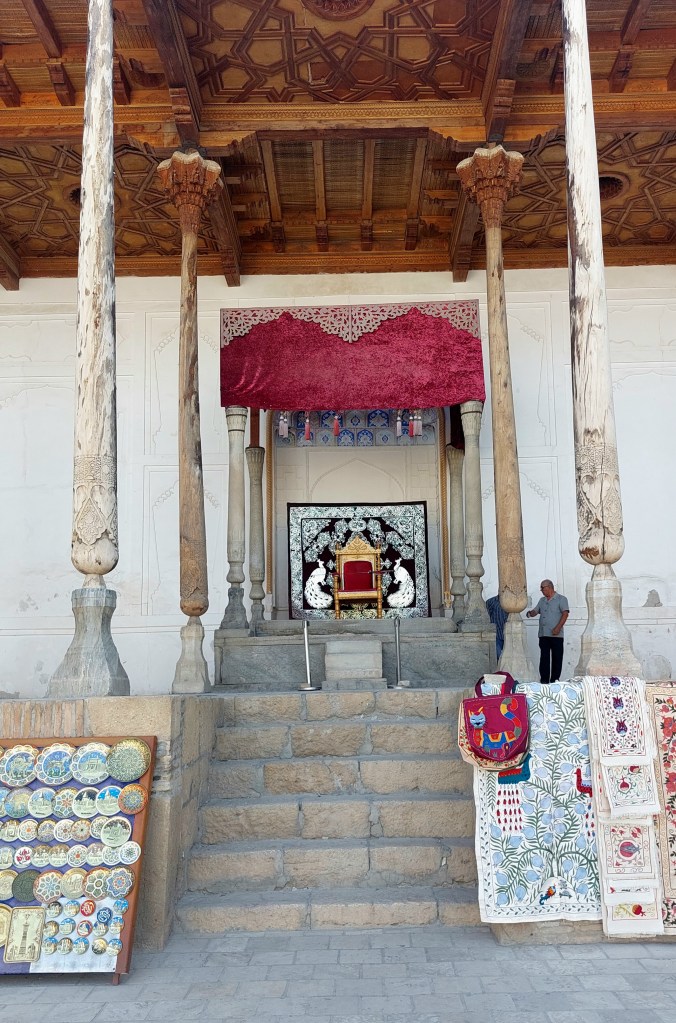
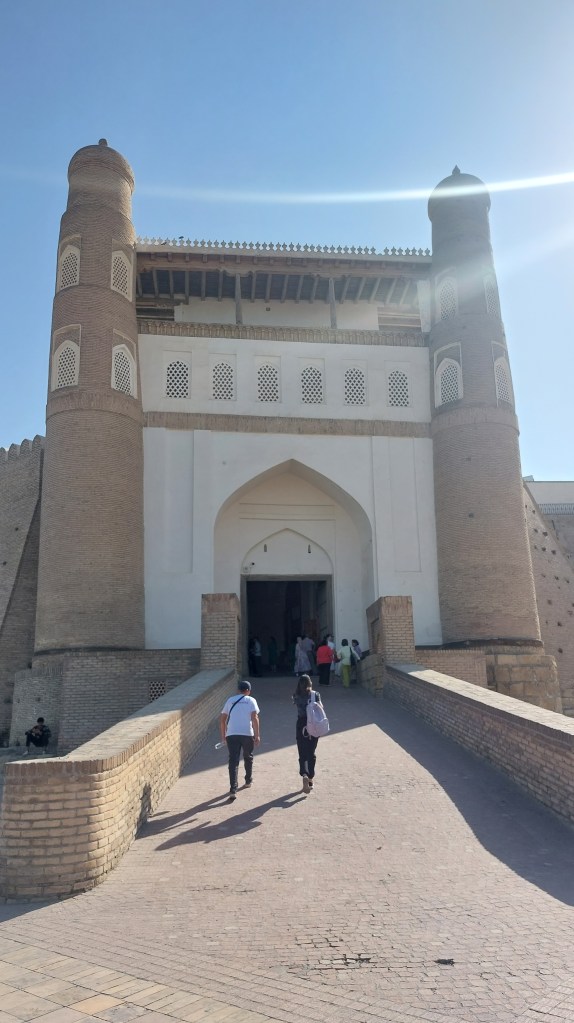
We then went to what is known as The Ark, which is the fortress of Bukhara and was inhabited by the rulers of Bukhara from the 3rd century through to 1922. It is built on an artificial hill which was then enlarged, but through the centuries has been repeatedly built, destroyed and rebuilt and has changed shape several times. It was even for a short period the region’s capital during the 16th century.
The last ruler of Bukhara, the Emir Sayyid Mir Mohammed Alim Khan was crowned in 1911 and lived here until then, and as the Soviets took the city, he departed with 3 caravans loaded of treasures. When he was close to death (in 1944) he asked the Soviet’s permission to be buried in Bukhara. He was told he could, but only if he returned all the treaures. He is buried in Kabul.
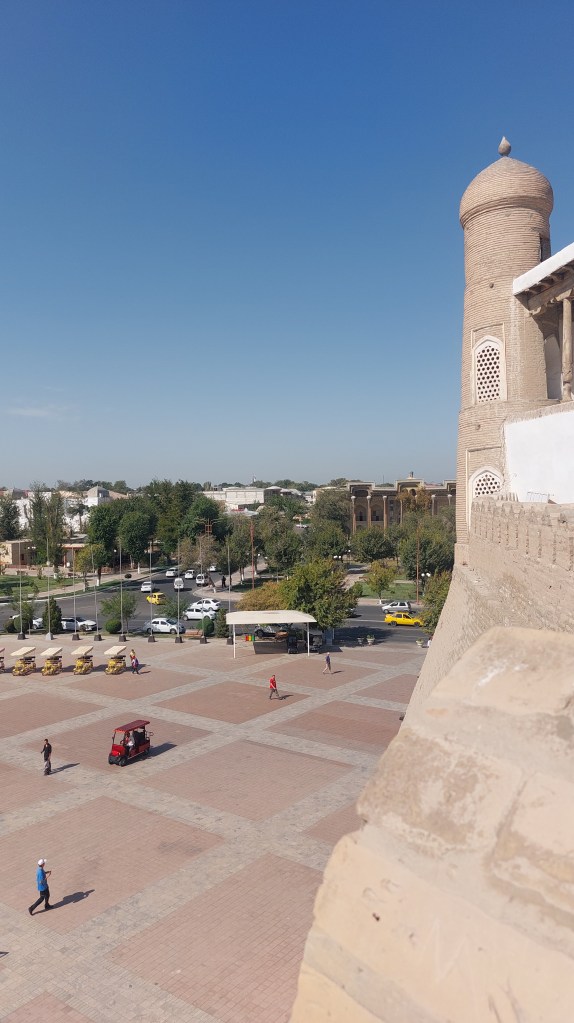
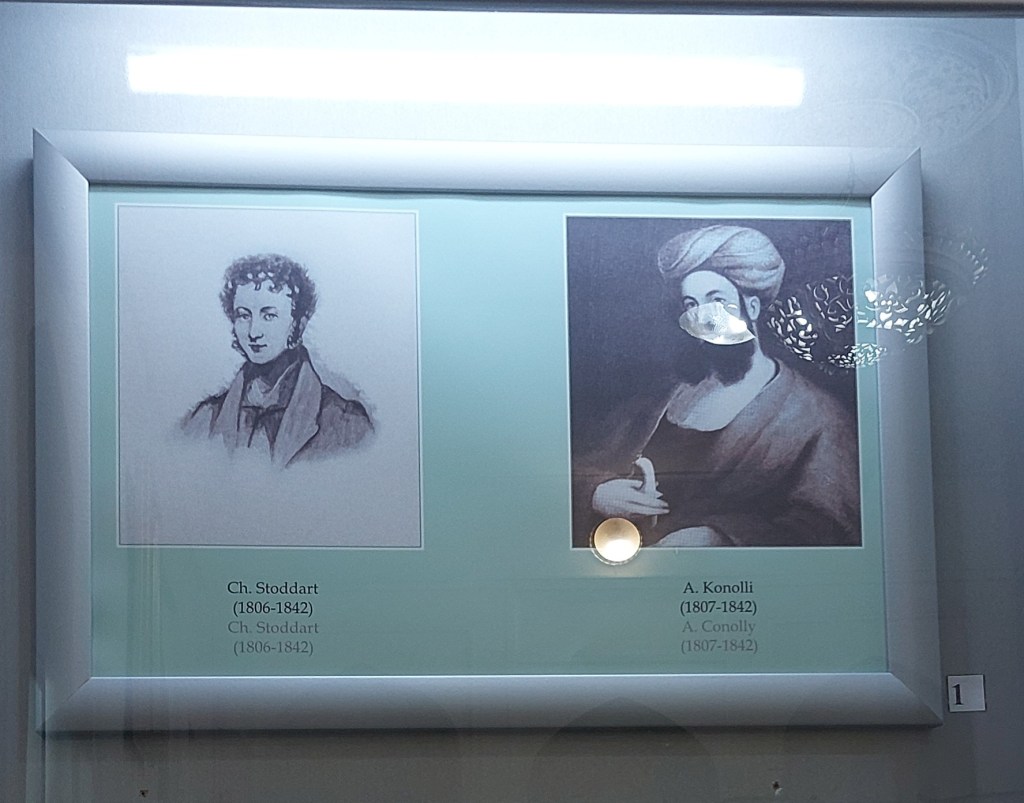
Even duing Tsarist Russian times, the rulers of Bukhara had something of a bloody reputation, which was certainly demonstrated by their treatment of two English officers (pictured below). Colonel Stoddart arrived into Bukhara in 1839 on a mission to reassure the Emir regarding the British invasion of Afgahanistan. He was sent in somewhat unprepared with a distinct lack of gifts, and with a letter not from Queen Victoria (as he expected as an equal ruler), but from the Governor-General of India. He also (being British and thus believing he owned the world) violated local protocal by riding, rather than walking up to the Ark. He was, as you might have guessed, thrown in the “bug” pit by the Emir, which was literally a pit filled with all manner of bugs and other nasties. In 1841, Captain Conolly (the cavalry) arrived to secure his release. But he to, was tossed into the pit. They were both beheaded in the square outside the fortress. After that, the British, sensibly, decided to let the matter drop and move on. The Russians (the Emir’s overlords at the time) were apparently rather surprised the Emir went that far, but the Tsar denied his sister’s wish to visit Bukhara to avoid such extreme actions.
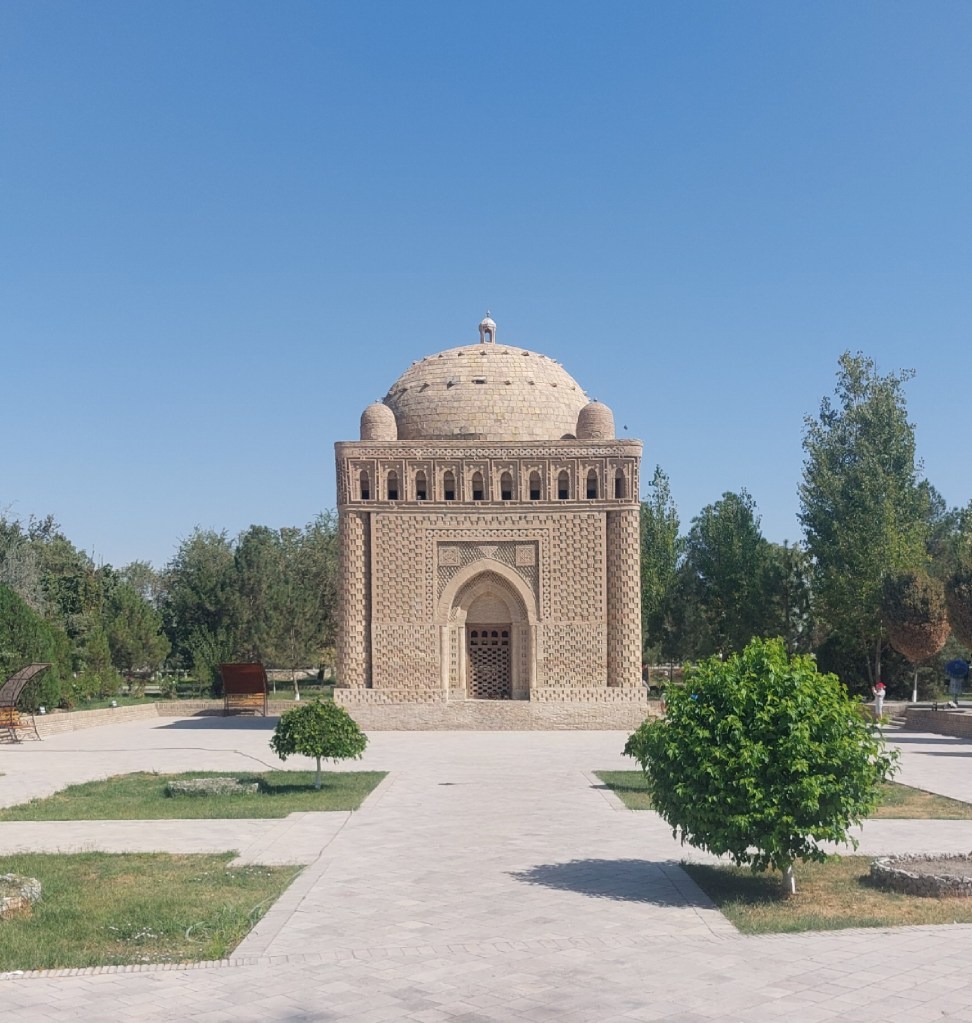
Our next stop was the mausoleum of the Samani dynesty (between the end of the 9th and 11th century). This was another building that survived the Mongol horde, most likely because as a mausoleum from Gengis Khan’s perspective, it was of no use to people. The building is made of local bricks, and the bricks are used in different decorative ways rather than adding actual colours or tiles. The layout may remind you a little of the Taj Mahal, which would make sense, as it was the ascendor of this dynesty (Shah Jahan) who built it. Apparently, if you make a wish and go around it three times, your wish will come true – I shall let you know either way…
Our final stop of the day was the Palace of Moon and Stars (the Sitorai-Mokhi-Khosa). Before 1911, the ruler of Bukhara had 2 palaces: the Ark, and main palace (slightly outside the city near the train station, and currently closed for restoration), the new ruler evidently felt this was insufficient space so decided to have this palace built over a 17 hectere site to bring together Uzbek design with Russian design, having been inspired by his time in St Petersburg (and some buildings certainly have a Herimage feel about them). He even started work on a guest house for the sister of the Tsar to come for a visit. However, history overtook, and it was never completed.
We stopped for lunch and were met with the interesting news that there was no gas in Bukhara which meant that menus were somewhat limited to kebabas, salads and samsas – all of which was fine for me.
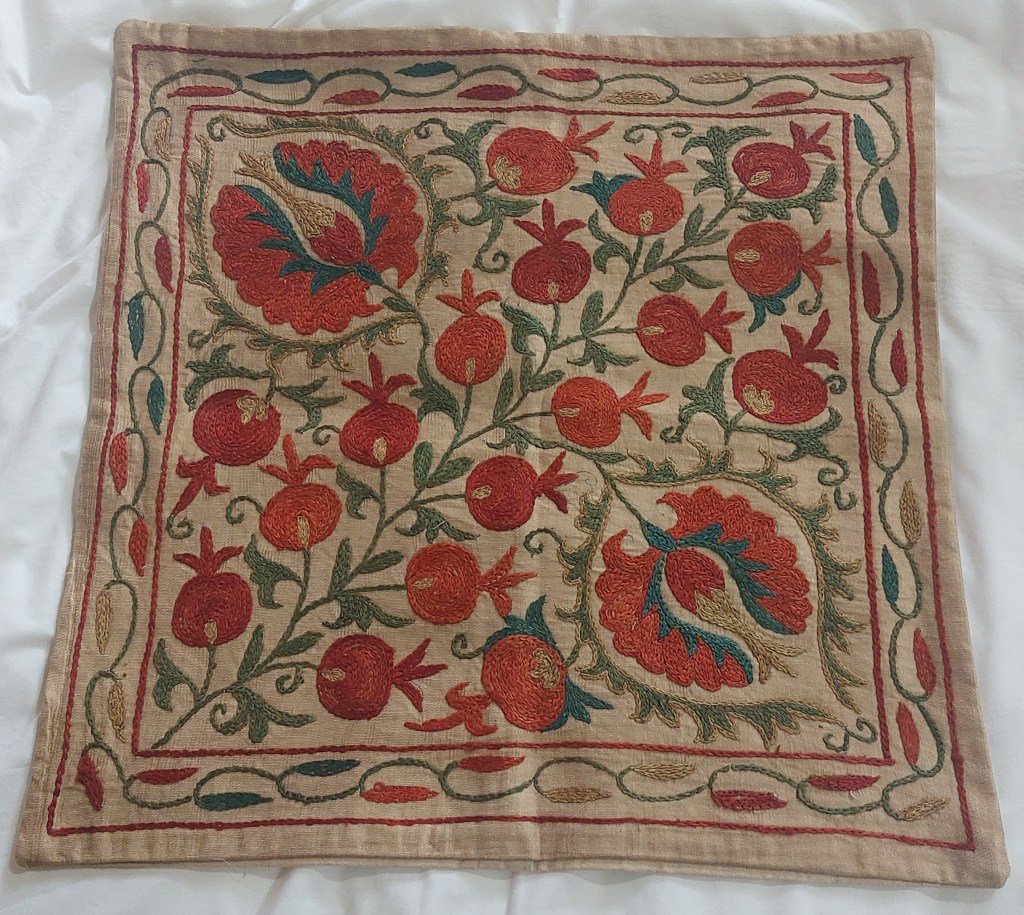
After lunch, we were unleashed in Bukhara for some shopping, and, as I mentioned above, Bukhara has really embraced free trade post the collapse of the USSR. I played with a number of things and have brought a tacky fridge magnet, and also a cushion cover (below) made of cotton with silk thread. You will notice it features pomegranates, which are a very common embroidery design across Central Asia and are a symbol of fertility. If I ever manage to buy a house with a guest room, it shall be going in the spare room where people can choose to leave it on the bed or not…
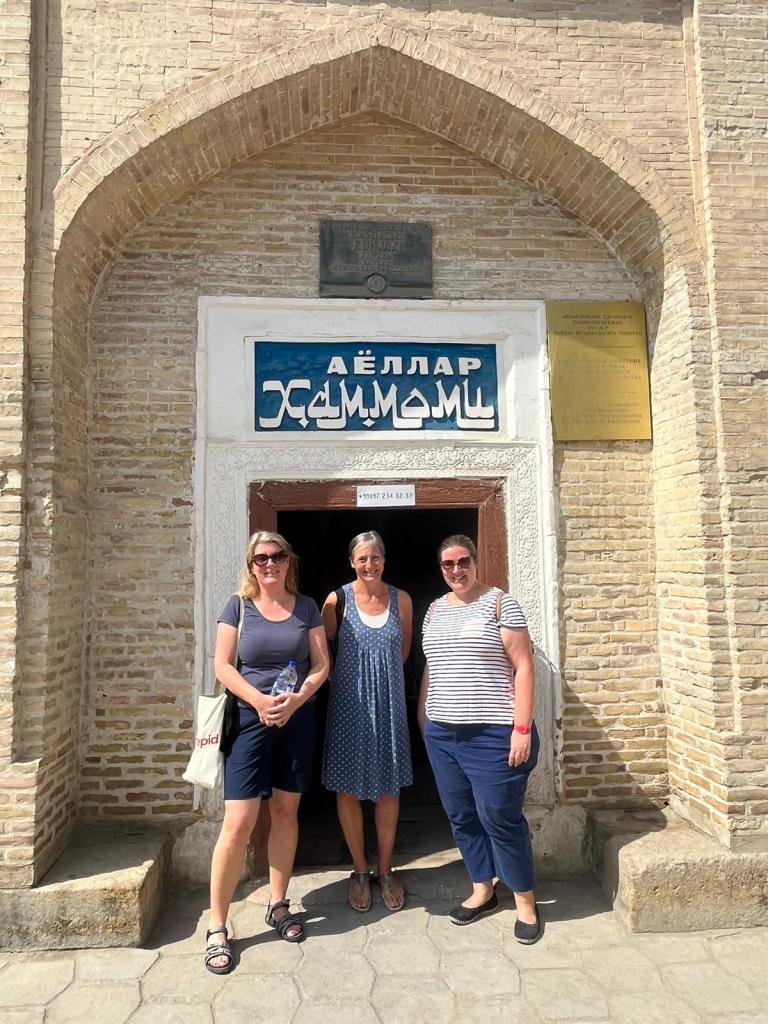
My final activity in Bukhara was a visit to the hamman where I was scrubbed, slucied, and vigorously rubbed (ending with a double smack on the bottom). I am sure I look at least 10 years yonunger (or maybe just slightly pinker?):
Bukhara has a very different feel to Samarkand. It does not have the large impressive sites, but what it has a real feeling of how the city would have looked to travellers on the Silk Road and this is perhaps the first place that I have really got that sense of what it would have been like to travel on the Silk Road. Having seen 2 points of the Triangle of the Orient, I feel that both should be on people’s must see lists. Oh, and the shopping is great


 Travels with Kathryn
Leave a reply to Anonymous Cancel reply