Today, we set off on a 5 hour jouney (by minibus) to Mary. Whilst the roads were not the perfect mirrors of Ashgabat, they were in a far better condition than the road through the desert – I only occasionally had to hang on for dear life whilst the driver speeded along!
Our first stop was at the ruins of the 13th century Saaid Jamaladin mosque:

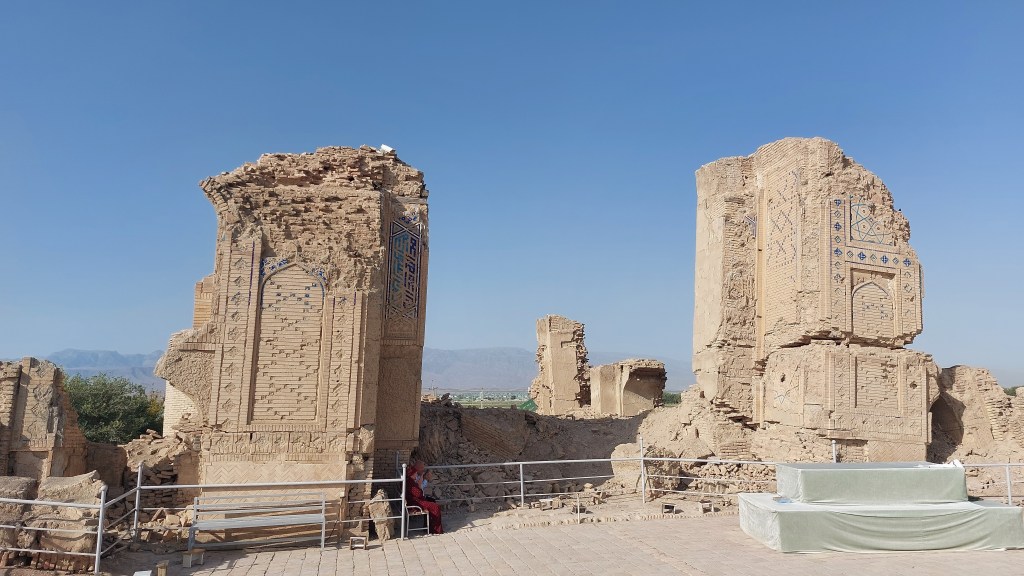
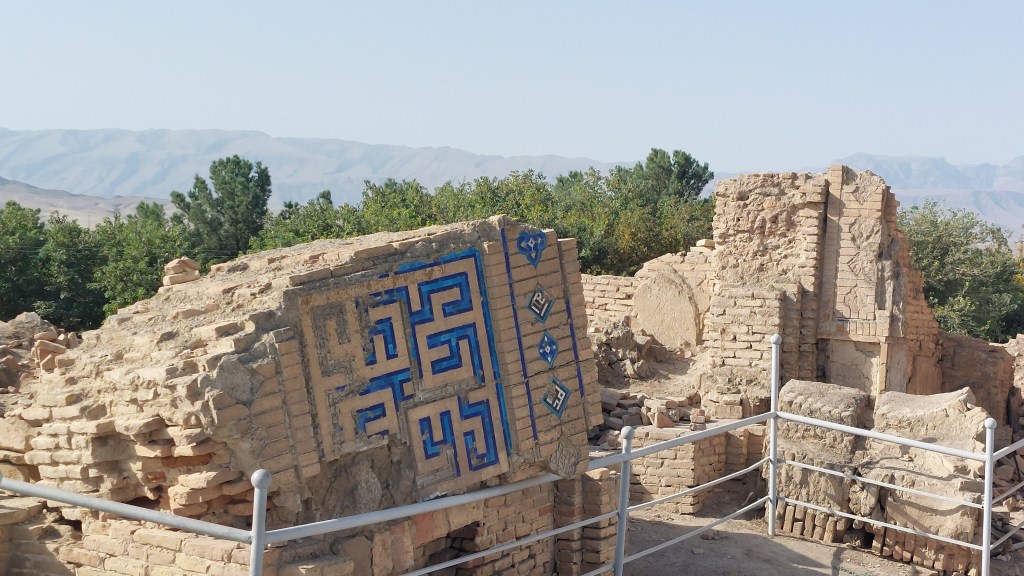
Very little remains of the mosque as what was here was destroyed by the 1948 earthquake. Originally, the entrance to the mosque would have been decorated with 2 dragons. Legend says that these dragons represent the story of a local princess who used to solve the problems of her people. One day, a dragon knocked on the door (as they do) asking for help, and the princess went with the dragon who led her to a second dragon (Mrs Dragon) who was choking on the horns of a goat. The princess pulled out the horns, thus saving Mrs Dragon’s life. In thanks, Mr Dragon shared his treasure with the princess, and she used the treasure to build a mosque. It’s either that, or the architect was Chinese, but that’s a far less fun story! Even though only a ruin remains, this mosque is still visited by local people to make wishes and if your wish comes true, you must return, cook up a big meal (slaughtering a sheep was sugested) and share it. Conviently, a large outdoor kitchen and seating area is just next to the mosque.
This road follows the border with Iran, and we were at one point as close as 8km to the border. If I had been (still) attempting to do this as a land only trip my options from Turkmenistan were either Russia (not a real option) or Iran and I did consider Iran, but in light of current tensions I am somewhat relieved that this is as close as I got.
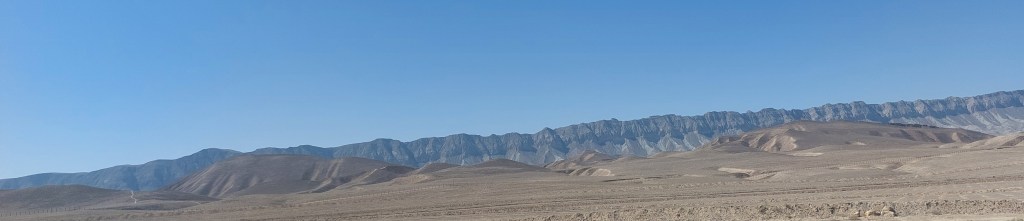
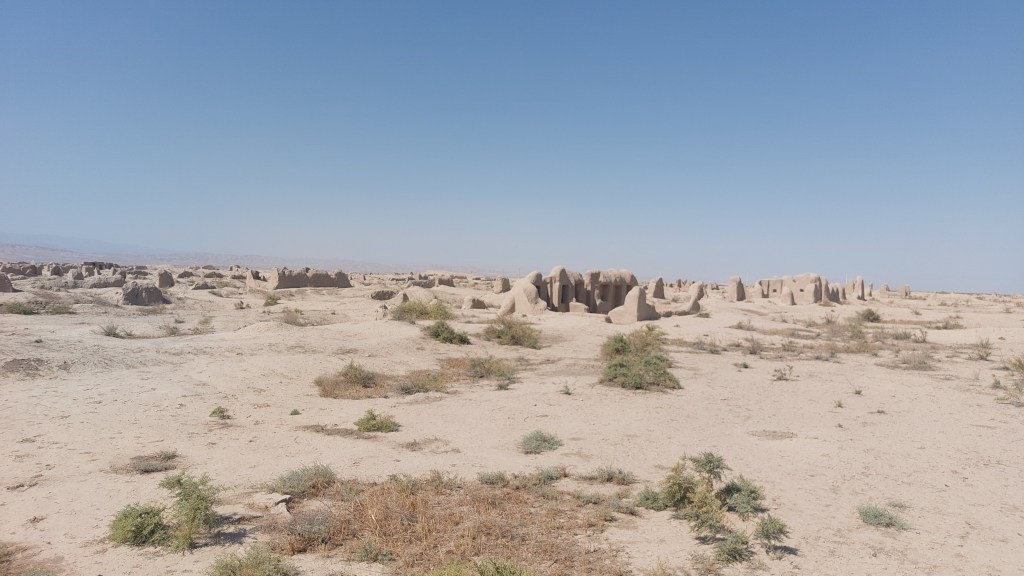
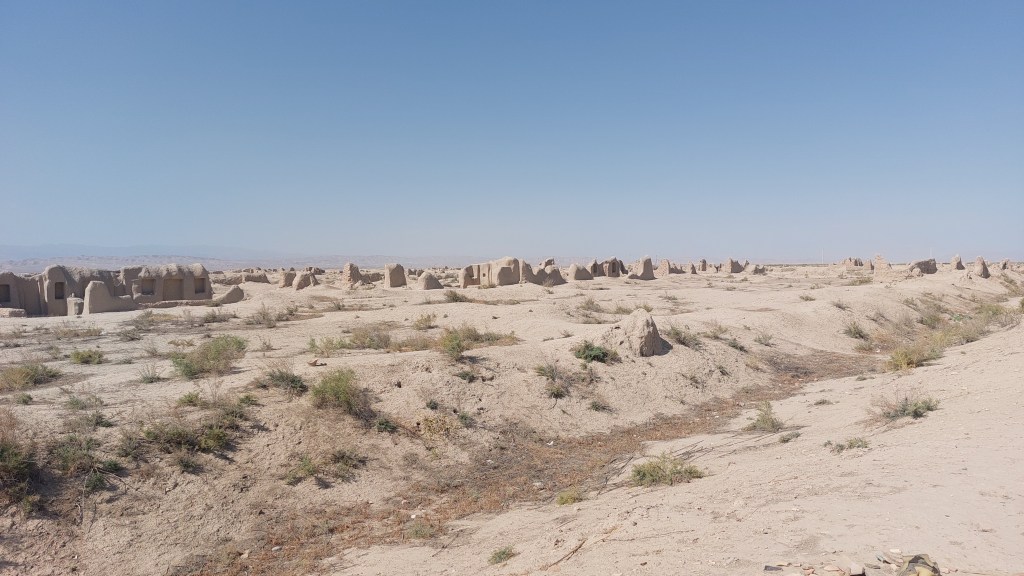
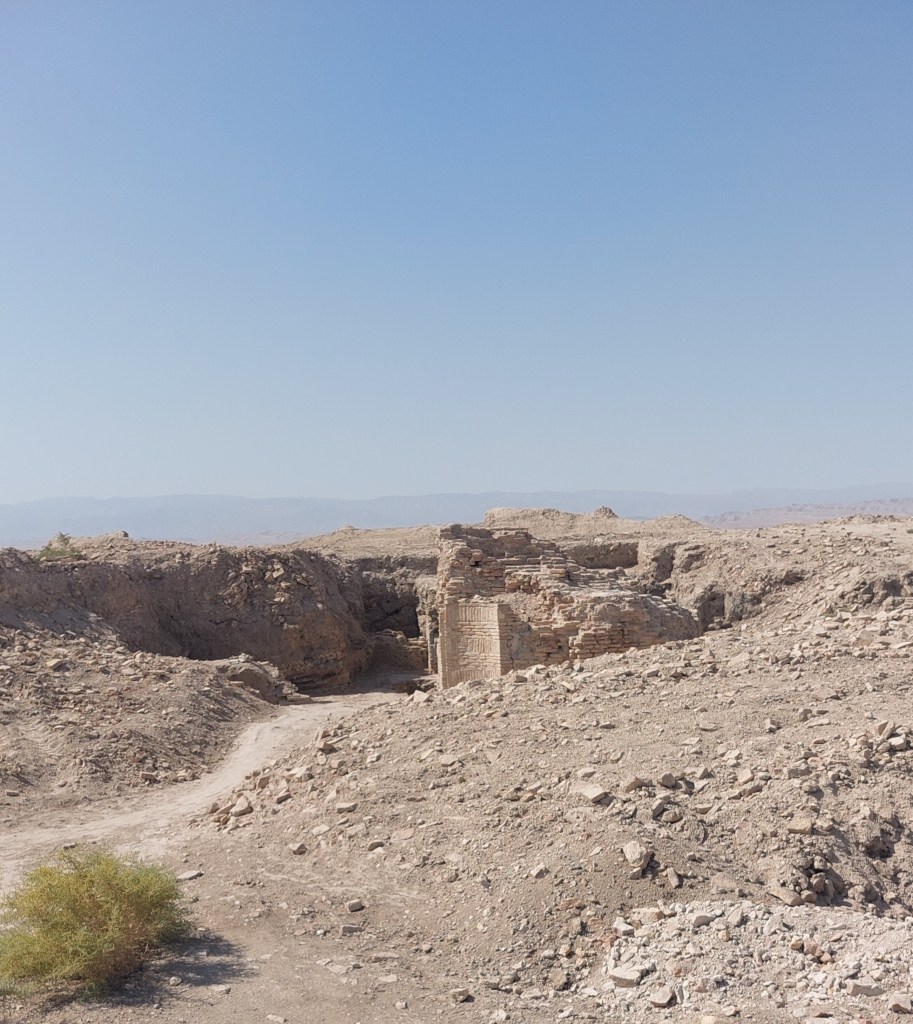
Our next stop was the ruins (ruins have been the general theme of the ancient sites of Turkmenistan) of the 9th century city of Abiwert. This would have been a trading city attracting traders during the Silk Road times on route between Nisa and Merv. The city was destroyed by Gengis Khan and his Hoard and left in ruins, and unlike almost all the other cities we have visited, nothing has been restored. From what is left, we know there was a large fortress containing a bazar, but other than that, you really have to use your imagination.
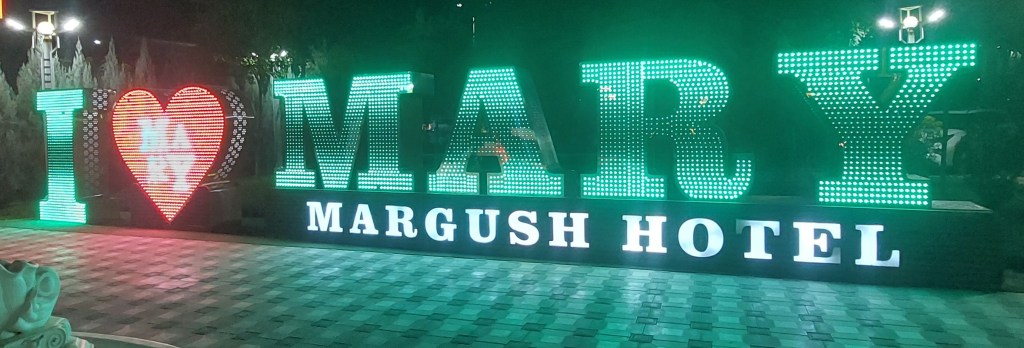
Onwards, along an ever deteriorating road (it seems that the government believes that money is only worth spending in cities!) to Mary. Although Mary does not have the huge grandeur of Ashgabat, there is evidently a wee bit of money here too (apparently its the centre of major cotton growing belt) with the classic white and gold featuring prominently. Our hotel is the only privately owned/operated hotel in the whole of Turkmenistan, the Hotel Mergush, and very nice it was to.
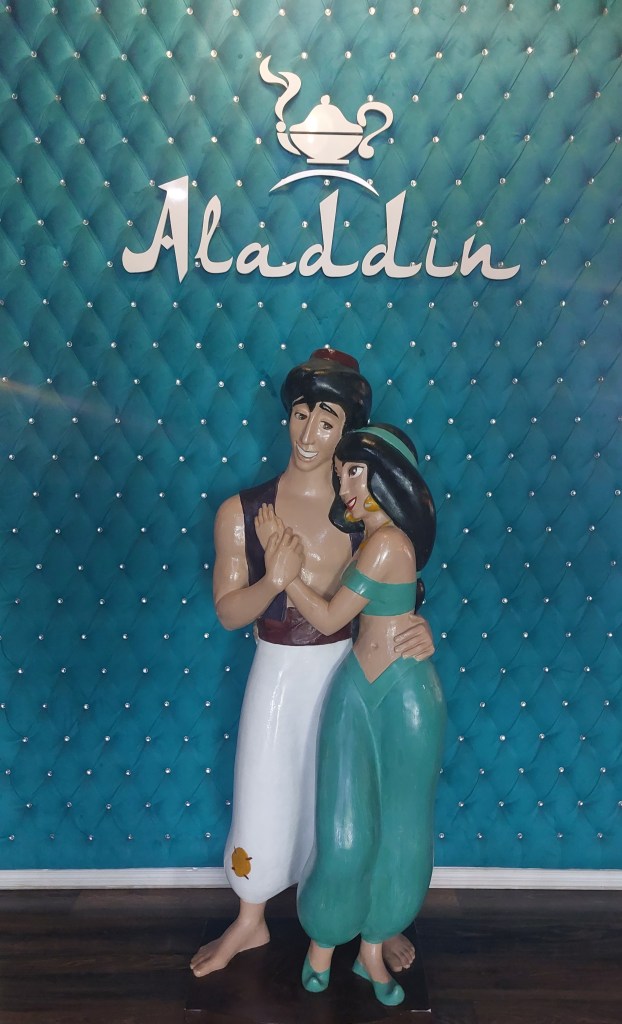
Then, finally, dinner at Aladdins (oh the trademark infringement):
The next morning was our trip to Merv.

In its hey-day, Merv-i-Shahjahan (meaning Merv-Queen of the Would) would have stood alongside Damascus, Baghdad and Cairo as one of the greatest cities of the Islamic World. It was a major centre of religious study and a key city on the Silk Road. Today, however, almost nothing remains so we are going to have to use our imaginations (big time) here.
The city dates back to the 7th century when it was known as Mergeana and was captured by Alexander the Great. Alexander ordered a city to be built here, which was called Alexandria in Mergeana. After the death of Alexander, the city was part of the Selucid empire (Alexander the Great’s empire being divided amounst his generals), and another city was built (Antioch Mergeana). Eventually, the city became part of the Sassanid empire and developed as an important stop on the Silk Road.
During the height of the Silk Road (11/12th century), Merv was at its peak as the captal of the Seljuk empire. It was attacked many times over the years, but instead of building on top of older ruins Merv spread West with a total of 5 cities being built next to each other which gives us the rather sprawling site we have today with the fortress walls of two of these cities remaining. You’ll never guess what destroyed the city in 1221? Yes, it was indeed Gengis Khan and his merry men. Merv suffered the same fate as Nisa when the Seljuk’s killed Gengis Khan’s ambassadors. Big mistake and just 3 year’s later Gengis Khan’s son Tolui arrived at the head of a huge army and after accepting the surrender of the city, then proceeded to kill every inhabitant of the city (an estimated 300,000 people).
Merv, as it stands today, requires substantial imagination. What little survived the Hoard has had no attempts at restoration (unlike Uzbekistan), and in the centuries after Gengis, the people of Turkmenistan became nomadic, and none of these cities were rebuilt. Also, part of the reason that these sites have decayed is because the primary building material of this region is mud and straw walls/bricks, which (even today, i.e., the walls of Khiva) require refreshment every 4-5 years.

We started our tour in a small museum, giving us an overview of the site. I should mention at this point that we collected our “local guide” on route, and this is where we had expected him to perhaps speak to us/acknowledge our presence – but nope. This guide is supplied and paid for by the government, and I suspect to watch our actual guide Ali, who did all the talking. Also, as this guy was probably about 17, I got the distinct impression that someone wanted a Saturday job for their son, which required no actual work. Asking Ali about it later, he said that he does ask not to have them where he can as this is the typical experience. I did quite enjoy that he was made to sit in the back of the bus.
Our first stop was what is believed to be the large house of a merchant dating back to either the 6/7th century (according to Russian archeologists) or 8/9th century (according to American archelogists). It would have originally had 17 rooms spread over 2 floors, so it would have been “well fancy,” but today, all we can see is the outer wall. Restoration work is underway on the interior, but it is not yet open for visitors.
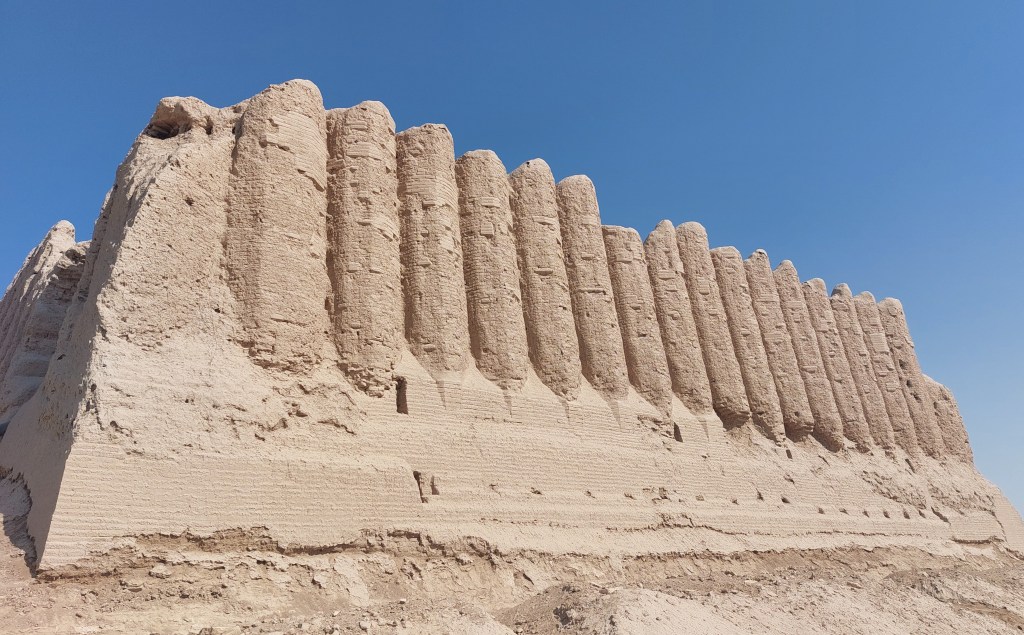
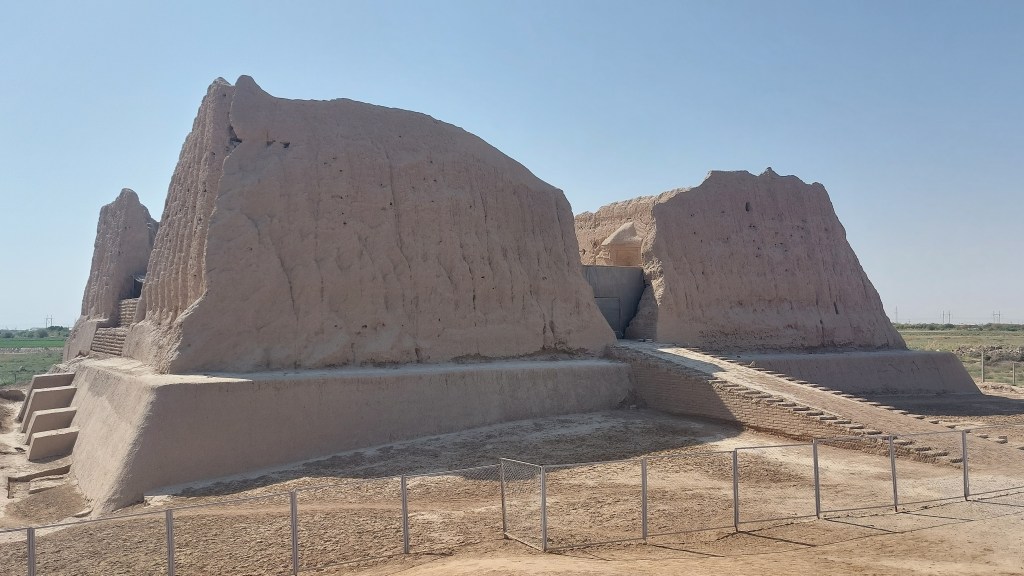
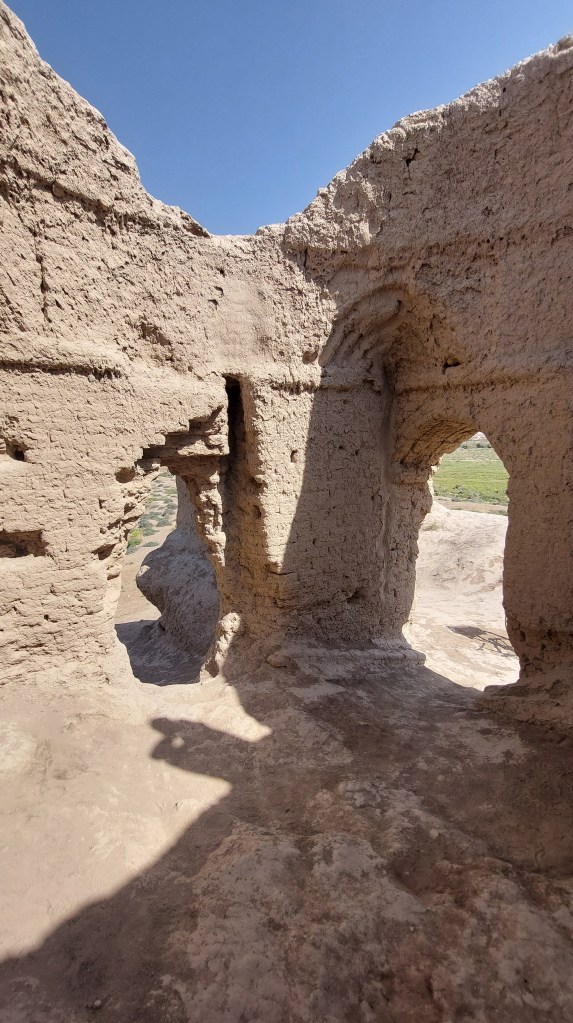
Next to this is another house of the same period with even less remaining, but you can get inside and get a sense of the original windows and decoration. Perhaps more interestingly is that this has evidently become a hangout of local youth (on bicycles) who seemed very interested in us foreigners. They did not want to interact with us, merely to watch us in a performing monkey kind of way due to our rarity and strange behaviours. It is a shame Turkmenistan does not get more tourists (its like they are not encouraged!), but seeing these ancients site as they would have been post-Gengis Khan really puts into perspective the restoration of sites such as Samarkand.
Back in the bus (as the site is so huge and its already baking hot) to stop off just outside the walls of the newer city and to visit the masoleum to a man known as “the Father of Medicine”. Legend has it that when the Mongol Hoard entered the city, he threw his herbs and various medical potions onto the ground where they were absorbed. Local people still visit this site today and pour water into the ground to make mud, spread this mud on an ailing area, and then roll it into a ball leaving it here to thus leave behind their ailment. From what we have seen, Turkmens are not particularly religious, but superstitions continue to be practiced and we saw any number of places where people come to wish for health, happiness, getting pregnant (all the important things).

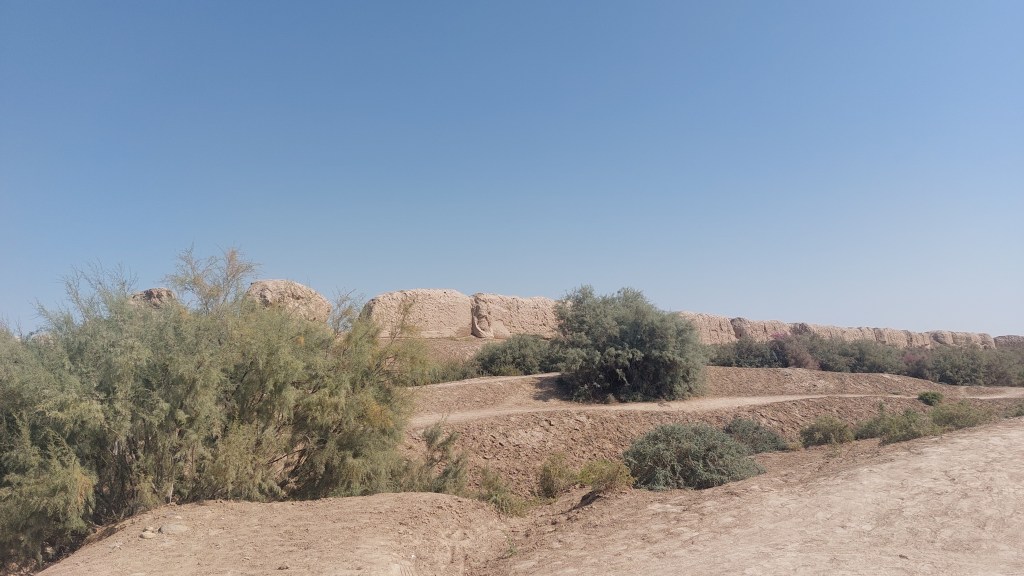
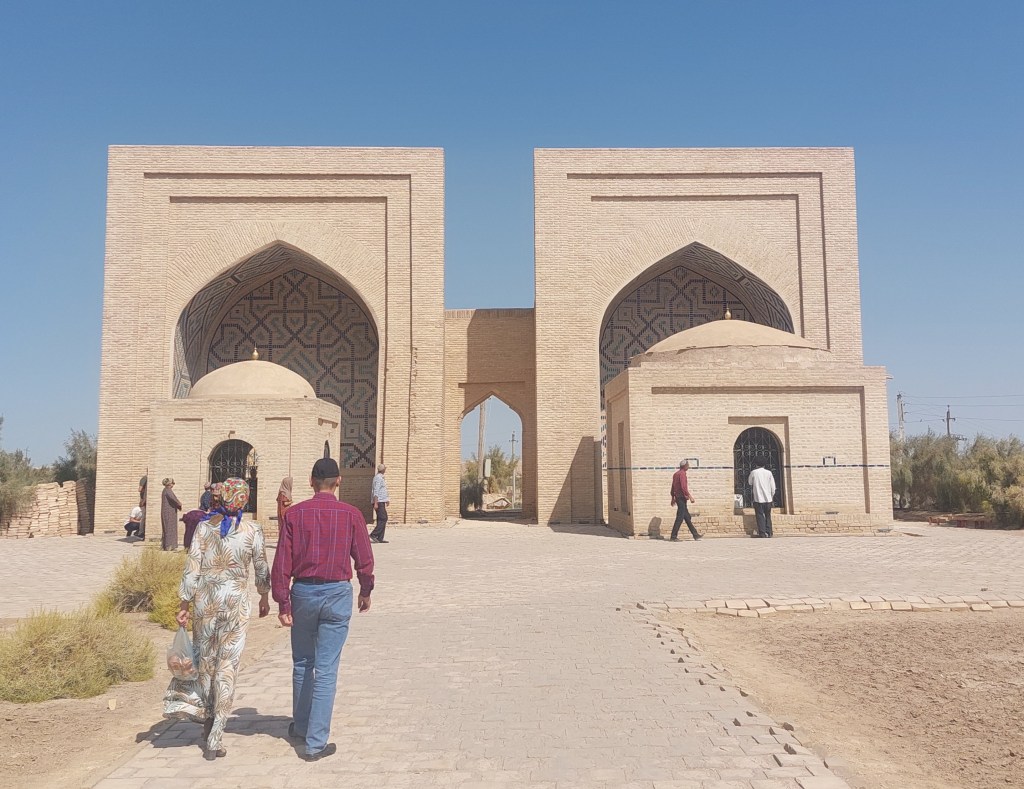
The heart of Merv is the burial complex of the Askhads (two companions of Prophet Muhammad) built during the Timurisd period. Next to this is a large cemetary contaning graves of Turkmen, Arabs, Azerbijanis, and anyone else who would want to be buried here.

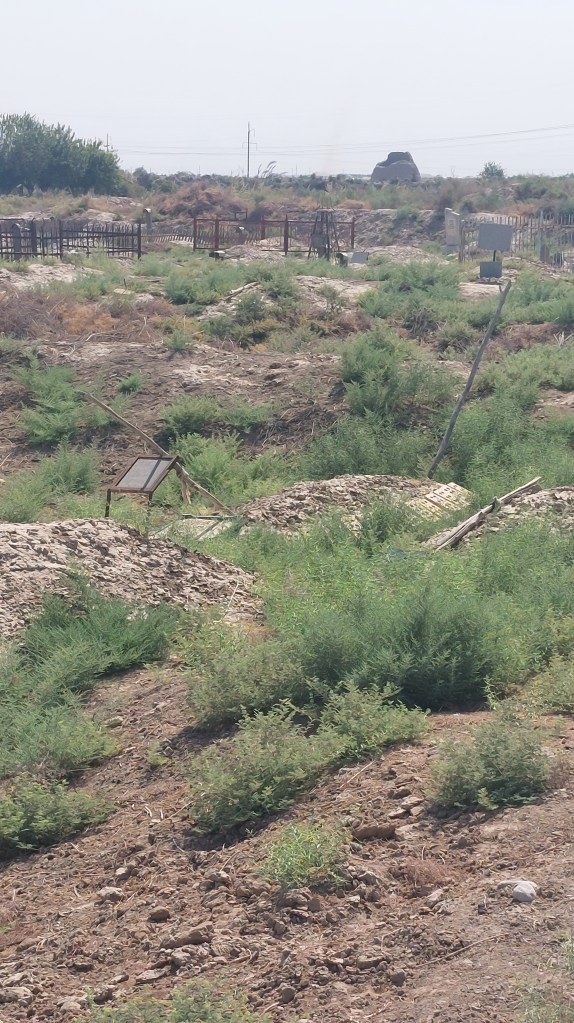
The photo below shows a Turkmen grave. Even today, this is common with no marker, just 2 sticks at each end of the grave. Turkmens believe that we are made from two parts: the body, made from mud and water, which goes back into the earth; and the spirit. After 40 days, the spirit is released, and these sticks point the way of the spirit upwards to heaven. A lovely idea, I thought.
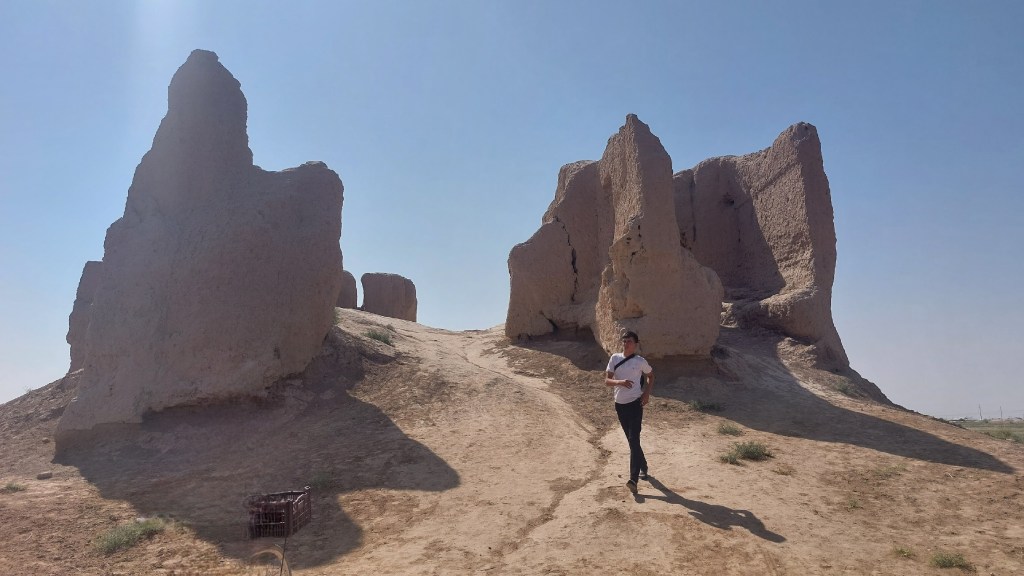
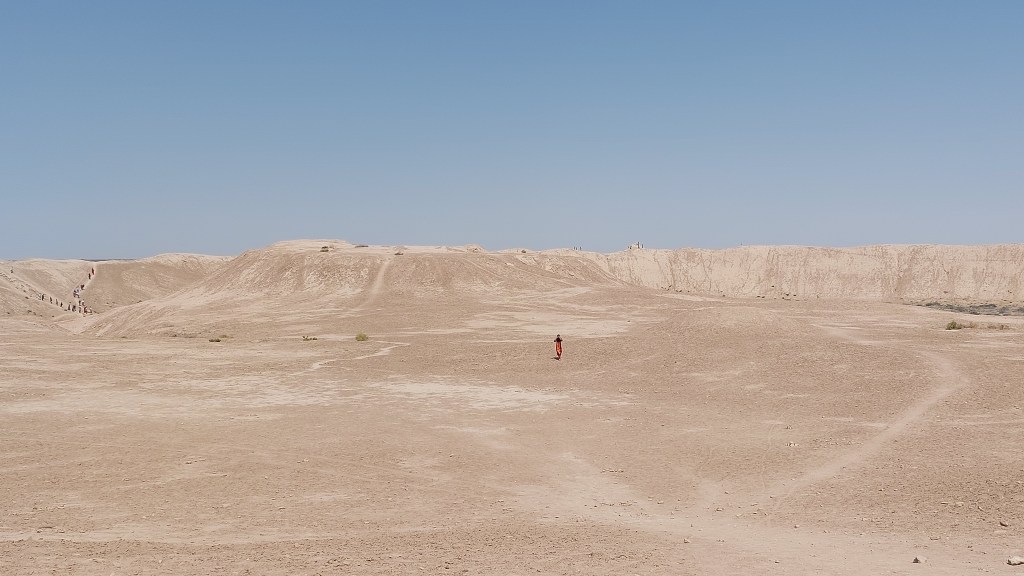
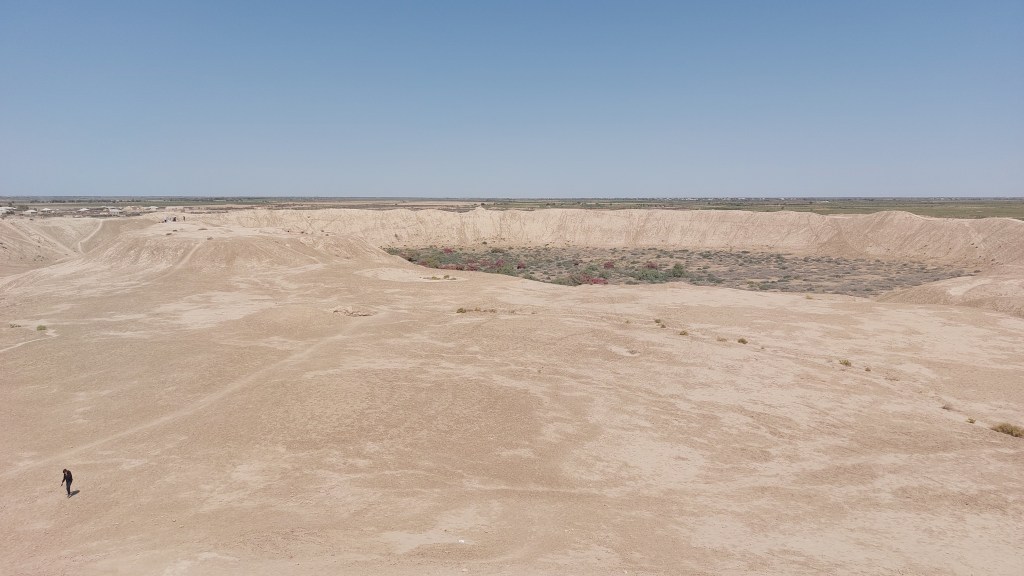
We then climbed up a mountain (just the thing to make a fat girl do at midday in the blistering sun!) to see the remains of the old city fortress. As you can see, all that is left is an impression of the walls (which were originally around 25m high) and the governor’s palace or perhaps barracks. I was struck by a distinct sense of deja vu by comparing it to castle ring at home (a reference for the locals there), just if castle ring was more deserty.
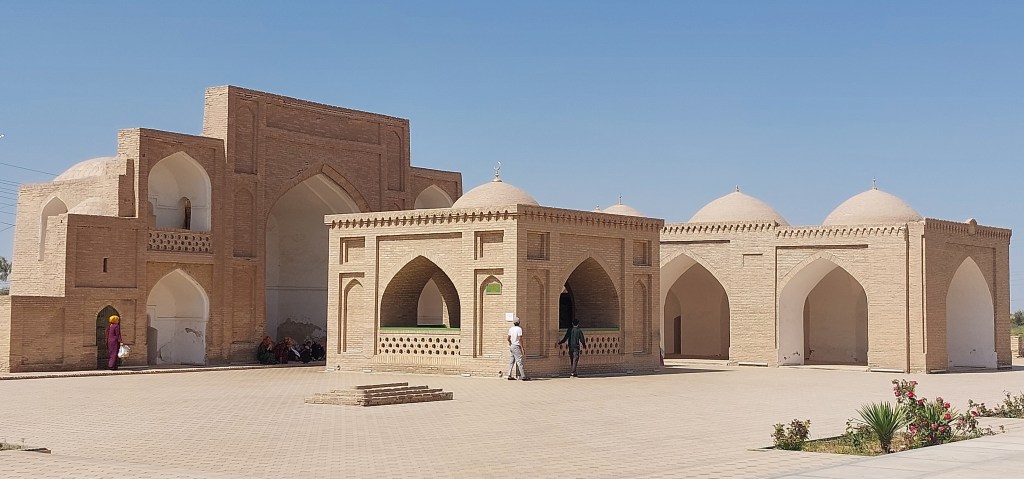
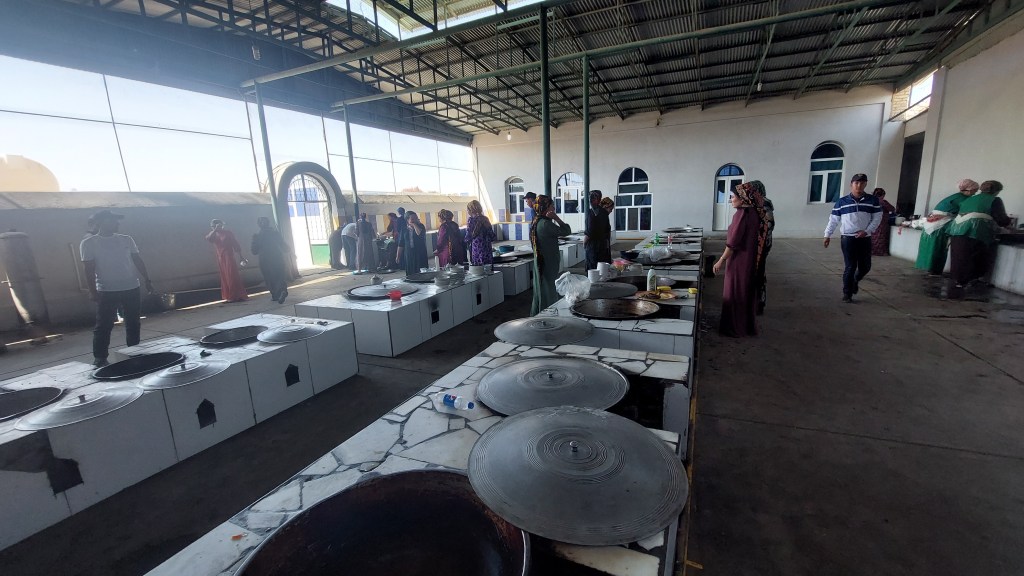
Then, on to the masoleum of Hodja Yusuf Hamadani. He was a teacher in the late 11th/early 12th century, and these buildings have been recenly reconstructed with assistance from Turkey (again). Next to the masoleum is a complex used for the preparation and eating of food. Tradition states that if you have an occasion you are grateful for, or you are hoping something good will happen, or if someone has died and its an anniversary of their death, you come to a complex such as this and make a huge batch of food to share with family and friends. As this masoleum is dedicated to a teacher, a number of groups were giving thanks for children having started university. Disappointingly, no one seemed interested in feeding us (a shame as it all smelt lovely), so on we went.

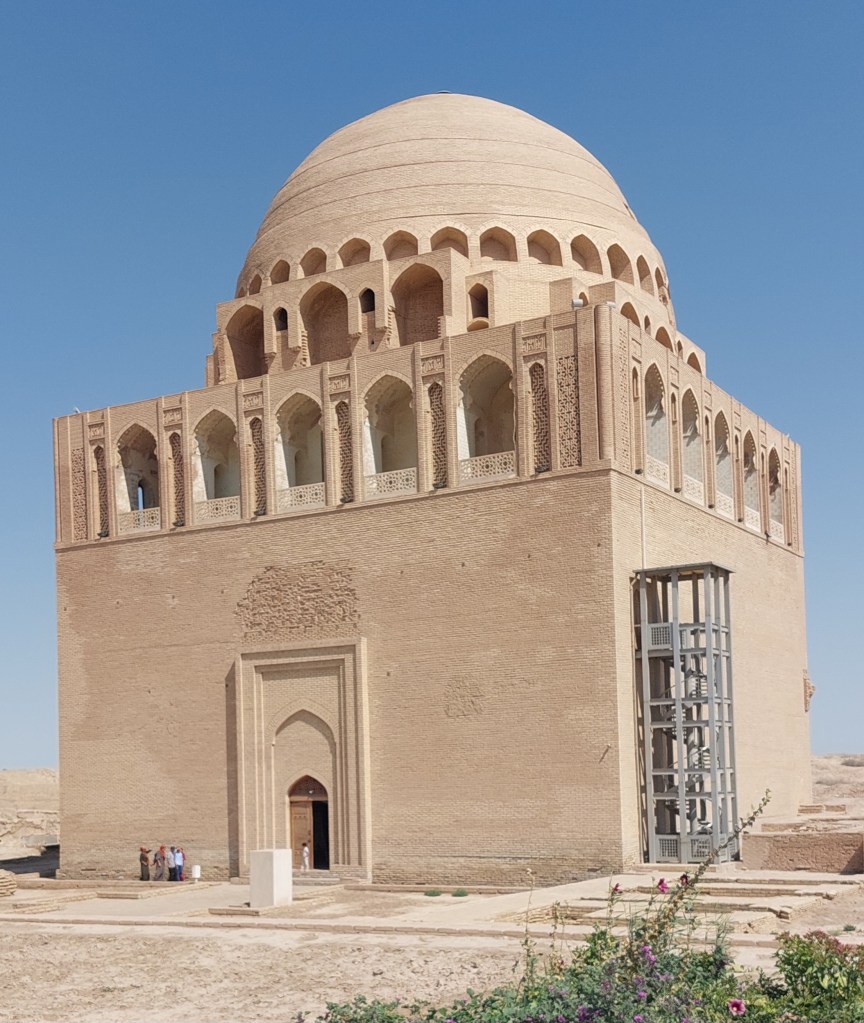
Our final stop was the masoleum of Sultan Sanjar, although his body was removed prior to the arrival of Gengis Khan’s Hoard. Inside (no photos allowed) has been restored (again, with a little help from Turkey), and there is a gap in the side of one of the domes. According to stories, Sultan Sajar married a fairy and on marriage he made 3 promises to her which he broke, so she flew away and this gap was so she could could come back after his death if she ever decided to forgive him. I checked, and there were no fairies in the masoleum that day…
Generally speaking, Turkmen hospitality has not quite been at the same level we have experienced in other places. Quite possibly due to the restrictions of people/ government control and a lack of foreign language skills (or even seeing tourists), 10 minutes here restored my faith in Central Asian hospitality. First, a lady stopped wanting to wish us well on our travels and have a number of photos with us, then a little girl wanted to hold our hands to escourt us into the masolum, and then a wedding party pulled up and we were invited to the wedding! We had to politiely decline (due to our packed schedule), but much photo taking ensued.
So that was Merv. It is hard to believe that this was as key a stop on the Silk Road as Cairo or Khiva, but if one was in any doubt as to the destructiveness of the Mongol Hoard, its here for you to see.
We called into the History Museum of Mary and to be honest, even with me being the history nerd that I am, there was little here of interest that we had not already seen before. My favourite was some of the fun (I suspect Google Translate) English labelling. It gave a hint of English, but it wasn’t actual English.
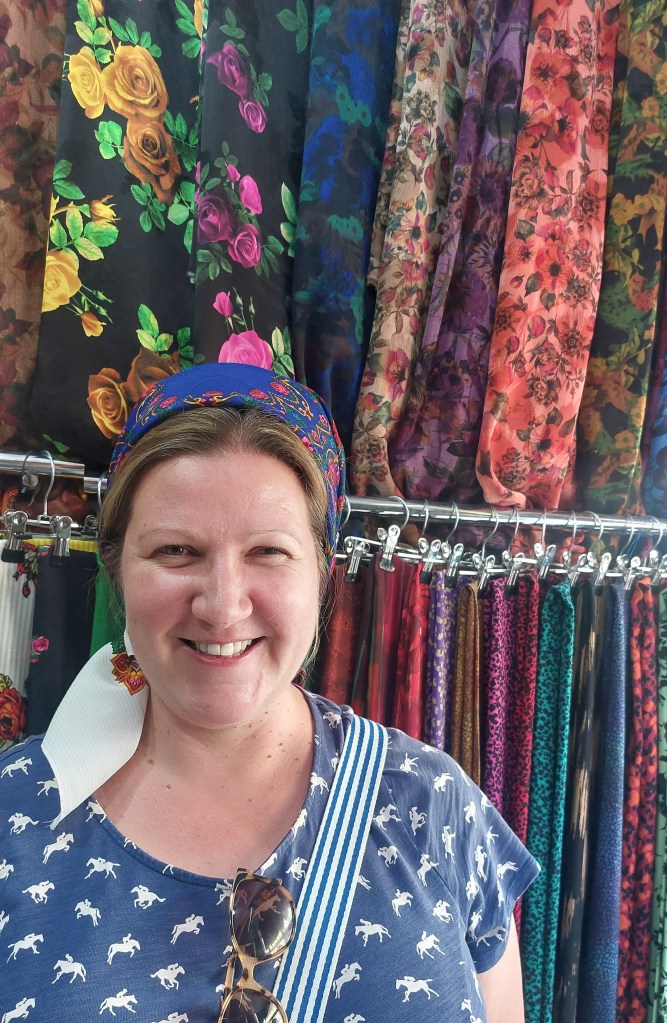
We also visted a local bazaar where I was most disappointed that a pair of pink knickers with “naughty pussy” on them did not come in my size (although not really)! I could not even convince Diane to buy them either, which I suspect she will regret! We did, however, both try on (with much assistance from locals) the traditional headscarf worn by most women here. I am not sure its going to be my new look:
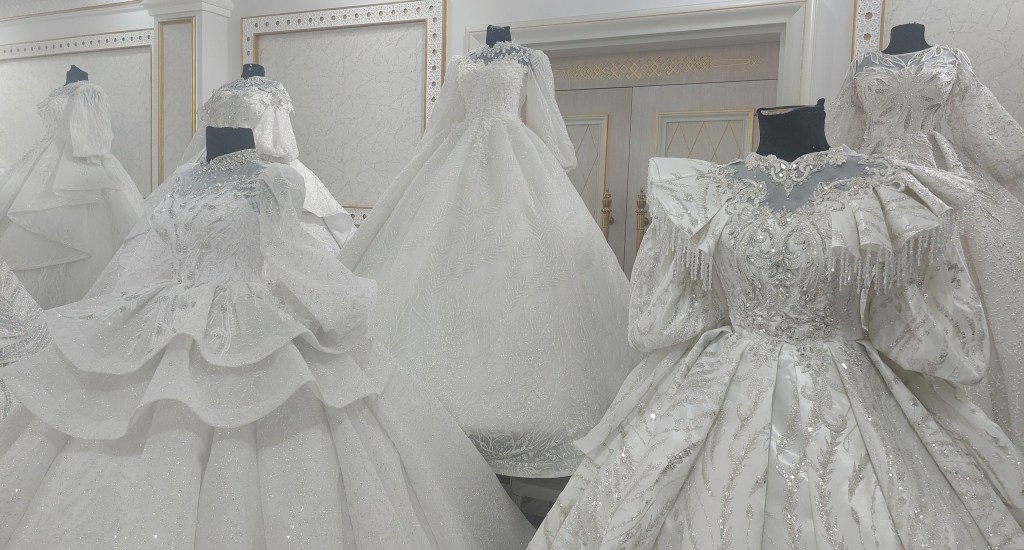
Our final stop the day was the region’s wedding pavillion where we enjoyed a tour of some of the understated wedding dresses (available for rent at just 300 manat a month).
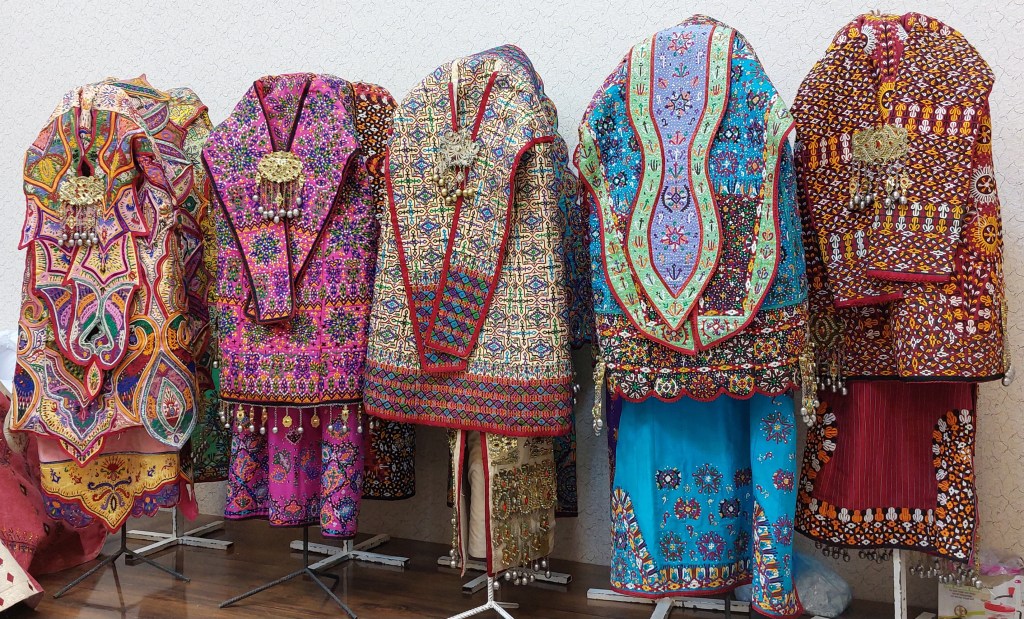
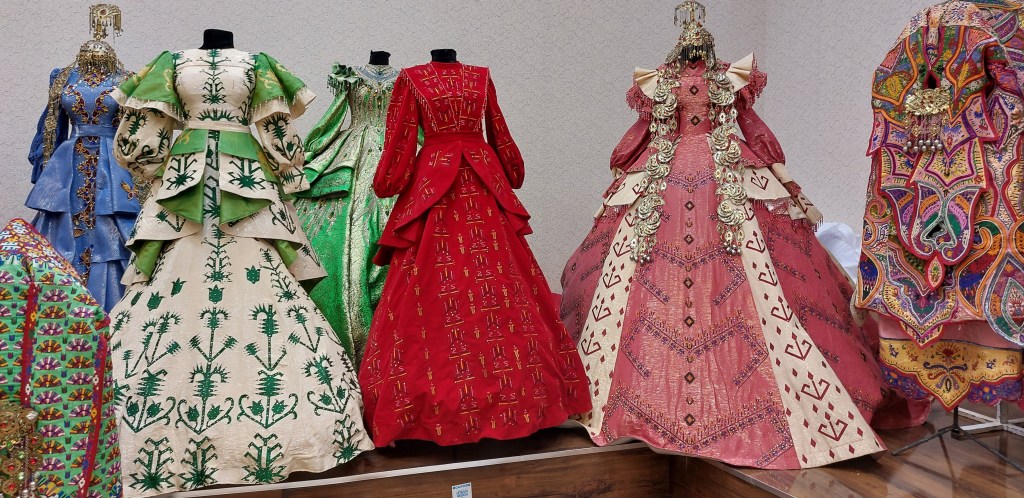

Today has been the last real day of my tour (and stage 1) as tomorrow we are driving back to Ashgabat (and for another attempt at the world’s biggest indoor ferris wheel, so fingers crossed!) to leave Turkmenistan.
2 responses to “Stage 11.13 Merv”
-
Genghis really was a rotter wasn’t he? Love those wedding dresses and shame about the knickers!
LikeLike
-
Or a very successful military campaigner, perhaps? We should probably just be relieved he died young before he had a chance to conquer/flatten Europe!
I can nip back and get you a dress if you want 😉LikeLike
-


 Travels with Kathryn
Leave a comment