As is my want, my plan for my first morning in a new city is to join a walking tour. However, I should start with a comment on the weather – it is absolutely freezing! Yes, the Goose is coming into its own, but today I could have done with mittens and a hat as well…
So, being a history nerd, Sarajevo’s big 20th century “moments” are: (i) the assassination of Archduke Franz Ferdinand (which everyone knows started WW1); (ii) the 1984 Olympics (not that I remember it being 1 month old), but for any ice dance fan, this is a pretty big moment; and (iii) the 1992 to 1995 Bosnian war including the siege of Sarajevo. However, that is just the last century, whereas there is evidence of a settlement around Sarajevo dating back to the Illyrians, but first real records date back to the 10th century where it was part of the Roman Empire. The Romans held the city until the 14th century when we had the first kingdom of Bosnia, who ruled until the Ottomans took over. It was the Ottomans who really turned Sarajevo into a trading city. They also brought hygiene to the city (as ritual washing needed a water system). The Ottomans built the first public bathhouse in 1530, which was followed by the first mosque in 1532. In 1878 Bosnia Herzegovina became part of the Austro-Hungarian Empire under the Treaty of Berlin – this was hugely unpopular as nationalism was already growing and this resulted in the assassination of the Archduke Franz Ferdinand (nephew and heir to the Austro-Hungarian Empire). After WW1, Sarajevo was part of the Kingdom of Serbs, Croats and Slovenes, then WW2, then Yugoslavia, then in 1992 Bosnia Herzegovina became independent. I am going to pause there, as I am going to cover the 1990s in another post…
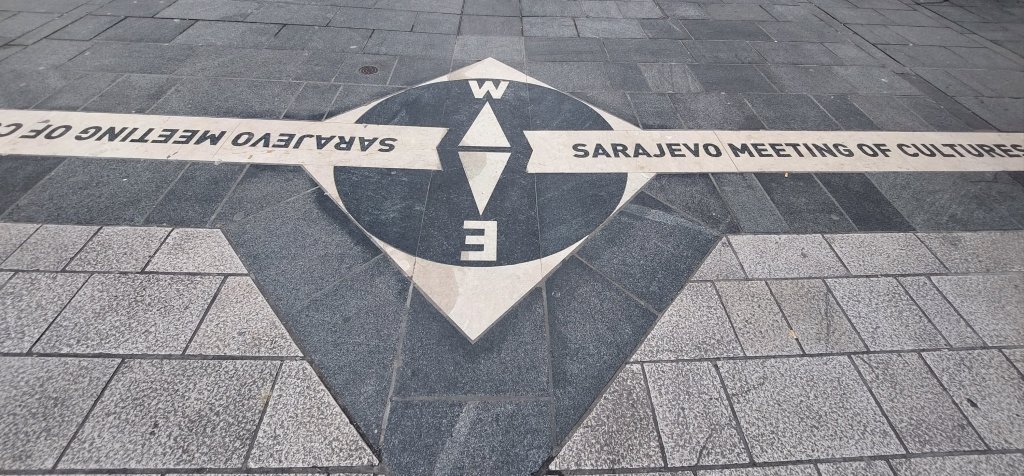
But as you may gather from the above, there are definate Ottoman (16th century) and Austro-Hungarian (19/20th century) influences on the city as well as evidence almost everywhere of its most recent history. This is very much obvious at a crossroads known as “Sarajevo Meeting of Cultures” – looking west, the architecture is all Austro-Hungarian and East, it is all Ottoman, you can stand at this point and hear both the Islam call to prayer, and Christian church bells.
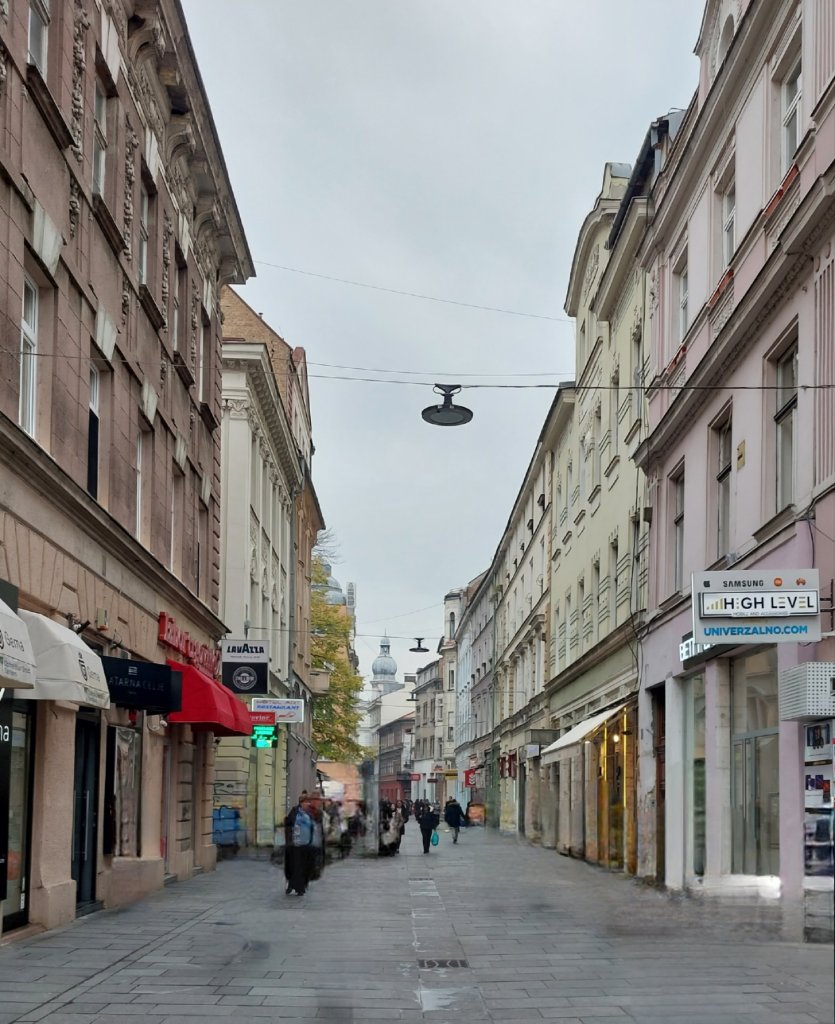
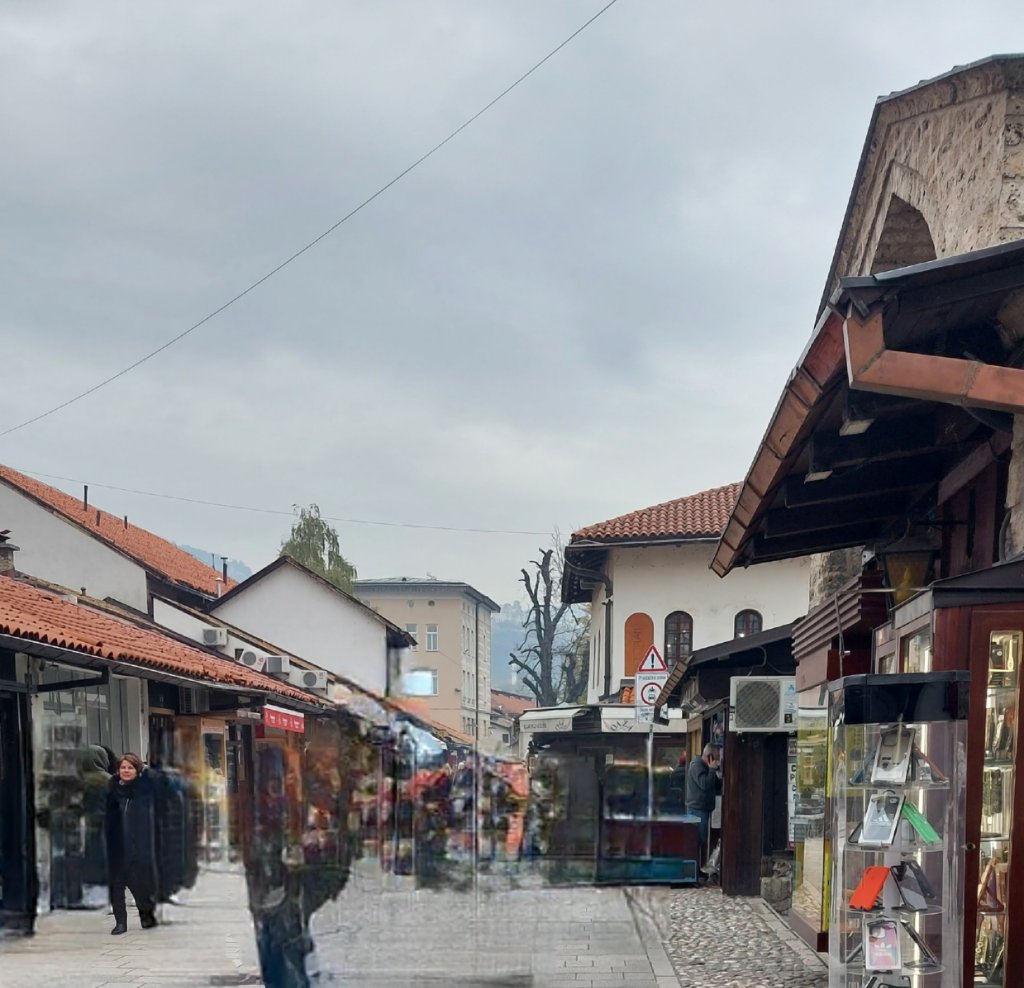
We spent some time walking around the old Ottoman city, including seeing the 1555 silk bazaar (now all tourist shops) and caravanserai (now a coffee shop). It is very obvious that my initial impression of Sarajevo being a “European” city is only true of the outskirts. The Ottoman centre reminds me very strongly of Istanbul – not only in terms of the architecture, but also the shopping options, e.g., hamman towels, baklava, and tourist tat.
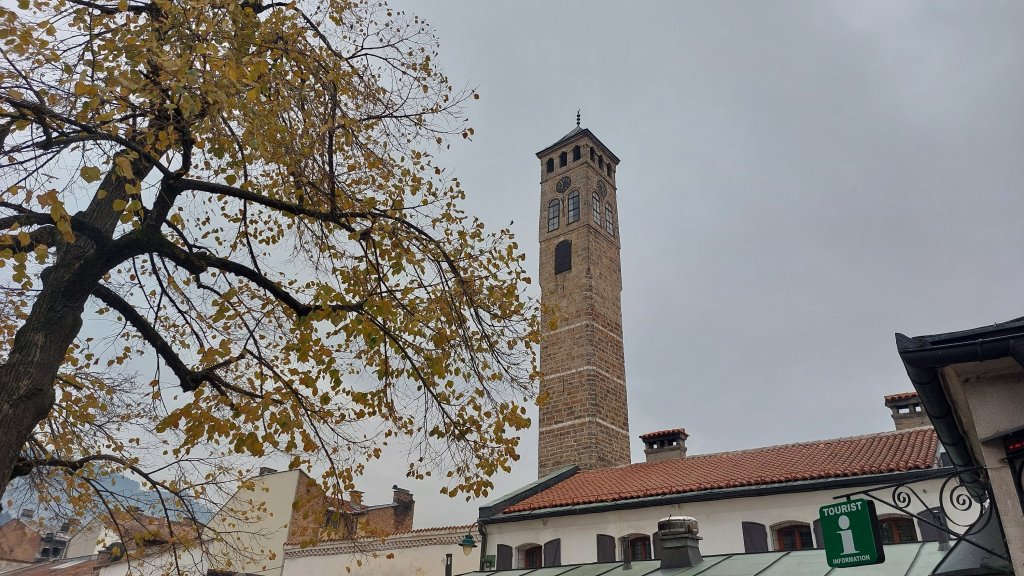
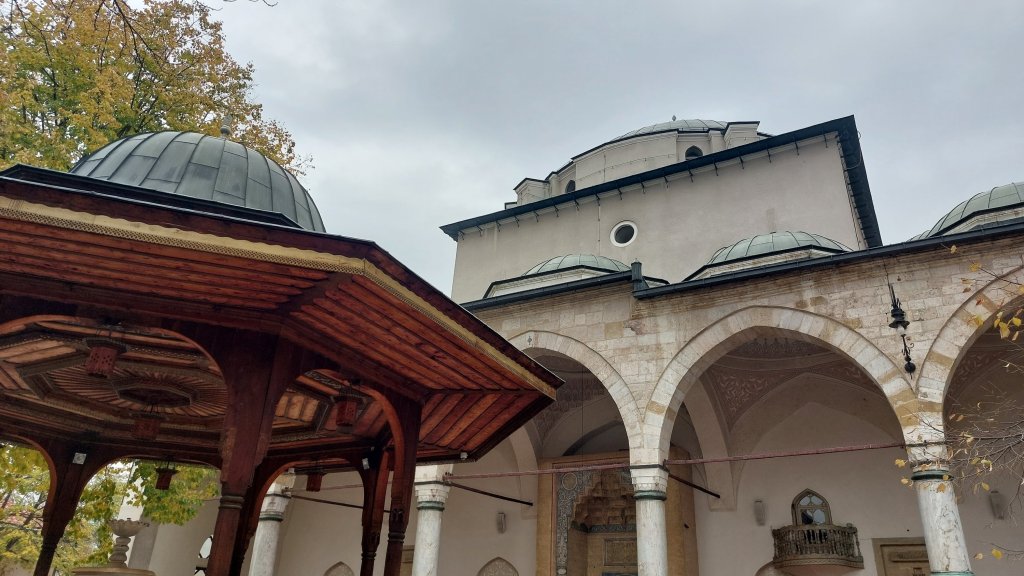
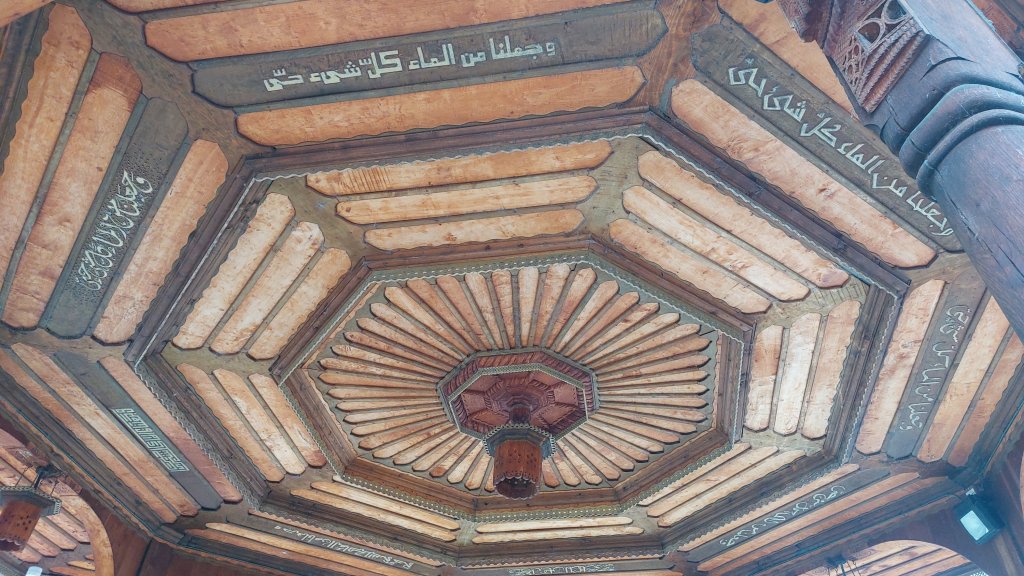

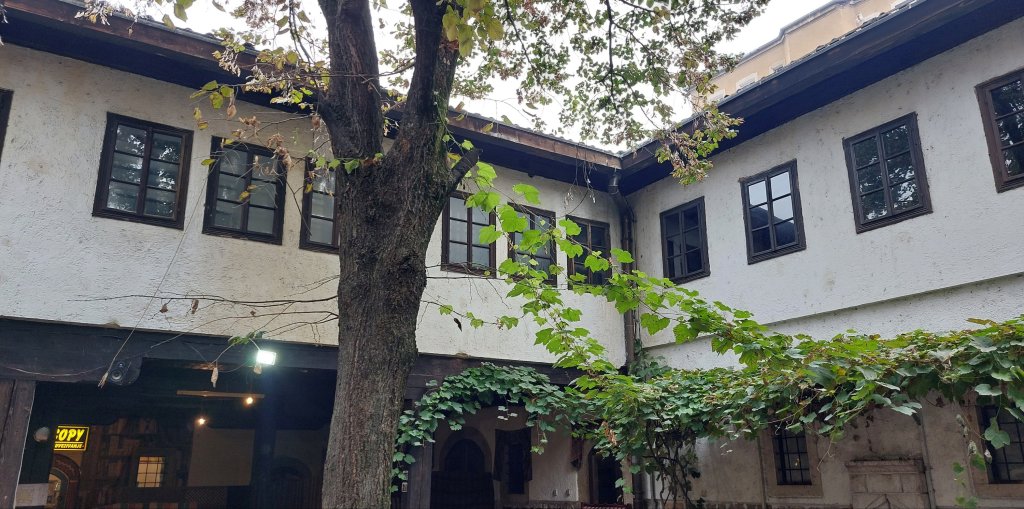
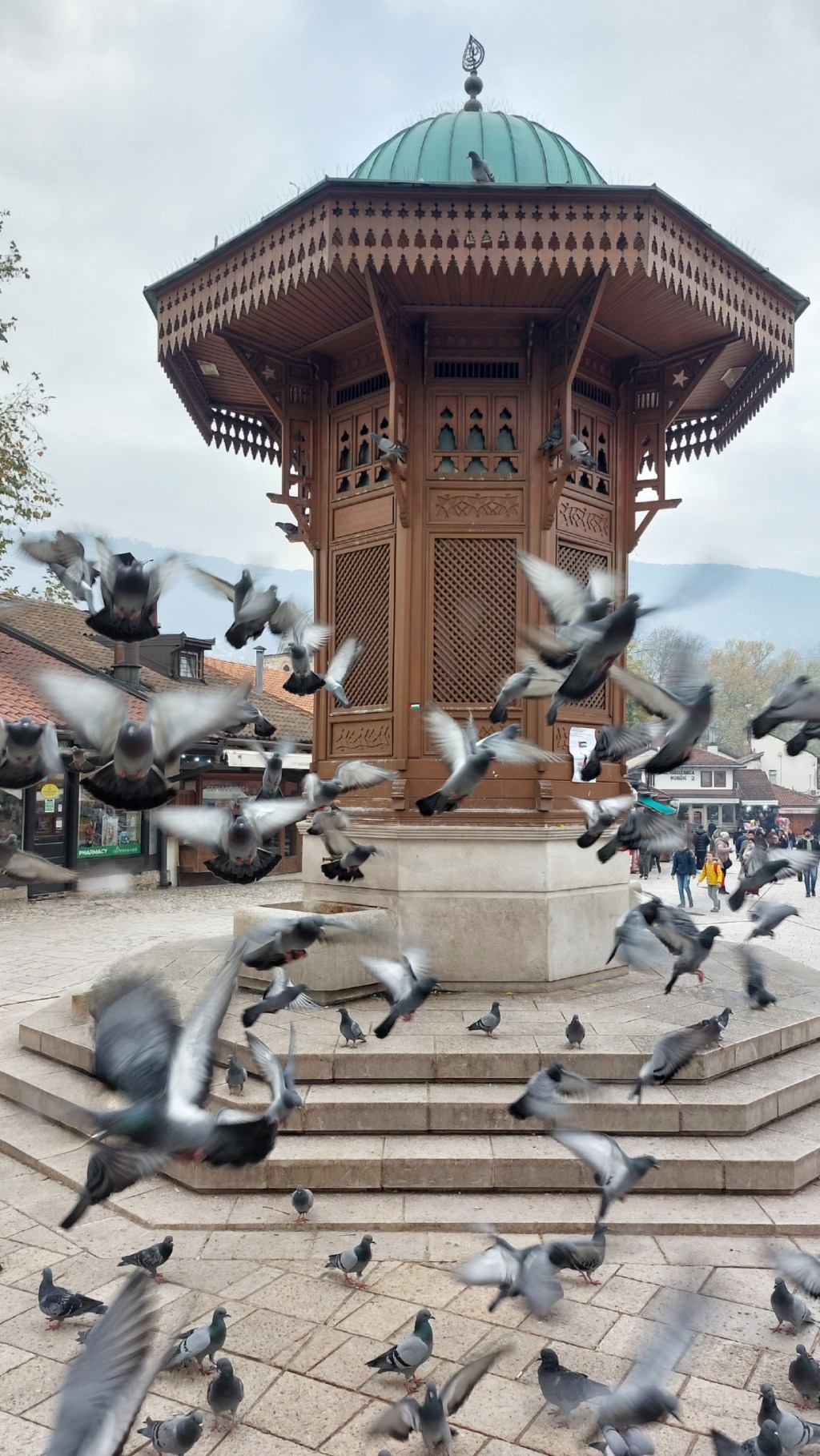
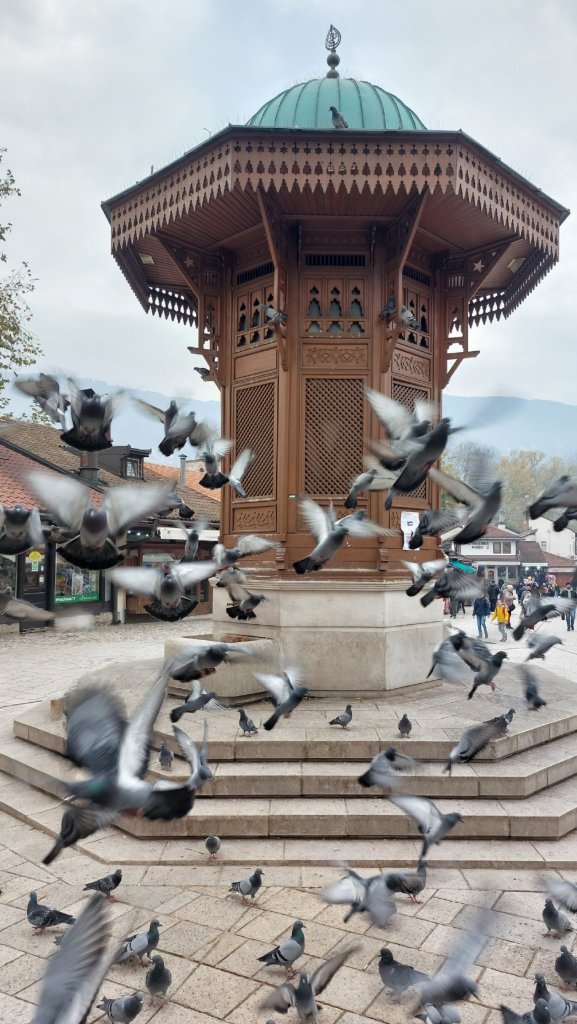
One of the main images of Sarajevo is the Sebilj fountain. This was built in 1913 and, in my opinion, has only become a symbol of Sarajevo as some people (let’s call them crazy tourists), like having their photos taken with pigeons. I saw this in Milan (and my travel companion from that trip may remember my incredulity ), and I do not get it. Pigeons are feral.
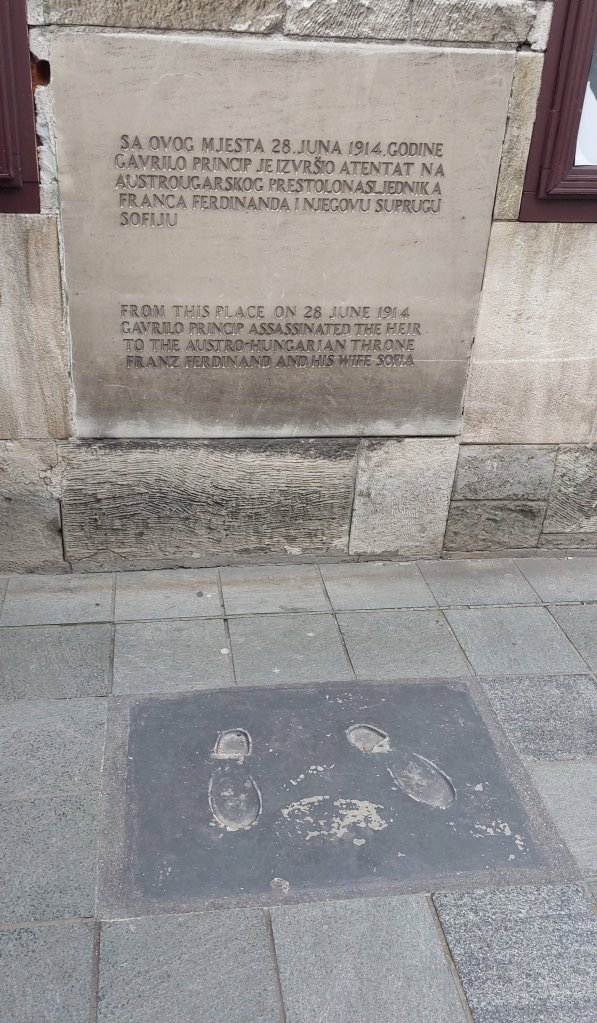
Anyway… I will not go into detail as to the planning of the assassination of Archduke Franz Ferdinand (which was done in Belgrade), but it took place in Sarajevo. However, I should add that the assassin Gavrilo Princip was not actually part of the original planning group. The plan had been to use a bomb. However, the bomb was not successful as it simply bounced off the car roof. Gavrilo Princip who was involved in the Young Bosna movement, and he decided to take matter into his own hands. He fired 2 shots from a short distance and shot Sophie, Duchess of Hohenberg (Mrs Franz Ferdinand) in the side, and Archduke Franz Ferdinad in the neck. One would have thought at this range that he could have been more accurate (as Sophie was considered to be an innocent bystander), but he was immediately arrested and died 4 years later in prison.
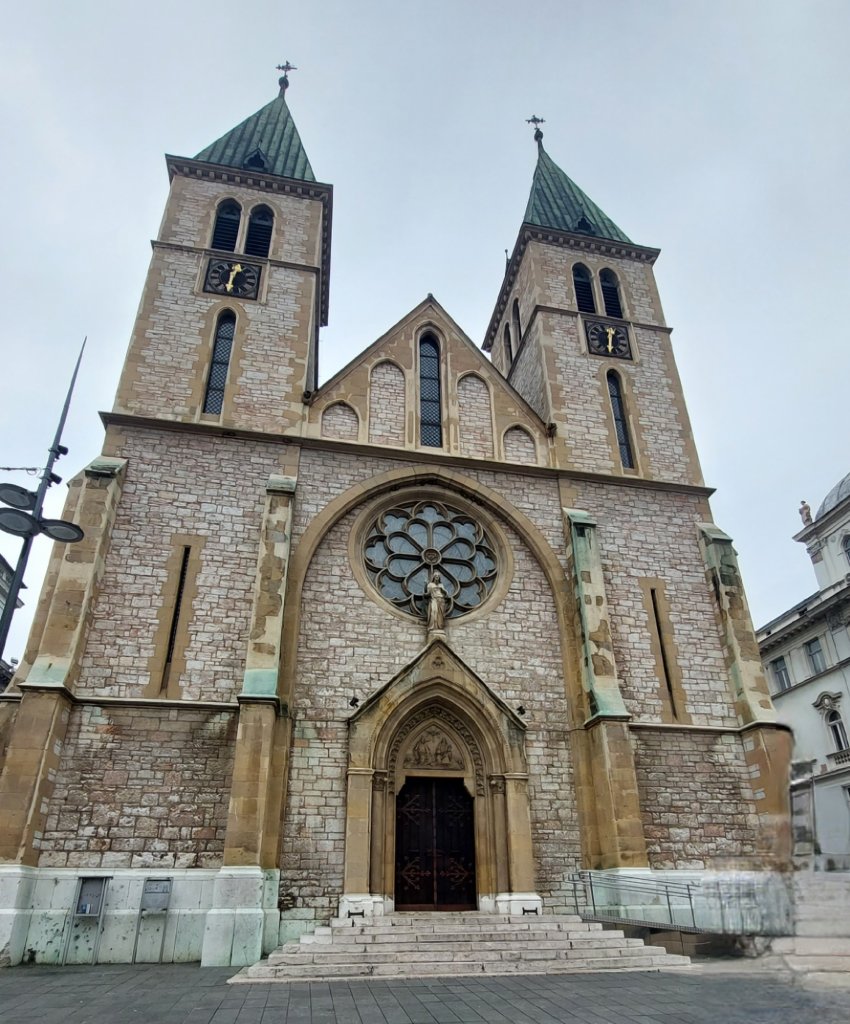
Below are two churches. Both were built during Ottoman times, but due to pressure on the Ottoman sultan (and general weakening of the Ottoman Empire), permission was granted to build churches bigger than mosques.

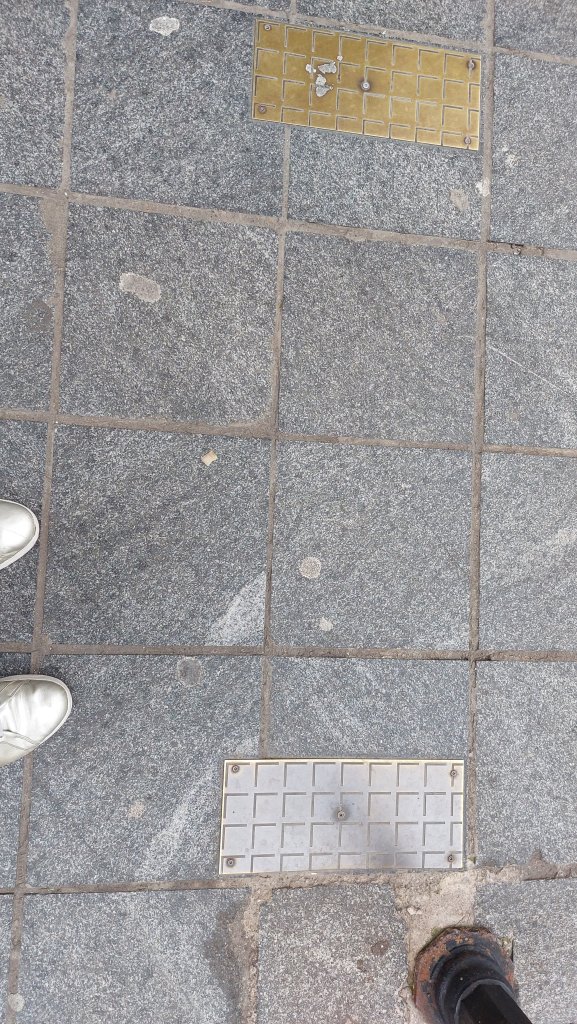
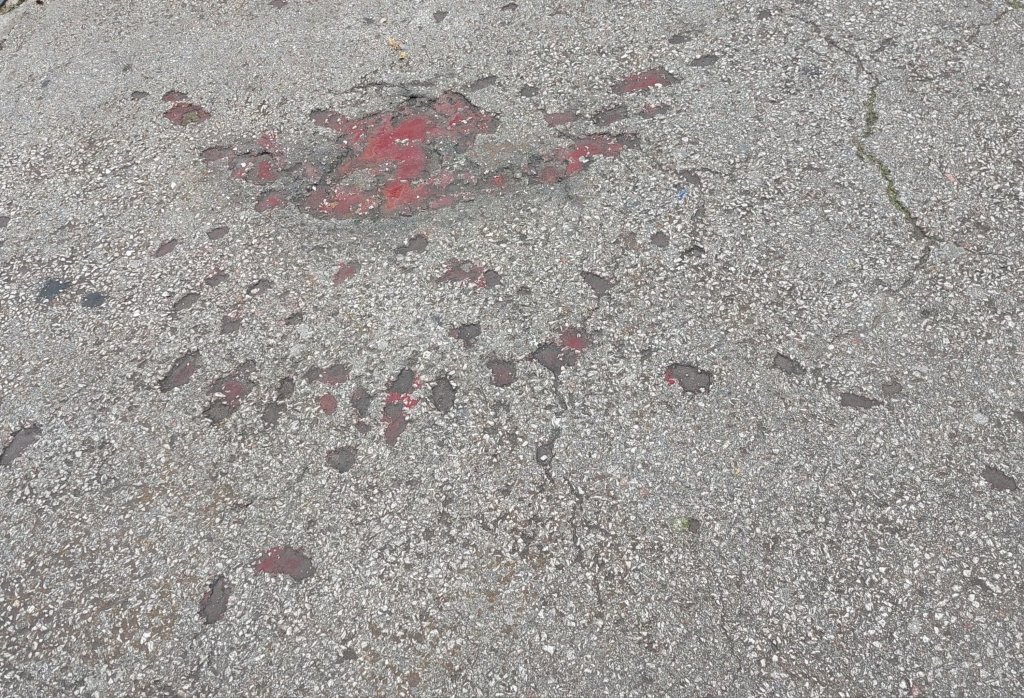
Our final stop was to see one of the roses of Sarajevo. These are locations of shells that were dropped on Sarajevo during the siege where someone died. They don’t look like much, but once you have seen one, you start to see more of them, and it is a frightening reminder of recent history:
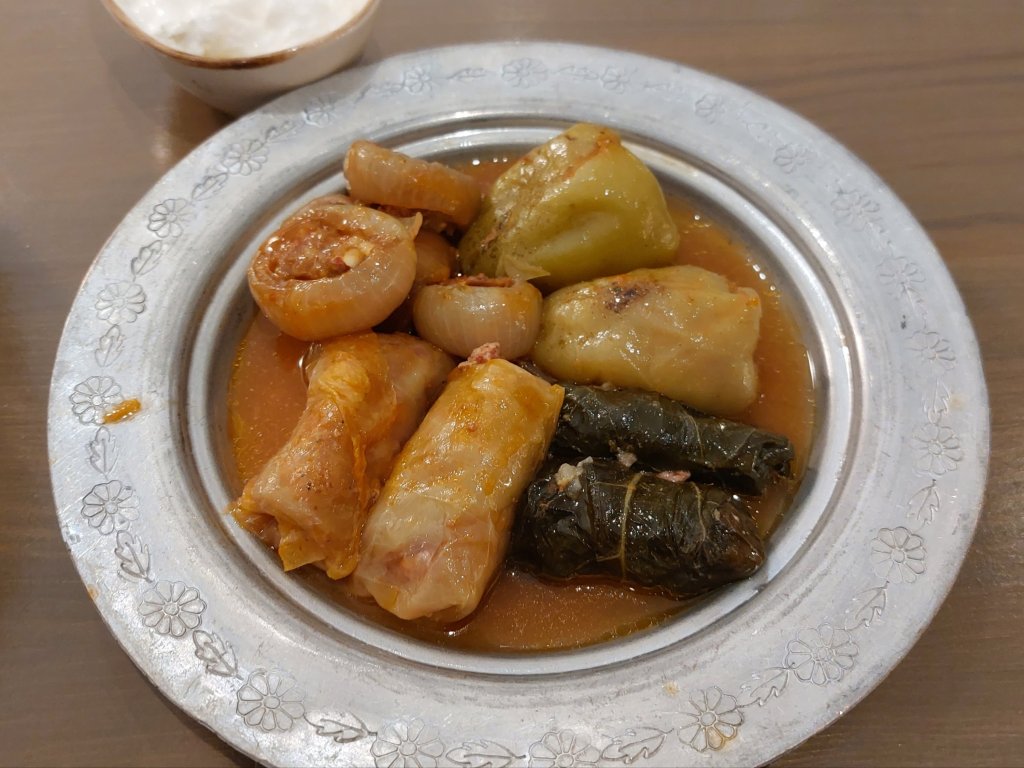
By this point, I was absolutely freezing, so I ducked into a recommended restaurant for food and warmth. I knew I was onto a winner when I had a very old man ahead of me and a policeman behind. I was recommended a selection of stuffed vegetables which may not look much, but were absolutely delicious (and not too salty), particularly the onions stuffed with mince.
I had an amble around the Old Town and headed to the supermarket for supplies (as its forecast to rain all day tomorrow) so I can cook myself something tonight. Tomorrow, I shall be doing indoor activities!
It is now tomorrow, well, today, and as forecast, it is raining heavily. I had a relaxed morning before going to the Museum of Genocide and War Victims 1992-1995. As you may gather from the title, this museum is dedicated to the victims of genocide, concentration camps, and mass killings during this war. Rather than re-hash the history, the museum has personal stories, items as well as items exhumed from mass graves.
The Bosnian war was part of the breakup of Yugoslavia. In 1991, Slovenia and Croatia left, and multi-ethnic Bosnia Herzegovina passed a referendum for independence in 1992. At the time, the country was 44% Muslim Bosniak, 32.5% Orthodox Serb and 17% Catholic Croats. Serb policital leaders boycotted the referendum, rejected its outcome, and adopted its own constitution. Bosnian Serbs, supported by the Yugoslav People’s Army, mobilised inside Bosnia Herzegovina to “secure ethnic Serb territory” and war spread against the country accompanied by ethnic cleansing. The war has been characterised by bitter fighting, indiscrimiate shelling, ethnic cleansing, and mass rapes mainly perpetrated by Serb forces. NATO intervened in 1995, targeting key positions of the Serbian army, including Belgrade. Estimates suggest that over 100,000 were killed during the war, over 2.2 million were displaced, and an estimated 12,000-50,000 were raped.
The museum is incredibly moving and more so because I remember seeing footage on the television – this is recent history. What really got to me were stories of girls who were the same age of me at the time, being forced to convert to Christianity and “sold” to their rapists. For the children who got to remain children, receiving war child Christmas boxes of toys that they had never seen of, but I had at home.
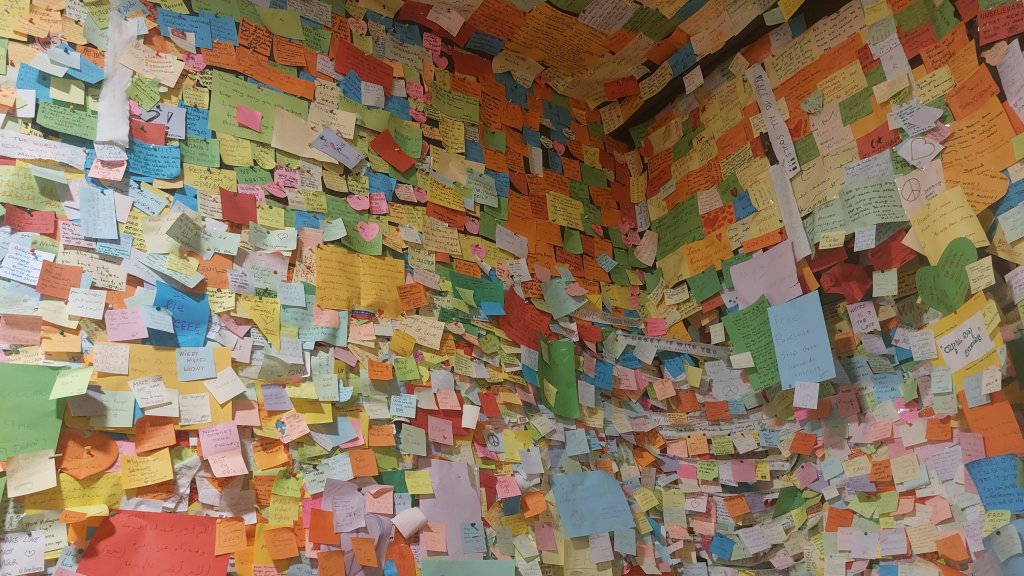
On leaving the museum, I had a reflective walk and have now returned to my AirBnB to do more background reading before my trip to Mostar tomorrow (and pack a bad of waterproof garments).
PS: This is post number 50. Thank you to everyone who is still with me!


 Travels with Kathryn
Leave a reply to dilymy Cancel reply