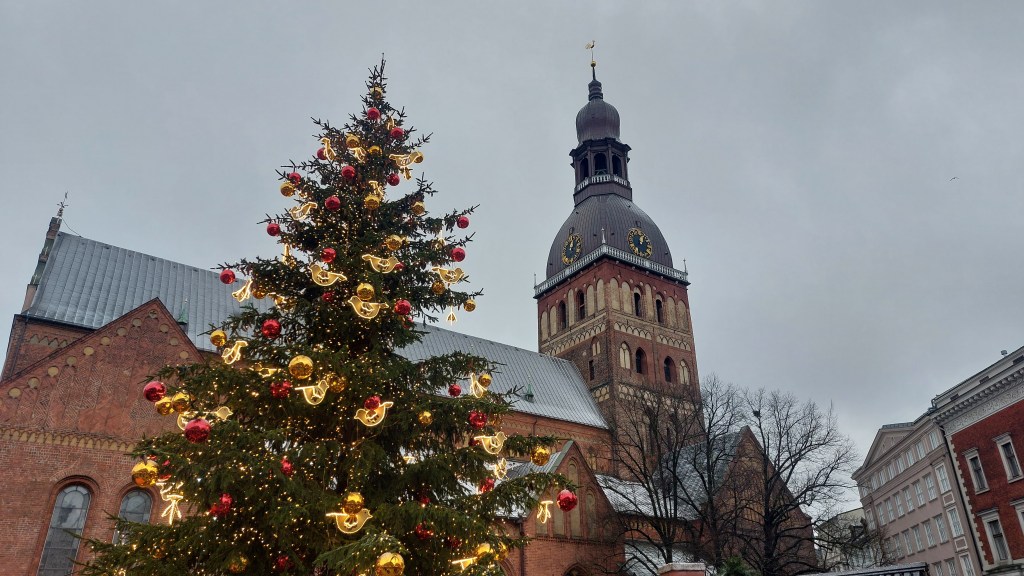
It may be New Year’s Eve, but this shall not hold me back from my touristing! I started my morning with an amble into town to meet up with my walking tour. However, I was hit with unforecasted snow. Whilst snow is, of course, very pretty, I was not wearing my hat and looked like a foolish tourist who had not been Baltic trained. I shall not make the same mistake this year…
I shall begin, like all good walking tours, with a little (or having re-read this paragraph, rather a big) history. So, there has been a Finnic settlement here since the 2nd century as the river Daugava was a trade route used by the vikings through to Byzantium. Riga begn to develop as a centre of viking trade in the Middle Ages, and in 1158 German traders began to settle in a nearby outpost who brought christianity with them and in 1201 the city was taken over by Bishop Albert/Livonia and started to fortify the town. In 1207, Bishop Albert obtained a papl bull, which decreed that all German merchants had to carry their Baltic trade through Riga, which helped the city to prosper and gain strength. In 1221, the merchants acquired rights to independently self-administer, and they adopted a constitution. German dominance over Riga would continue for many centuries, starting with becoming a member of the Hanseatic League. Even when the city was conquered by Sweden (in 1625) and then Russian (in 1710), Riga remaineained autonomous. However, despite these changes in power and demographics, the Batic Germans retained a dominant position with 43% of the population in the 19th century being German and German being used as the official language of administration. During the mid-19th the city boomed with rapid industrialisation and became the largest exporter of timber in the Russian Empire. During WW1 and with the demise of the Russian Empire, the city fell to Germany before a brief period of independence. After WW1 the Baltic Germans (many of whom were n generation Latvian and had never been to Germany) were given the option of “returning” to Germany and by 1939 many were resettled in taken Polish territory. During WW2, Riga was first occupied by Soviet Russia, and then Nazi Germany (who killed most of Riga’s jewish population in 1941 at the Rumbula massacre) and heavily bombed. After the wa, Riga became part of the USS, and Stalin deported around 16,000 peopl, including the remaining jews, German, and 20% of the previous Lavian governmen, and the percentage of Latvians living in Riga fell to 36%. Riga gained independence in 1990 with a population of around 1 million people. And breathe…
We began our tour of the Old Town with streets that would have been part of the warehouse district. This was the lifeblood of Riga for many centuries, but around the beginning of the 20th century, industry began to decline, as well as ongoing political problems (see above, i.e., Russian revolution). Many people started to emigrate, and in the early part of the century, there were direct boats from Riga to New York. Much of what is left today has either been substantially reconstructed or managed to escape pre-WW2 desires for bigger streets/spaces for gatherings and Allied bombings.
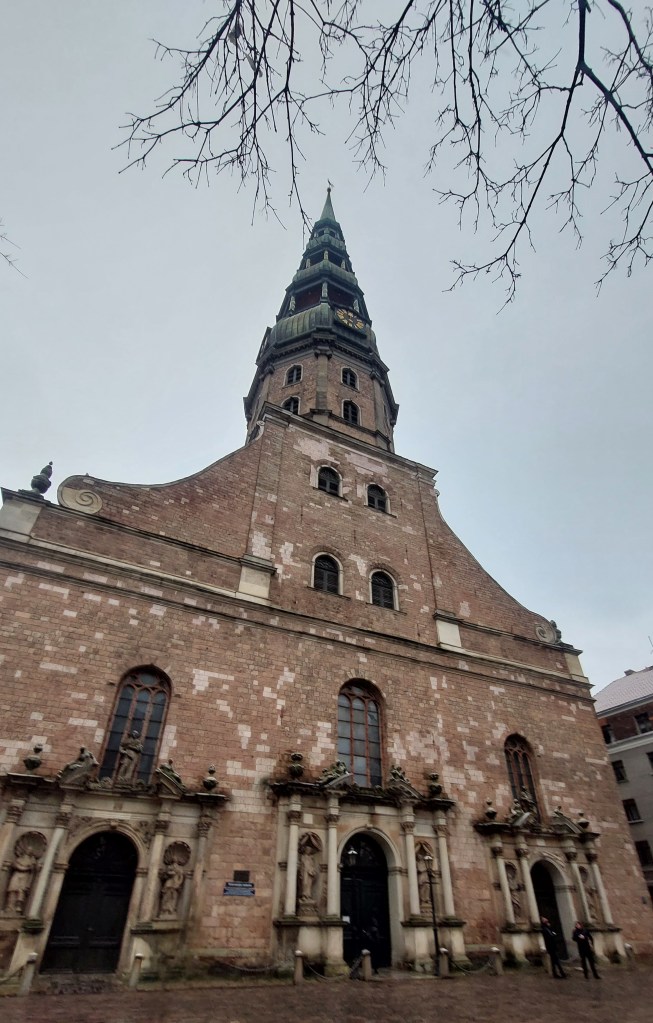
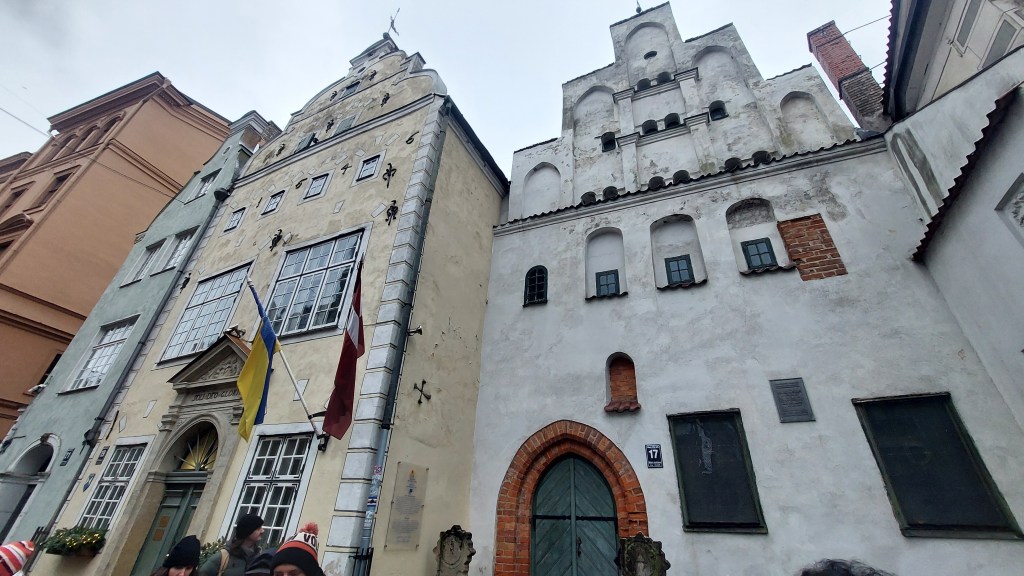
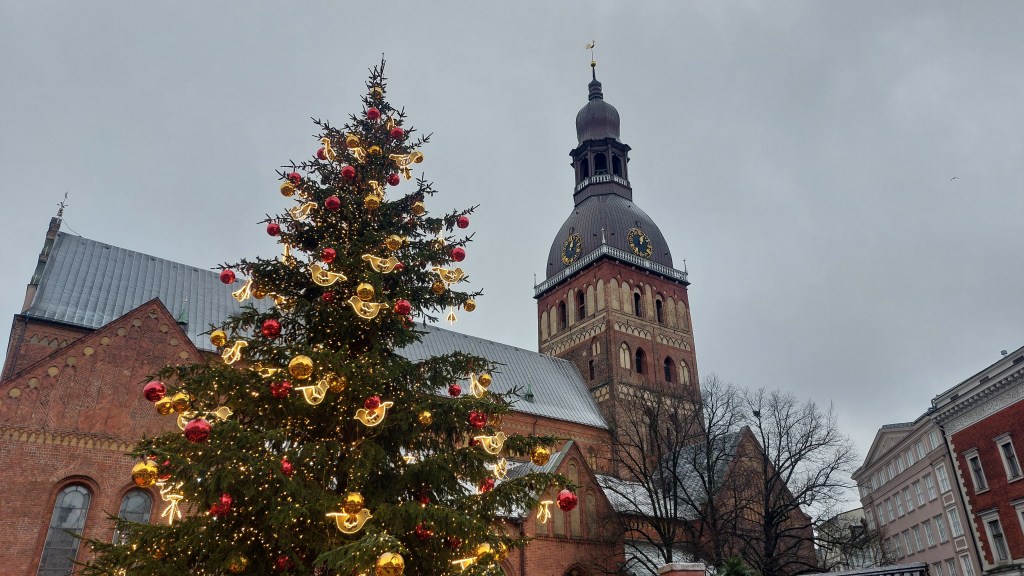
Walking around today, Riga is a beautiful European looking city and has often been used as a backdrop to represent other European cities. Apparently, there is a famous Soviet adaptation of Sherlock Holmes, and the street below is the opening shot of Baker Street. The series was incredibly popular, and the director was made an OBE for services to the UK!
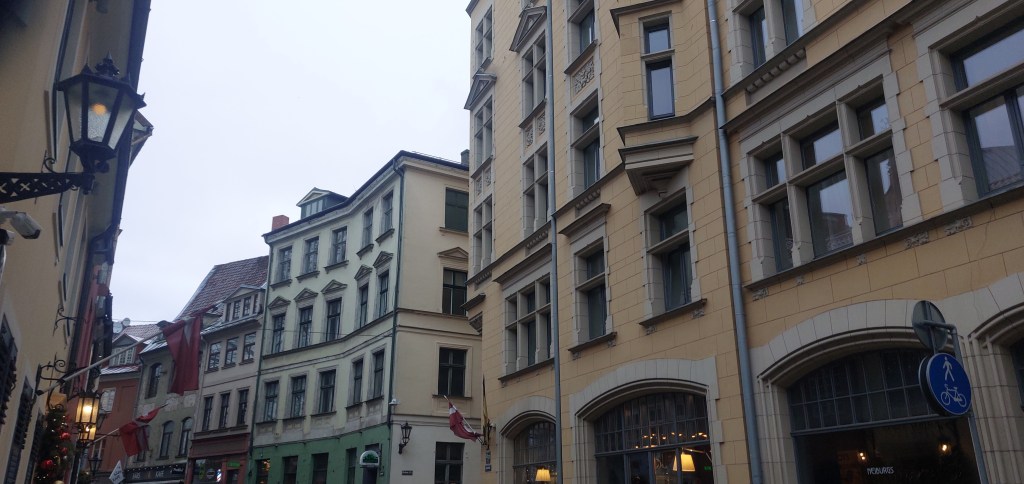
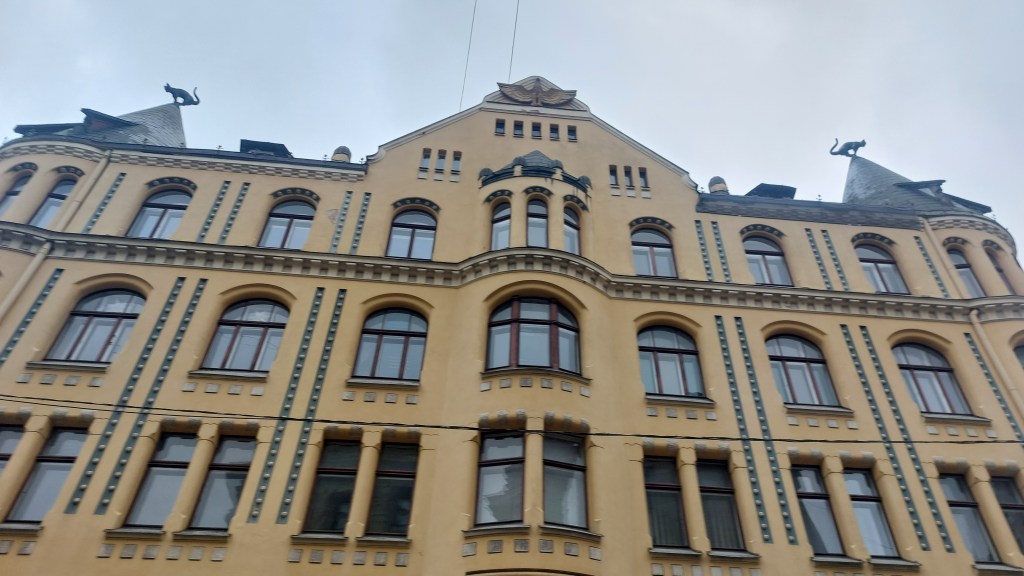
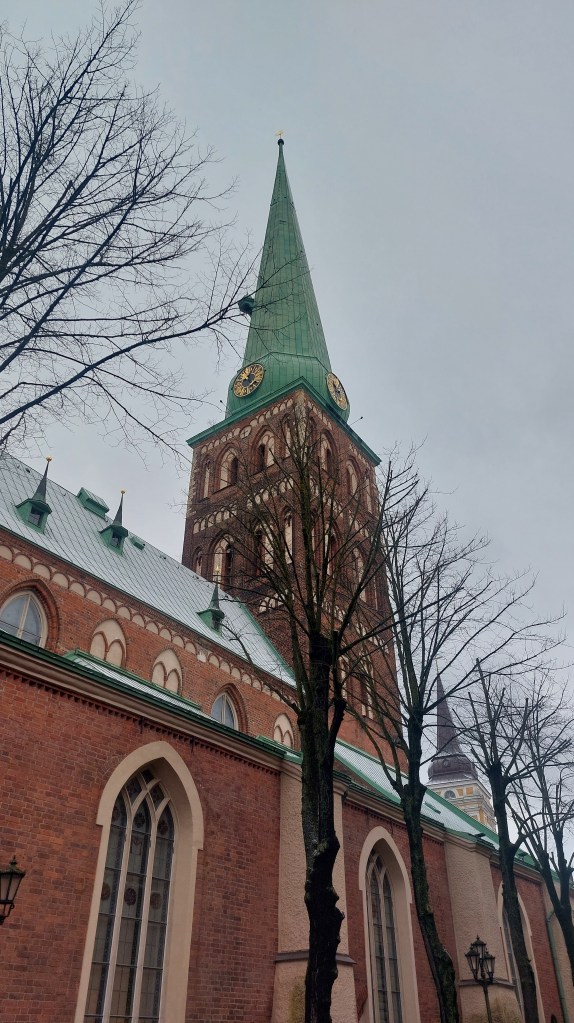
A few nice photos are below. I will just tell the story of the Black Cat House. Now, as most of you know I am not a cat fan, however, this is a good story which has been made up to explain why anyone would want 2 giant cats on the top of their home. As the population of Riga exploded in the early 20th century, Latvians with “new” money started to demand access to German held places of power such as the guilds. The owner of this house was rejected from membership of the guild opposite his house, so he added the cats with the cats bottom facing the guild – there is a Latvian saying along the lines of something being under the cat’s tail is someting being over. The guild reversed their decision, and the owner turned the cats around. Complete fabrication, but it makes a nice story.
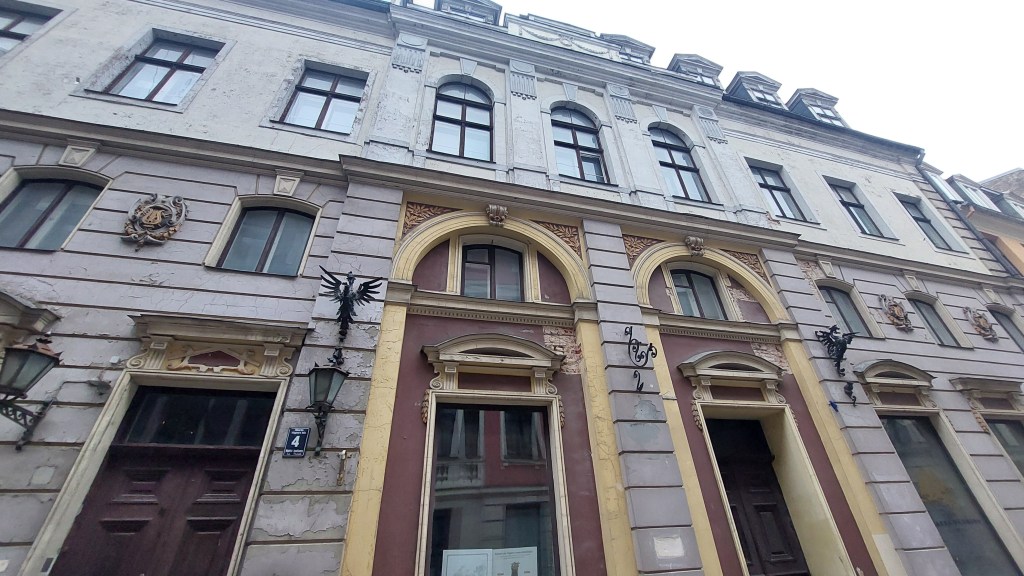
The abandoned building below was once the Riga City Theatre and is famous for Richard Wagner being the creative director here between 1837 and 1839. He was engaged to revitalise Germanic theatre in Riga. However, Wagner was actually running away from huge debts he had amassed in Germany. His creditors caught up with him and he escaped to London (taking a stormy sea pasage which became the inspiration for The Flying Dutchman) with money he had earned giving piano lessons for parents he managed to convince had musical geniuses for children. It is rather sad today as it stands empty, but there are rumours that some EU money is on its way to turn it into a creative art space.
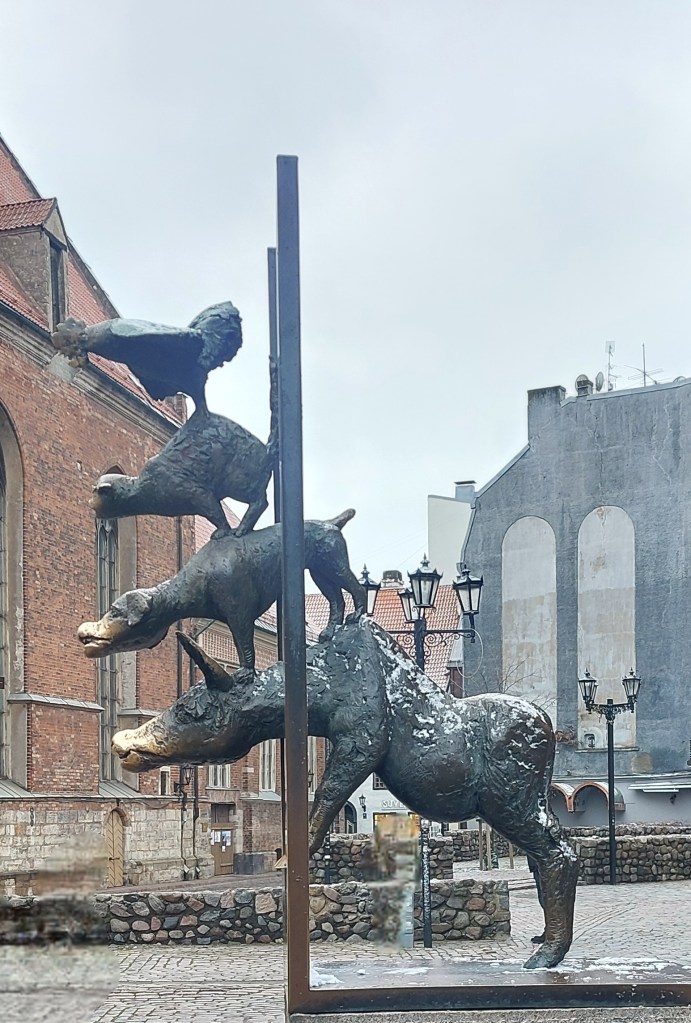
Our final stop was a statute of the Town Musicians of Bremen (from the Brother’s Grimm fairytale). the city of Bremen gifted the sculpture to Riga in 1990 (apparently, they have their own version, which I shall have to make a point of visiting whilst I am in Bremen). In the original, the animals had stood on top of each other to face down a group of bandits. However, here they are looking through a brack in the wall. This crack represents the Iron Curtain, and the animals on top of each other represent the Baltic Way, which was a demonstration where 2 million people joined hands to form a human chain protesting for Baltic independence.
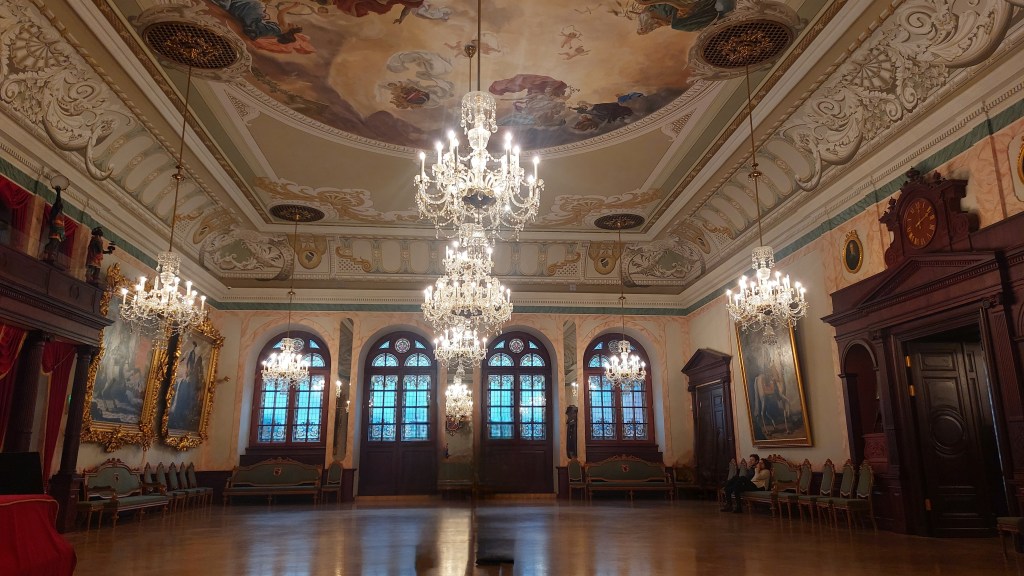
By now, I was very cold – a forecast of +3 degrees had lured me into a false sense of security, and I had failed to factor in the wind chill. I shall be wearing more layers when I venture out this evening! To warm up, I decided to go to Blackheads House – firstly, let us apologise for the racist connotations, but here we go… In the 13th century, a group of unmarried, travelling merchants chose St Maurice as their patron to come together as a merchant organisation. St Maurice is traditionally depicted as a black soldier/Egyptian martyr, so they started calling themselves “Blackheads” and registered themselves as “The Brotherhood of Blackheads.” The organisation operated across Livonia (I could have visited the house in Tallinn), but effectively, it was something between a frat house or gentleman’s club for young German sons who would become the city elite.
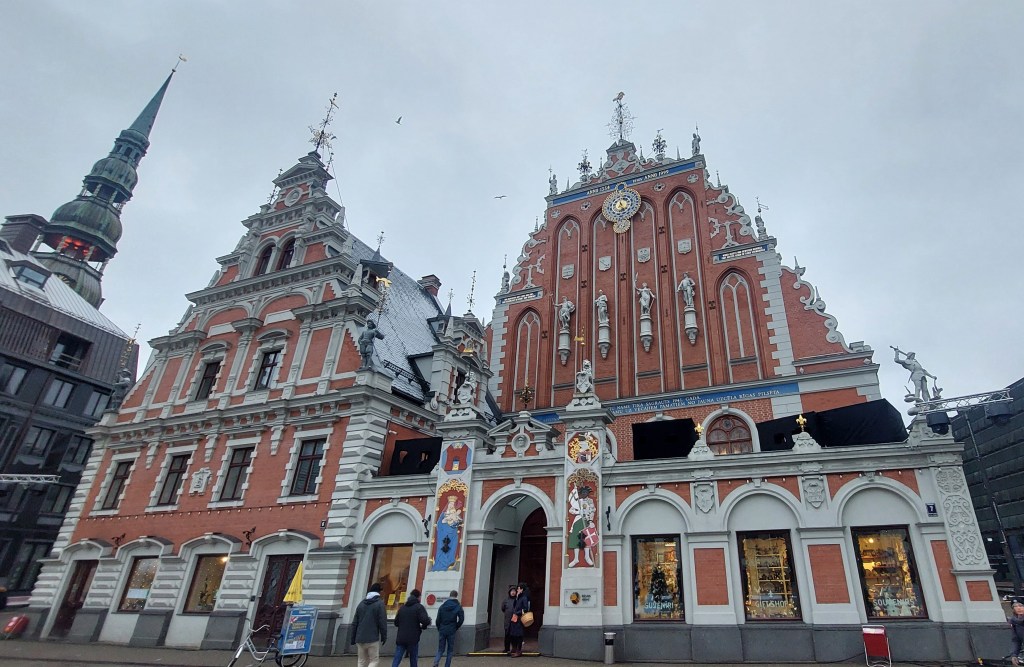
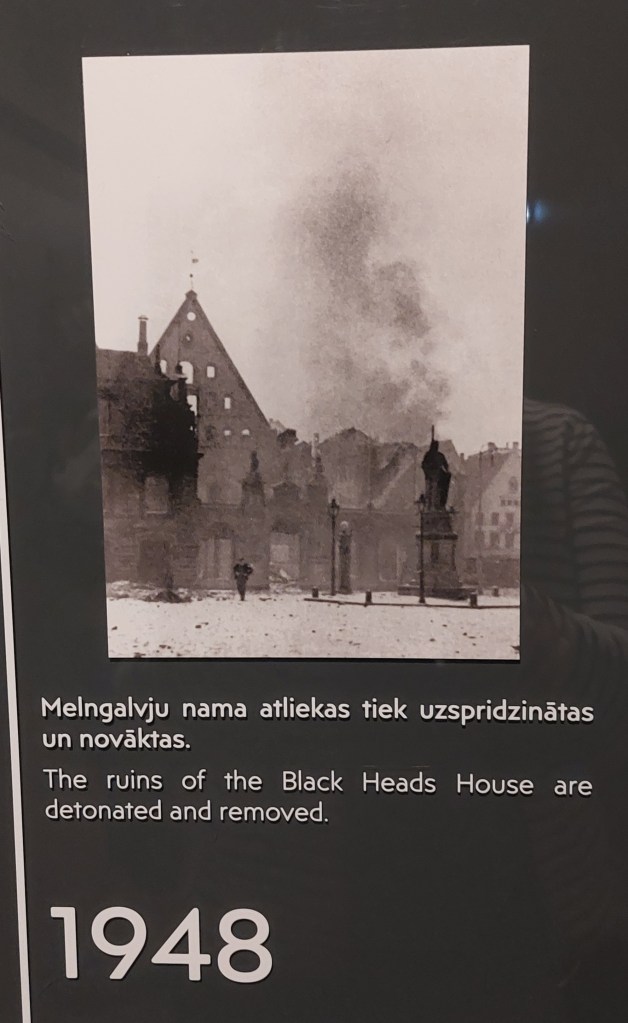
The original building was erected in 1334 and was the biggest public building in Riga. However, the building we see today is a complete replica as the building and most of the old town was bombed in June 1941 (between Nazi Germany and the Soviets) and what was left was then demolished by the Soviet government in 1948 (as part of a plan to create a more Soviet style public square). Luckily, after much protesting from local people, it was left to be rebuilt and was finally done so between 1996 and 2000 and today is used as a museum (which I visited) and events centre).
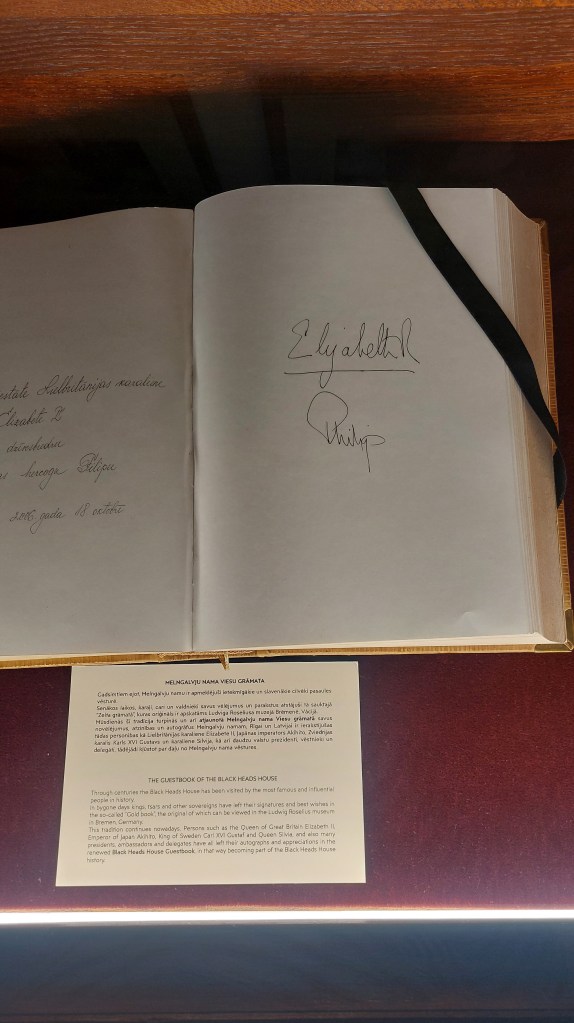
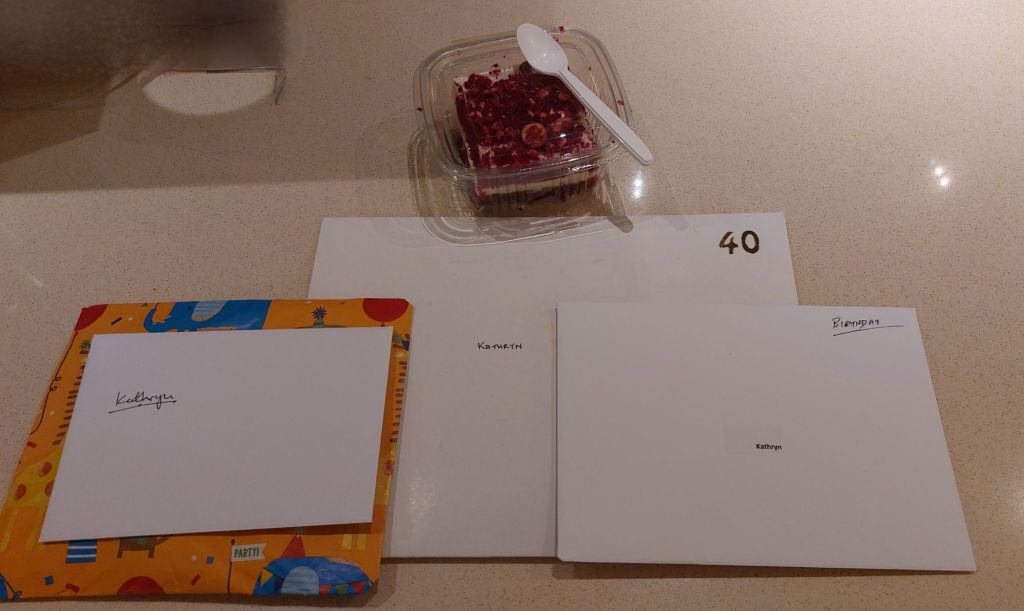
So after all that, having defrosted I visited the Christmas market (bless Riga for keeping this going after Christmas!) and was able to procure a back-up cake for me to eat tomorrow in case nothing is open – a birthday without cake is too sad to contemplate.
It was then time to return to the hotel, another wait for the spa. I am resisting the urge to organise it – whilst I object in principle to having to wait, there is no system other than relying on the reception ladies (who are much abused for making people wait) to know whose turn it is next. Why we can not be given numbers or book entry times I know not? I feel some feedback coming on… Anyway, I had a nice spa, and now I am planning to shower, dress more warmly, and kill a bit of time before heading out to experience some of the festivities. I suspect I will not make it to midnight (I am nearly 40 after all), but I shall go be among the crowds and report back.
At this time of year, one also reflects on the past year. This has certainly been an eventful one, I began the year living and working in Switzerland, and I shall end it (technically) homeless, unemployed, and in Latvia. I cannot say I miss working, but I do miss the advising bit – there have been a few occasions where I have explained to the group why we have to sign a disclaimer, why personal data cannot be shared or the reason for residents in an “unsafe” building not being able to obtain buildings insurance. I am hoping that this means that somewhere, deep down, I am ready to go back to work, and maybe that I do actually enjoy my profession of choice! I am also nostalgic for my London life. By this, I mean pre-pandemic life, so I am planning to find a job (first) somewhere to live (second), and then crack on living my best life. I should also probably reflect on this being the last day of my 30s, its been a good decade and I have no issues in getting older, other than the greyness of my hair and the age spots on my hands (I live in fear of developing my Mum’s hands) as quite frankly I think by the great old age of nearly 40 I am old enough to know myself, what I want and what I do not.
Carrying on with reflection, I have started putting a list of “best” things from my trip together – best guide, best meal, when I was coldest etc. I am also working on a page of travel tips, mainly to remind myself of travel things e.g. the need for a tupperware, but some of you may also find this useful.
Right, off I go to shower and layer up. When I next post, I will be in my 40s, and you will note a new sense of maturity in my writing, I am sure…
4 responses to “Stage 5.7 – Riga (and the last day of 2023!)”
-
Happy Birthday for tomorrow and welcome to the 40’s club! I look forward to reading the thoughts of ‘mature Kathryn’. Sounds like a good name for a new cheese brand!
LikeLike
-
Mycock Matured perhaps? 🤣
LikeLike
-
-
Happy Birthday, you forty year old!
I am very surprised that you disrespect your sainted mother’s hands, which have raised you from birth and still labour tirelessly to provide you with innumerable lovely fitted garments, etc.
BTW, the statue of the town musicians of Bremen reminded me of my late father, who brought home a souvenir from one of his many visits to the port as a merchant seaman – a delicately carved wooden ornament of the same subject!LikeLike


 Travels with Kathryn
Leave a reply to Mike Hook Cancel reply